Easy brilliant DIY fan-coil heater

DIY fan-coil heater

DIY fan-coil heater by Original Twist

Maybe the best fan coil heater regardless of price.

If you are wondering how a heat pump might (or might not) work at all with your old radiators and pipes this might give you the answer, and it won’t cost too much

Underfloor heating did away with horrible radiators, and we don’t want them back, so that just leaves warm air blowers such as kickplate heaters and bigger fan-coil units – i.e. hot water powered puffer heaters.

A kickplate heater can give an occasional guff of hot air and they cost under £200. However these neat little units aren’t perfect. They have to shift a lot of air through a small aperture so they are intrinsically noisy, draughty and the heat exchanger, or a filter, can clog with dust and pet hair fairly quickly. Larger fan-coil units are available but they aren’t so neat and they are much more expensive.

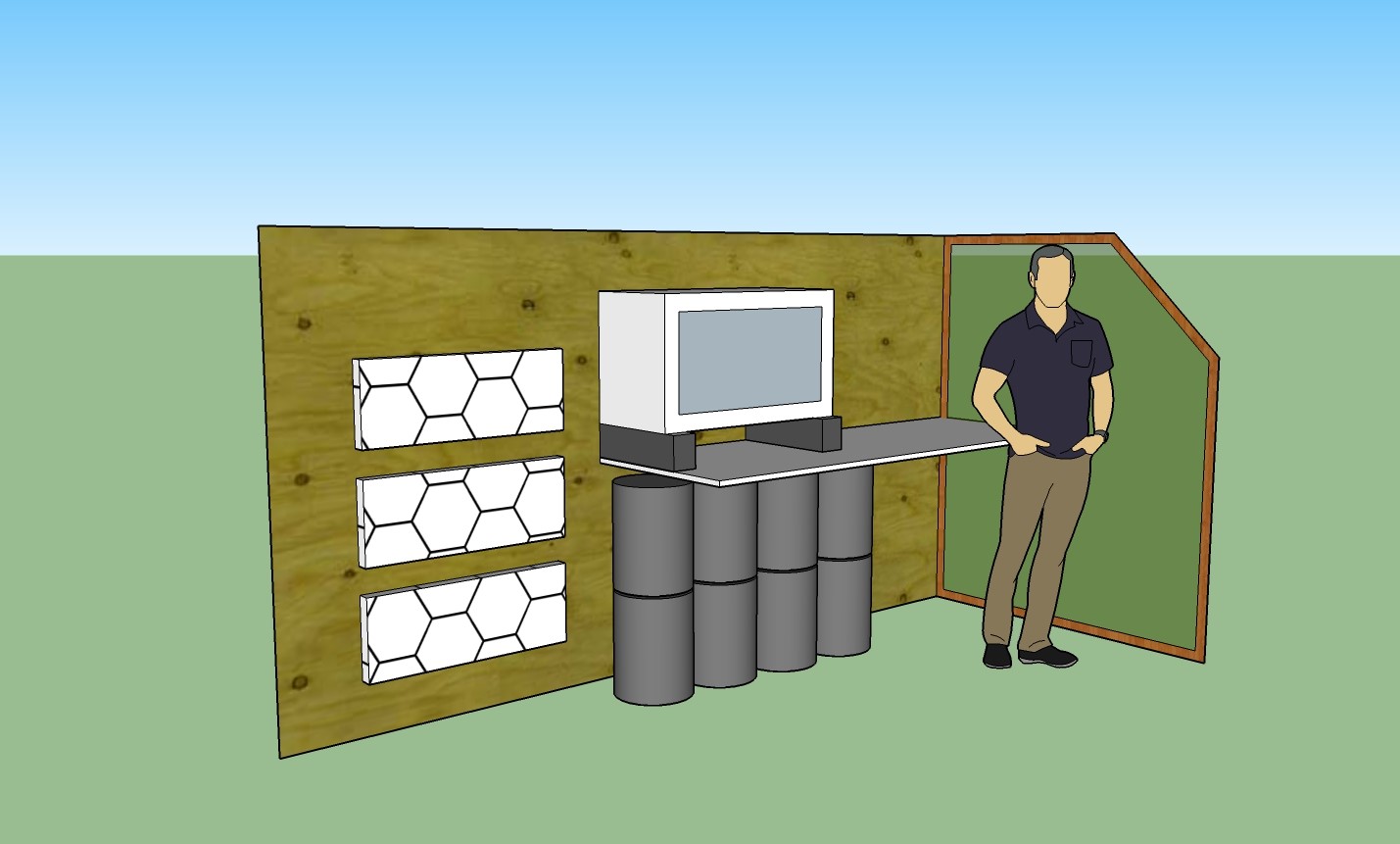
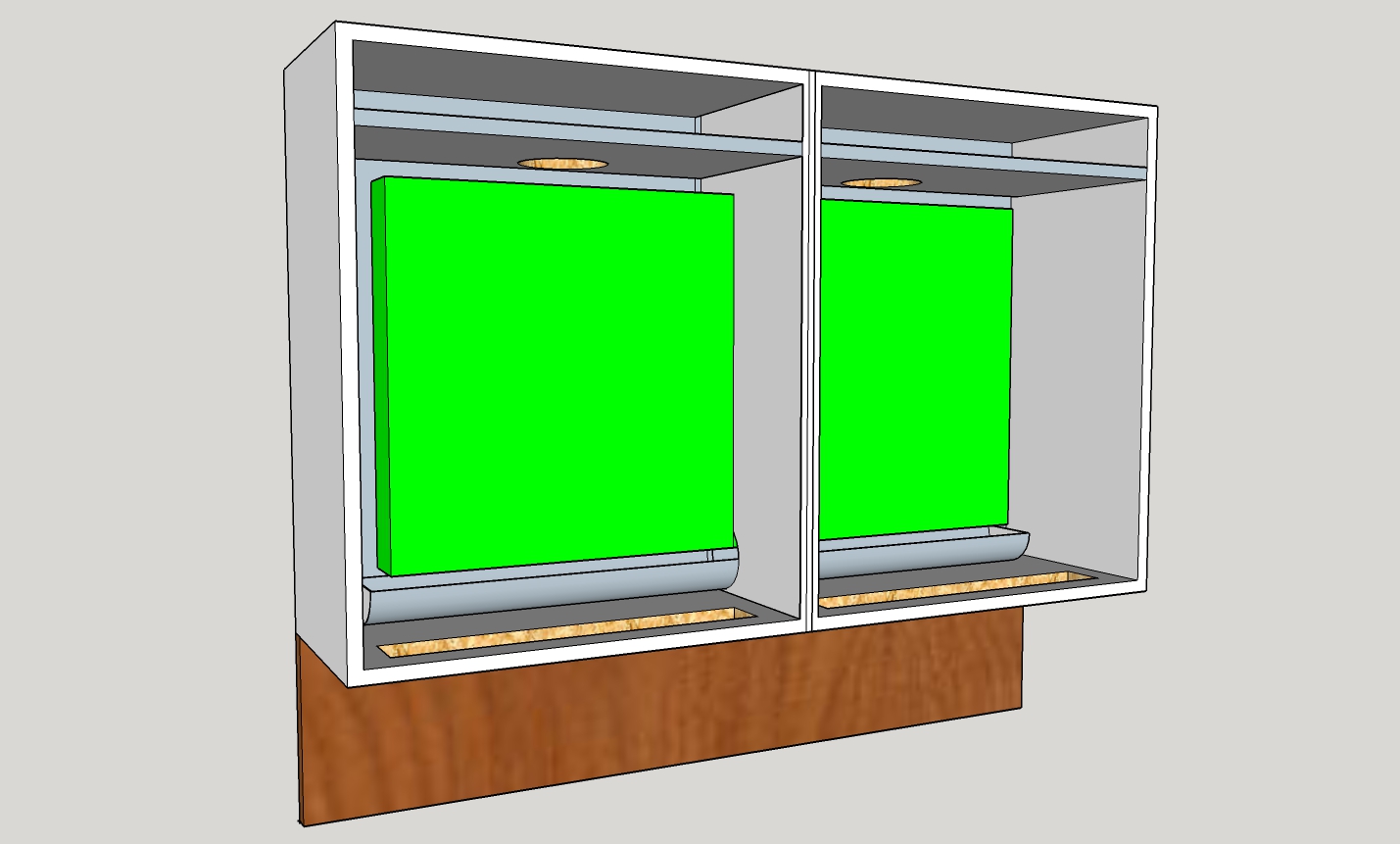
So here’s the Original Twist fan coil heater which is cheaper, quieter and more reliable. Double click this picture for a better look.  Can’t see the heater? Neat huh.
cupboards with fan-coil heater built in.

Lets assume that the low cupboard in this sketch is made of typical 720mm x 300mm kitchen carcass units, (just like your top cupboards). A pair of them (each 600mm wide) with a large slot cut out of the inner sides allows a 1000mm x 500mm x 70mm double radiator to fit inside (£48 Screwfix). Each of the top shelves is fitted just low enough to mount a 140mm fan from a computer (£10 – 20 Amazon etc) and these gently blow air past the radiator and out of the bottom. You can decide where the air inlet goes: probably top front but a wall panel channelling much warmer air from ceiling height is worth a thought. Note that this is much smaller and neater than the huge radiators you would be trading up to if you were trying to make a heat pump conversion work. 

When paired with a suitable heat pump this unit can also do air conditioning, hence the length of plastic guttering under the radiator to catch any condensation. However, a separate mini-split aircon unit (a very cheap heat pump) which delivers hot or cold air could be a much simpler installation. Cold air flows across the floor so spreads around the house surprisingly well. You don’t need multiple sources like you do for heating.

UV-C disinfection: For many asthma sufferers this will be the main feature. Fitting  UV-C tubes in the top sections will neutralise airborne bacteria and viruses, colds and Covid included. There are pros and cons about the ozone produced so I’d recommend thorough research before going ahead. UV light can damage your eyes so put kill switches on the doors and make sure there is no direct light escaping from the air inlet. Also, mount the fans underneath the shelves to keep the light off them. For the same reason it makes sense to put the transformer, relays, wiring etc screwed to the underside of one of the shelves.

A pollen filter, such as fitted to many cars, dropped over the low outlet will help too and can be Hoovered clean easily enough.

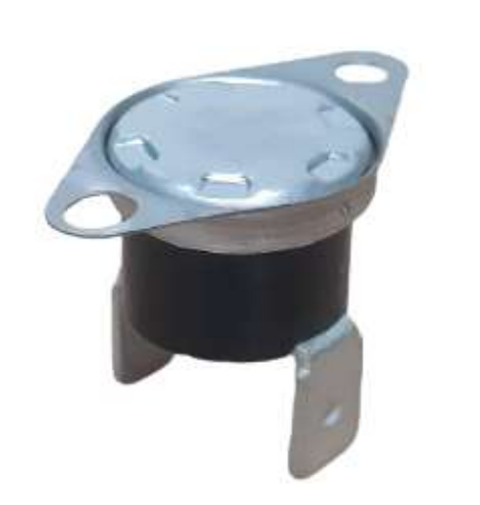
Controls:  The fans can be switched on automatically when hot water arrives at the radiator. A bi-metallic thermostat switch will do the job simply enough – RS Components do one for about £8. It clicks on at 40C and off again at 25C. The switch can be glued directly onto the radiator near the water inlet. See picture below.

You’ll also need a variable resistor for speed control of the fans. They are 12v so you’ll need a power supply, another cheap PC component.

If you are doing the ‘off-peak energy storage for cheaper heating’ thing the hotter water is available for a boost start which could almost instantly make your bedroom warm for getting up. Fan-coils are best for bedrooms where you need fast response times; under floor heating takes ages to come on and then stays on too long.

Cleaning:  Open the doors and Hoover it out – easy.

And that’s it really. A few simple components all easily obtained and making the perfect, reliable fan-coil unit. When turned down to essentially silent the fan pair will move about 100cfm and the heat output will be between 1 and 2kW depending on the water supply temperature. Turn up the fans to double this.

Noise? Just like putting your PC in a kichen cupboard so practically inaudible.

You might wonder why all this effort gives you anything better than the same radiator fitted as normal. The answer is that heat pumps don’t work efficiently at the 60c+ normally used with radiators. While under-floor heating is the best at very low temperatures a fan-coil unit works reasonably well at 40c. The only reason our unit has a radiator is that with all the fins in a double radiator you get a high surface area for not much money. The heat delivery couldn’t be more different. A radiator wafts hot air straight up to the ceiling where it tends to remain, replacement  air then moves across the floor as a cold draught. A fan-coil, on the other hand, wafts warm air across the floor where it mixes with cooler air to give a faster and more comfortable heating experience.

Some extra mods

If you want to direct warm air somewhere in particular, patio doors for example, then a row of slats on the exit slot can send the air to the side. To go further with directed air flow you can also fit a duct or two to the bottom of the unit. This might be useful if you were trying to warm the air near those patio doors. In a new build you could fit a drain channel beside the doors (those ones with the clip-on metal tops) and blow hot air into the ends of the channel. That same channel could also be used as a handy route for the heating pipework and as an added benefit it makes the channel like a radiator in its own right.

MVHR reheat  The MVHR system is essential in a modern house but as it is not 100% efficient it does cool the house slightly so using one of these fan-coil units as a re-heater is a neat and inexpensive route to perfection. If you have an MVHR system in mind you could run your return duct into the top of this unit with the benefit of hiding the outlet and getting a free blow from the MVHR fan.

What about the bathroom?

Now we’re talking. The perfect place to  have hot  air blowing especially when you are drying yourself. For a start turn the unit on its side so the air is blown from a vertical slot, then go one step further and have a pair of them so you step between them into a hot air blaster, like a giant Dyson hand dryer. Electricity in the bathroom!  No worries there, keep it all 12v.
insulation matters

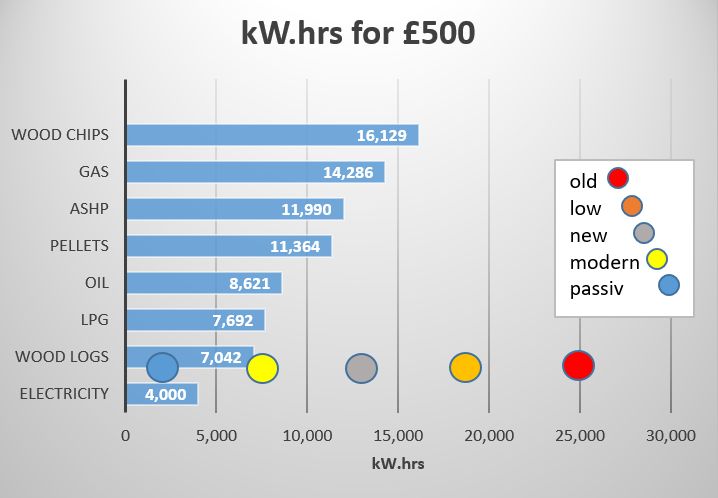
Have a look at this chart on heating costs for various house types to appreciate why a Passivhaus with a small heat pump and some fan-coil units could be the way to go. You’ll see that the ASHP can meet the Passivhaus demand for almost no cost. Indeed if the ASHP is connected to PV panels then the running cost of the house will be close to zero. This chart is out of date now but the message is the same.

I guess you might be in a state of shock now. Thousands saved on your heating strategy, the government might buy you a heat pump and air-conditioning can be a simple addition.

For more money saving shocks check out more building ideas on LIST OF POSTS.

Don’t miss ideas on off-peak energy storage; see the Large house heat pump system

If you’ve built this unit please let me know on the comments form below. We’d all love to see pictures.
Leave a comment

This site uses Akismet to reduce spam. Learn how your comment data is processed.

Off-peak energy storage for cheaper heating

High temperature heat pumps are a game changer. How about a sub £500 heating bill for the whole winter? Higher temperatures present a new opportunity to store cheap energy in a heat store (a large buffer tank).

Off-peak electricity costs a third of the day rate and that allows heat pump energy multiplication to produce unbelievably low-cost heating (like 2.5p/kW.hr).  A heat store tank can time shift the night rates to the following day with that energy simply dispensed to underfloor heating and fan-coils by blending it back down to the required temperatures. With energy this cheap the inefficiencies of large buffer tanks and blending are hardly relevant.

Large tanks are better for high temperature heat pumps which don’t like short cycling and prefer a large volume of water to chew on so that’s another win.

For example: Over 5 hours a 12kW heat pump can place 60kW.hrs in 1,476 litres of water raised from 30c to 65c. As the model lower down shows, that costs just £300 over 200 days of winter. Similarly, a 1,000 litre tank, plus a large hot water cylinder and a heated floor slab make a good combination to store this night time bounty ready for the next day.

Cheaper than a battery

A 1,000 litre tank can store 40kW hours and costs about £1,500. A battery that can make 40kW.hrs (via a heat pump) would cost twice as much and could wear out after 10 years. Water lasts forever so works well as a storage medium; it doesn’t even ignite and burn your house down. Having said that, batteries are still very useful and will become strategically important when you access the very large one in your car. The battery is the top performer in the chart below because the heat pump will run a better COP during the day.

N.B The 7.5p off-peak rate is for electric cars but economy 7 is a workable alternative.

A much bigger heat pump

In order to bank the entire heating load over just a few night hours the heat pump will have to be significantly bigger than normal. 12kW (delivered) is a good place to start especially if only single-phase electricity is available. The Samsung EHS Gen7 R290 12kW is a good example.

Additional power

The calculated heat loss of the house must be matched by the heat pump power (to get the grant) and, on paper, a big heat pump will easily meet that requirement but the stored energy may not always meet the actual demands of the day. Cheap power is time limited rather than power limited.

If there is the occasional shortfall the heat pump is still there to give a powerful boost on that exceptionally cold day – however there is a better way.

Part of a sensible strategy is to have another smaller heat pump (like a mini-split air to air) that runs mainly free off solar panels. Obviously this helps to keep the electricity costs down but also gives the option of topping up when necessary at minimal cost. The blown air of a mini-split is immensly useful for laundry drying and the cooling feature gets the air-con requirement largely sorted too. Forget the daft headline costs of regular heat pumps – mini-splits can be bought for around £600 and you’d get one fully installed for under £2,000. With a typical consumption of around 1kW the mini-split will nearly always run free off the panels whereas the big heat pump would cost precious pennies to fire up.

Domestic hot water

To store off peak energy the 300 litre domestic hot water cylinder has standard 3msq coils for heat pump use. It may require a trickle charge during the day and instead of repeatedly firing up the heat pump an EDDI solar diverter tops it up via a Willis remote immersion heater (better for stratification and servicing if you were wondering). The EDDI captures even tiny excesses throughout the day to produce a higher temperature and the lost exports are about equal to the cost of running the heat pump.

System benefits

Water is usually hot enough to make towel rails work properly.

A large domestic hot water cylinder needs fewer daytime top ups if any.

The big heat pump gives faster DHW recovery times (if needed).

Fan-coils take from the hotter level of the heat bank.

Fan-coils can tolerate high temperatures so a boost mode is possible. Eg. 5 mins of full power on startup to give fantastic response times.

Heating can be zoned without complications.

Off-peak electricity is mainly renewable so this system is as green as Kermit.

Daily characteristics

In the morning the tanks will be hot and ready. The bathrooms will be toasty with the towel rails on full pelt and the floors heated. The bedroom fan-coils instantly transform a cold room into a warm one and there’s loads of hot water for showers. Downstairs the floors are already warm.

The towel rails stay on for a while but all else takes a rest until the floor slab downstairs calls for a top up from the big tank. With a bit of sunlight the EDDI starts to reheat the hot water tank and the mini-split might be able to run free.

At this point the big heat pump has not run at all, at any time, during the day. However, by the evening the temperature is getting low in the big tank, the floors can continue to keep warm even with water down to 25c but the fan-coils may need a last-minute boost from the big heat pump. UFH in bathrooms is a good counter to the possible end of day shortfall. Note that this is all fine tuning to avoid costs; if more heat is required then the system can perform just like any other and in fact even better because it’s so powerful.

Controls

Everything is much simplified with no interlinking of controls.

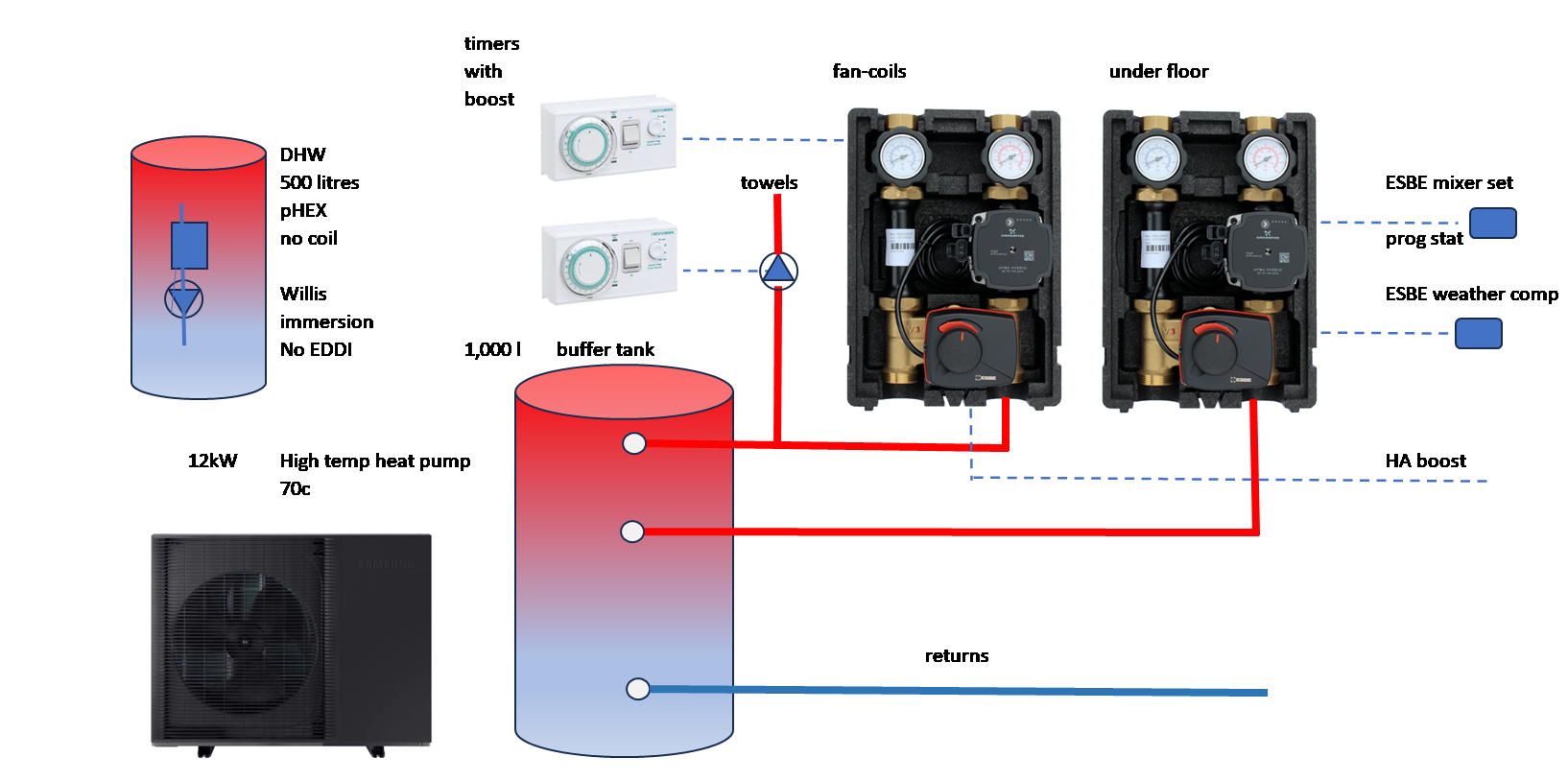
The heat pump is allowed windows of operation on a timer and tank thermostats.

The night time set point would be 67C and 45C for the day – settable on the heat pump.

The UFH is timed and controlled by a programmable thermostat – an ESBE mixer adds weather compensation.

Fan-coils (OriginalTwist DIY units of course) are timed and thermostatically controlled locally.

Simplicity

There are many options to add sophistication to this system; weather compensation, ESBE electronic temperature reducers, blending down for fan-coils, fan-coils boost feature, air source GSHP boosting (as per the OriginalTwist hybrid concept), batteries.

All should be weighed by the PV test: would the money be better spent on more PV panels?

ZERO COST HEATING

As you increase the size of a solar array so the energy bills fall and the export tally rises. For some well insulated houses the income will pay the electricity bills – ZERO COST heating has just become easier.

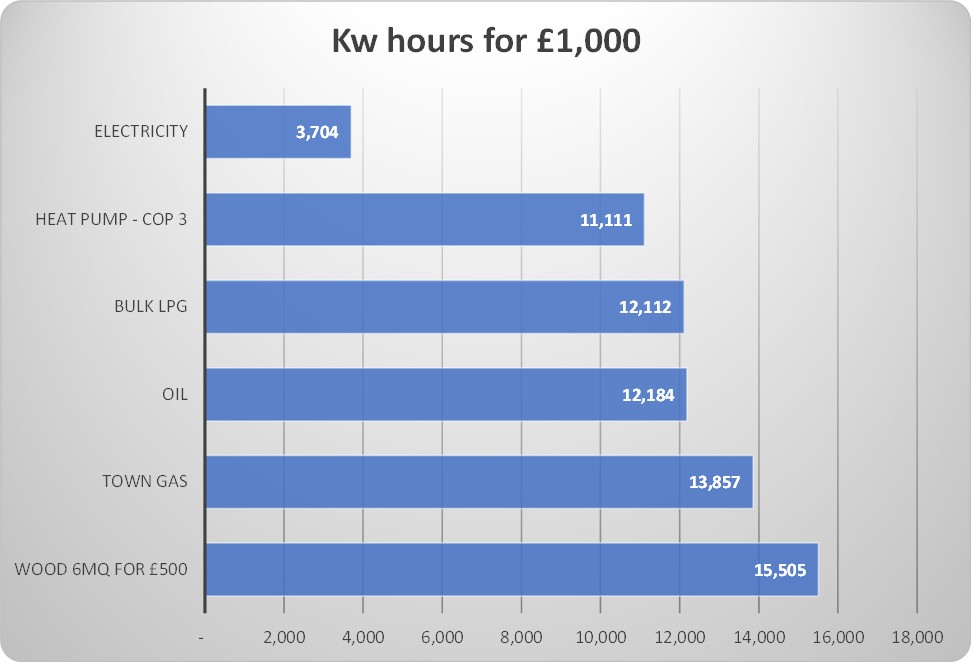
From the chart below you can work out how many kW.hrs your current system requires over the winter. Just compare each £1,000 bar with your own bills. 25 -30,000 kW.hrs would be normal. Ultra insulated homes are nearer to 15,000 and only about a third of the way up a £1,000 bar. Note how the off-peak system is easily twice as good as anything else. Want a laugh? Compare direct electric resistance heating with the off peak system.

Just how cheap for 200 days of winter?

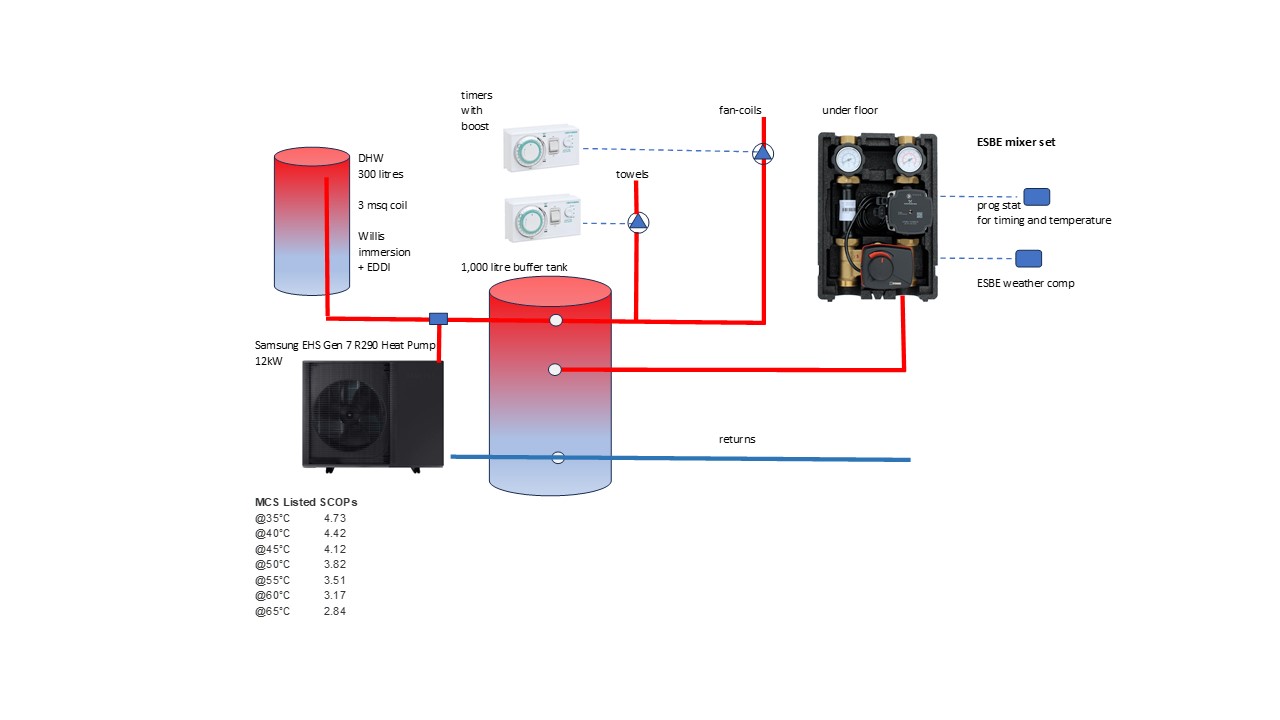
The Original Twist model of this entire system looks something like this:

A 12kW ASHP running for 300 minutes a night charges a 1,000 litre tank, a 300 litre hot water cylinder and the floor slab.

Over 200 days of winter this makes  12,000kW.hrs for £300. No, that’s not a mistake, £300 for 200 days!

The 3kW mini-split adds 1,000 kW.hrs for £125 (half from PV).

Total cost for 13,000 kW.hrs is £425 and less with large PV.

The same energy would cost £570 more with conventional daytime heating.

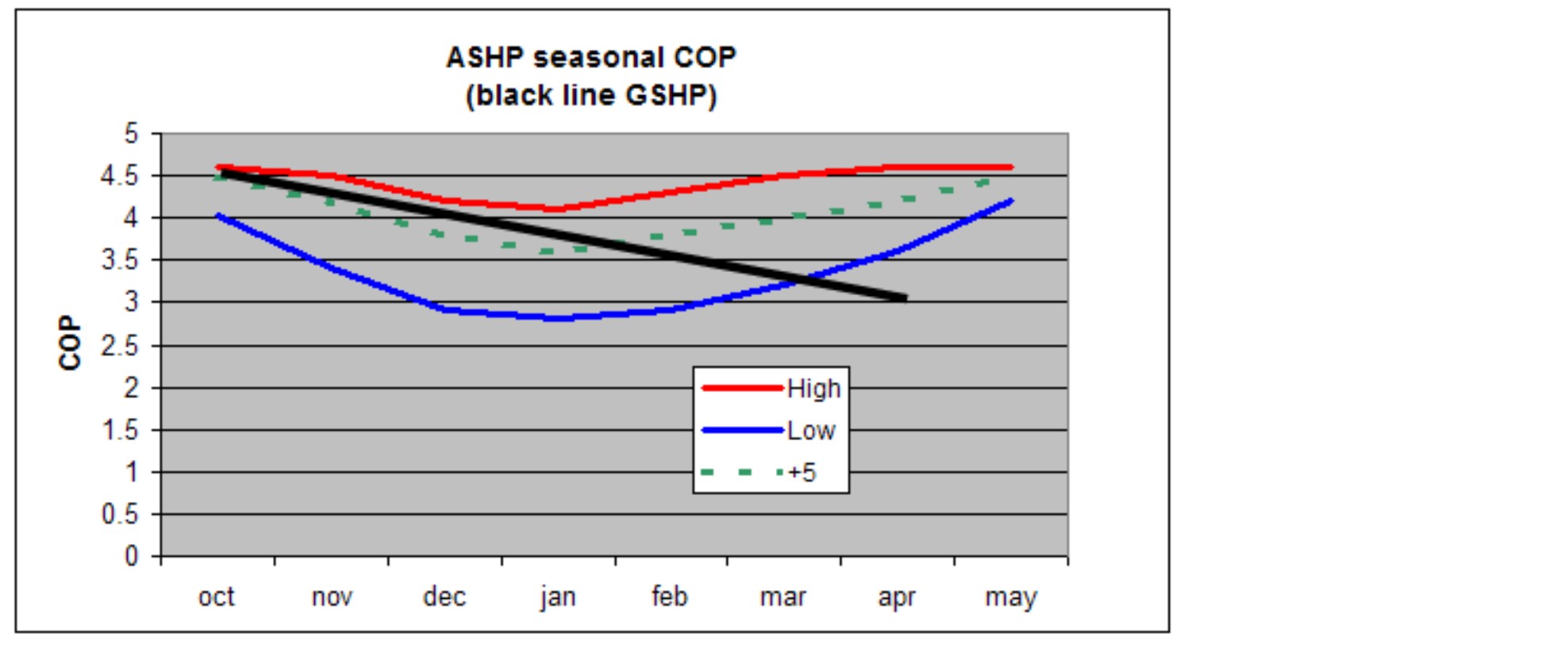
You’ll see on the chart below how night time use of an ASHP (blue line) is particularly disadvantageous compared to a GSHP (black line) which doesn’t really see any significant changes in source temperatures. From that point of view it might seem that this system will be optimised by using a GSHP for the night runs and an ASHP for the day time back up.

The GSHP will not suffer the defrosting cycles which will eat up into the precious off-peak time and the COP will be excellent particularly if the Originaltwist air/ground hybrid idea is incorporated..

You won’t find an R290 high temperature GSHP: that’s because they are fitted indoors and spilled R290 is toxic. The 10kW IVT E11 GSHP might be a contender though. The maximum temperature is lower though so you’d need more water storage; probably a pair of tanks.

Conclusion

This idea can be scaled and tweaked to suit individual requirements but the underlying message is convincing.

Off-peak electricity can be time shifted with large amounts of water to dramatically cut heating costs.

A concrete slab floor also stores heat usefully so a boost at the last hours of off-peak could be part of the mix.

N.B. If you want the grant, with it’s strict rules, you have to ‘design’ the system for normal efficient heat pump systems and then run it ‘inefficiently’ at night when all the techies have paid up and gone.

Note that a heat pump costs about £5,000 so when you are quoted £15,000, guess who really gets the grant money!

These ideas are now wrapped up in The Grand Designs Heating System and for bigger properties in Big house heating system.

Heat pump conversion – the successful way

How much is a heat pump – £15,000?       Actually, they start at £1.200

so let’s get going.

It’s easy to ruin a perfectly good house by doing a heat pump conversion. Thousands of people have already done so and yet the pressure is on to keep doing it. So, here’s how to do it logically and successfully. The measure of success here being better comfort with lower running costs and the satisfaction of lowering emissions too, but most of all, a system that actually works.

First of all, don’t rush in until you know how much power you have already and whether that is too much or too little. All installers have to err on the side of caution so your boiler will certainly be bigger than it needs to be.

Stage 1/:

Insulate, insulate, insulate, floors, walls, loft windows, all of that. Start here because, compared to your old boiler a heat pump is relatively weedy and anyway very different. It’s a low temperature high flow device and it will need all the help you can give it.

Stage2/:

How much power?

After insulating take a look at how much energy you are currently using and hoping to replace. There are a couple of ways of doing this and it is best to do them both. First check the nominal power of your boiler then see how often it cycles on and off on a cold day. This might involve half an hour standing by the boiler with a stop watch. You might have a 30kW boiler but the chances are it will be short cycling, especially if it runs on oil. When you have the time to running ratio you can see the average power your boiler is delivering and this will give an idea of your peak power requirement.

Secondly, check your total oil or gas bill and use this chart to calculate how many kilowatt hours of energy you have been buying. Whatever you replace your boiler with will have to make as many kW.hrs over the season.

There are about 200 days of winter so dividing the energy total by 200 will give you an idea of the average daily power requirement. This is only going to give a rough idea but that may be enough if you add a mini-split to the mix as a substantial top up for those arctic-blast days.

Unfortunately, we are not there yet because there are transmission issues to consider. The pipe that runs from your boiler to the radiators is likely to be 22mm copper which with typical heat pump temperatures will transmit between 10 to 15 kW and more likely towards the lower end of that. On a COP of 3 that means the maximum heat pump power will be around 5kW (delivering 15kW), any more cannot be used. That almost certainly leaves a large hole in the requirement and is the reason why so many installations are a disaster. The solution is pretty obvious though; just add that mini-split air to air heat pump or even two. They will plug the gap and leave your existing pipework untouched. A mini-split has no connection to your existing system and all the pipes and radiators etc. It’s a stand-alone heat pump and that’s why it is so cheap to install.

Stage 3/:

Transmission

It’s not just the limitations of the pipework to consider, now the heat has to come out. Assuming there is no underfloor heating in place that leaves replacing existing radiators with really huge ones (not an inviting prospect) or fan coil units. The latter can be inexpensive and effective – see DIY fan-coil units. Again, the mini-splits make up for transmission shortfalls.

Hot water

Quite often you will be quoted for a new hot water cylinder to go with the heat pump. The reason being that the coil needs to be bigger (3msq is good) to accommodate heat pump low temperatures. If you don’t have room for a new tank consider ignoring that suggestion and spend the money on solar panels and an energy diverter like the Eddi. Cheap night time electricity might be in your mix and that too can drive the immersion heater.

Looking back at that chart it appears that there are no savings to be made by running a heat pump. You can press on happily though because further tweaks will lead to the cheapest heating available. Heat pumps can run on renewable electricity too so they really will help you to save the planet.

If you have solar panels, they can make a free contribution and the low power mini-split(s) will often run for free on the first glimmer of sunlight.

In the long run you might have an electric car that allows the use of its battery to power the house. In one stroke that will easily halve your energy bill as you time-shift cheap night time electricity and amplify it with a heat pump.

For bigger houses with unusually high heating demands the answers are still the same although the transmission limitations can be bypassed with the aid of a heat bank with its multiple pumped outlets. That’s a longer discussion but have a look at The Grand Designs Heating System to see what the cutting edge system might look like. You might be a bit shocked.

So that’s it. Just sidestep the limitations and embrace the advantages. Easy really.

P.S. Some EVs can offer 240v vehicle to load with around 3kW available. They imagine you might plug in a toaster when you go camping. So you could plug in, for example, a Mitsubishi SRK60ZSX-WF Heat Pump System along with a changeover switch to pull in the mains when the car is not connected. This unit consumes 1.71kW (a lot less than a toaster) and delivers 6kW which is pretty punchy when it comes to making up any system shortfalls. Expect to pay £2,000 fully installed. This all gets you connected to super cheap heating without installing the expensive V2H charger and you can choose from a much bigger range of cars.

Heating News – Free or Freeze

Energy price comparison

Well, the Ofgem cap for October is out and also, over the last few months. various energy prices have changed quite significantly. So, allowing for the likely efficiencies of the boilers, stoves etc here is the latest chart showing how much energy you get for £1,000. Most houses will need 15 – 20,000kW.hrs over the winter so you can guess the level on (or off) the chart where your house is.

Electricity

Still the most expensive energy you can buy by miles despite a slight fall. Solar panels are still the best way forward and payback is quick if you don’t have too many.

Heat pumps

Now slightly worse than natural gas so there is little incentive to go along with the Government push on boiler replacement. Of course, if you have access to solar power then the picture gets a bit better but remember that in the winter it’s dark and cold by tea time.

Natural gas

As this is what most homes have, and it works very well, there is no great rush to change. An upgrade to a condensing boiler might be timely if you are still nursing an old boiler. (insert predictable joke here)

LPG

The price has risen about 16% to put LPG on a par with oil but a lot depends on the efficiency and running costs of the boilers in question. I once had an LPG gas boiler that was never serviced for 9 years so I could have replaced it on the money saved – that’s not a recommendation, just making a point.

Oil

There have been some big swings over the last year but it looks OK for the time being although boiler efficiency could make the picture worse. Old oil boilers can be very inefficient and servicing and sludge cleaning costs can add up. If an upgrade is needed then LPG should be the top consideration.

See https://www.boilerjuice.com/heating-oil-prices/ for an oil price chart.

Wood

I just bought a huge load of about 6 cubic metres for £500 and the result looks good on the chart although there will be significant variation depending on weight and moisture content and type of wood. I used 70% efficiency for a stove but of course an open fire would slay the calculations, maybe even down to zero gain.

Solar panels

Still worth it? Depends on what you pay of course but a rough estimate goes like this. 3 panels cost £1,200 and make 1,200kW.hrs a year worth 27p x 1,200 or £324. So, your money back in 4 years then. In practice it’s hard to consume all you make, even with a solar diverter driving your immersion heater, and self-consumption falls off with even more panels. Even so it looks like a good plan and the gas boiler will get negligible use in the summer months. You can, however, bump up self-consumption to 100% with batteries, whether car or domestic.

Batteries

They are simply wonderful but the trouble is the cost. Once your electricity bills have been eased by solar panels the remaining savings produced by batteries give rather extended payback periods in line with the life expectancy of the batteries themselves. Cheap energy deals from Octopus and others make for some interesting calculations though. If say you paid 9.5p/kW.hr overnight and used it later driving a mini-split heat pump then the resultant heat would have cost you under 4p/kW.hr. That’s astonishing but you’d need a very big and expensive battery to make it work for a reasonable length of time. Hold on though – electric cars have huge batteries!

This is all very exciting and as soon as your electric car battery can be utilised in the home a new era will arrive. A Nissan Leaf battery is about the same as 4 Tesla Power Walls! If this piques your interest then check out the car battery maths below.

Car battery maths – halve your bills

Your 7kW car charger charges your Nissan Leaf for 6 hours every night on Eon’s 7 hour offer (Octopus only offer 4 hours). The other hour is for the car itself and the 6 are for use back in the house.

Each day we can use 40kW.hrs in the battery to run a small 5kW heat pump for 8 hours and on a COP of 3 that’s 120kW.hrs a day. Totalling 24,000kW.hrs over the 200 day winter that will be more than enough for most homes.

24,000kW.hrs would have cost you just £760 but the chances are you could get under that.

Without any further key bashing the outcome is that your heating bill will be more than halved.

This is such a game changer that it must be part of your future heating strategy and that means you must have a heat pump of some sort even if it’s a mini-split or two. A regular heat pump with a mini-split added as a gap filler would be perfect.

And let’s not forget

Mini-split heat pumps

Mini-splits are just small air to air heat pumps which are easy to install and you could get one fully installed for about £1,200. Yes, a proper heat pump for £1,200.

I’ve said this before but it bears repeating.

My mini-split has been running for over a year so I can tell you how it’s been.

In the shoulder months the PV panels (4kW) run it free a lot of the time

It often draws well under a kilowatt so we run it when needed without worrying about the cost too much

Low power means the solar panels have it covered very often

It often provides enough background heat to enable the main heating to be left off

It blows hot air so makes a great laundry drying machine.

Summer air conditioning is really good, cooling the whole ground floor

It actually cost under £1,000 installed and that took just 4 hours

It was bought from Saturn Sales who gave good advice and delivered on time

Conclusions

It’s still a good idea to go solar. Check out micro-inverters on the panels, a concept that makes sense – ‘Gary does solar’ on YouTube will explain all and get you £50 off if you change to Octopus.

After solar get a mini-split or two. Your bills will plummet and your comfort levels will rise.

Start thinking about an electric car with V2H charging. That is still only a Nissan Leaf as far as I know.

It’s early days but with some solar exports and a bit of insulation, might that car battery get you close to ZERO-COST heating?

While I hope my figures are accurate, please do your own research before making any commitments.

Comment on electric cars.

We’ve seen a massive depreciation hit as electric cars transition from very expensive to near parity with normal cars. A series of price cuts from Tesla, to the chagrin of current owners, and now a wave of reasonably priced EVs such as the MG4 and the rather fabulous Volvo EX30 are setting the tone. The high cost of batteries will halt the slide for a while, and the car makers will have to try to settle into profitability, so it is probably safe to enter the market now. Vehicle to home charging capability should be high on the options list when you do. Before you dive in perhaps consider locking in a nice old-school classic for the potential appreciation when it becomes clear that they are the last that will ever be made.

Join the debate below

Leave a comment

This site uses Akismet to reduce spam. Learn how your comment data is processed.

Condensing boilers don’t condense

When hydrocarbons like oil or gas are burnt they produce a fair bit of water in the form of steam and that steam contains energy that can be reclaimed if it can be cooled enough to condense. If your heating system returns water to the boiler at 55c or below then condensing happens in the boiler and that plume of steam outside disappears. The benefit to you, the boiler owner, is immense. The boiler that was sold to you as 97% efficient actually gets there instead of the mid eighties which is probably where it is now. On a gas bill of £3,000 a reduction of £300 – £450 makes this a topic worthy of some perusal. Plough on, it’s boring but not difficult.

There are different accepted design targets for the temperature drop across heat emitters (like radiators). A Dt of 20c or 11c. Both so widely apart to be pretty unhelpful. Maybe all of that is irrelevant as your system already exists and you can only move on by measuring what Dt you get.

So, say a radiator circuit might be set at 90c in and 70c out (Dt of 20) the desired return flow at 55c is far out of reach. Owners of oil boilers are a bit stuck here as the boilers don’t modulate which means they work on full power and are either on or off. Gas boilers, however, can have their output temperature turned down and this is the place to start but, unless you can tolerate a lot less heat in the house, it isn’t the full solution. The trouble is that the radiators don’t move as much heat at lower temperatures so they won’t achieve a Dt of 20 – maybe only 15 or less – so say you drop the input temperature down to 75c the return only drops to 60c. Getting close, but the heat to the house will be down to 12kW from 16kW for example, and we are still not condensing. Turning on more radiators will drop the return temperature and this where the juggling needs to begin. If you time the hot water heating to coincide with the heating that will help too. Looking at that standardised Dt of 11c and working back from a return of 55c the feed would have to be 66c which is quite low for radiators. The chances are your current set up is a bit above that.

Taping thermometer sensors to the feed and return pipes next to the boiler is essential for seeing what is going on.

DIY fan-coil unit

There is one tweak that could help reach down to those last few degrees and this will be particularly useful where oil boilers are concerned. Check out the DIY fan-coil unit featured here.

This works well at lower temperatures, such as the reduced return flow you are reaching for, so it will work just on the return flow pipe alone (via a diverter loop) anywhere towards the boiler end. It’s all about removing power to widen the Dt and it doesn’t make too much difference where this happens but removing heat from the return will leave the main circuit running hotter and with a higher Dt. So, when you have turned down the supply temperature as much as can be tolerated the return flow pipe can be tapped for energy and maybe you’ll reach the magic 55c.

Hardly anyone has a heat-bank based system but these have a return feed to the boiler drawn from the cooler bottom of the tank and that results in the boiler running in condensing mode most of the time and with much longer runs which is particularly good for oil boilers and their short cycling problems. If you are starting from scratch there are many other reasons why a heat-bank is the way to go. There’s a case study on one here. https://originaltwist.com/2016/01/21/eco-heating-news/

Radiators and heat pumps

Radiators and heat pumps

Heat pump energy delivery can be calculated using just 3 parameters. The flow of water passing through the machine and the inlet and output temperatures – that’s all.  Heat pumps deliver energy at lower temperatures than gas or oil boilers so they need to flow more water to contain and transport that energy. That’s why the pipes coming out of a heat pump are fairly large.  When that high flow is confronted by the slightly smaller pipes of a system designed for radiators it can get bogged down, even more so when the house has zoned heating areas and many parts are shut down. For these reasons the heat pump must be able to modulate the output flow – not all can.

The same 3 parameter calculation – flow and temperature drop – works for the heat output of radiators and for that matter, to heated floors. In typical 15mm OD pipes, leading directly off a radiator for example, flow will be around 7 litres/minute  and, when supplied from a gas or oil boiler, at least 65C on the inlet, dropping to say 55C on the outlet (Dt of 10). The power extracted and delivered to the room in this case would be 4.9kW. So very hot radiators work well.

As flow is constrained by pipe size it is the design and size of the radiator that decides how much energy it can transmit and what the resulting Dt is. Heat transmission is restricted by any sludge on the inside and also the insulating boundary layer of air on the outside, just like the slower water flow near the banks of a river. The rate of loss of heat is proportional to the excess temperature of the surroundings, so clearly hotter radiators work best and also benefit from a stronger updraught which strips the heat off.

If we lower the temperature range to say 45 in, 35 out (typical heat pump) the calculation for power delivery would remain the same (Dt of 10 again) but the temperature drop is harder to achieve as the lower differential to the room cuts the updraught and also the heat transfer. The result can be a disastrous drop in performance – more than half. Your shiny new heat pump might have the nominal power output but the rads just can’t shift it to the rooms.

Assuming you are not able to dig up your floors for under-floor heating the solution is to blow air over the radiator surface to shift that boundary layer and replace it with cool air at room temperature, just like blowing on a hot cup of tea. That’s what fan-coil units do – they are fan assisted radiators and with their lower operating temperature they can make a heat pump system actually work. Alternatively bigger radiators would help, but as you probably already hate the smaller ones you have ,,,,,,,

Reverting back to our power calculation the other parameter is flow, so turning up the heating circulation pump speed is worth a try although pipe size imposes limits on this. Of course increasing pipe size is an often suggested solution and the right one if micro-bore pipes are in use. However my model suggests that the normal 15mm pipes will do as long as the delta T can be reached.

Quite often the main feed will be in 22mm pipe with 15mm take offs to the radiators. So just one pipe feeds all the radiators from your main heat source. This can easily flow about 14 litres/minute which with a 10 degrees Dt produces 9.8kW. The choice of power output of the heat pump is limited by the pipes it serves. Don’t buy a huge expensive heat pump because it won’t make any difference.

Of course if two or more pipes can be fed in parallel from the source then all these flow issues disappear.

Theoretically some heat pumps can deliver 60 degree temperatures but it is a struggle, particularly in very cold weather, and will result in a COP near to 2.5.  Running costs will be worse than gas. Fitting fan-coils will lift the COP to about 3 and give much better performance all round. The order of play should be to get the heat pump installed then start fitting fan-coil units and turning down the set point as you go. Check out here for an inexpensive DIY fan-coil unit  (pictured)

DIY fan-coil unit

At this point you might be dismayed to realise that your house needs more energy than your pipes and radiators can transmit. Don’t despair though. Have a think about installing a mini-split as well. These are independent, air to air heat pump units, quite cheap (under £600) and they can do air conditioning as well as make heat. They make excellent partners with PV panels which apart from running your heat pump in the winter will have masses of surplus power in the summer to run air conditioning.

Heating system for heat pump – 2020/24 revision

Cheap PV panels have radically changed a few of our preconceptions about heating. The heating system layout has become much simpler (and less expensive) as under-floor heating and wet solar panels are deleted and heat pump connections are simplified.

heating system for heat pump

heat pump – heating and cooling

The heat pump connections are easier thanks to the Original Twist Hybrid Heat Pump which indirectly supplies chilled water without breaking the rules for the RHI incentives. Note that the system copes with 2 set points from the heat pump; hot water is routed to the hot tank while the heating is kept going with stored energy from the cooler tank. For the lower set point, heat is sent directly to the cooler heating side without disrupting the stratification in the hotter tank. The system can heat either tank while simultaneously supplying chilled air – how cool is that? An extra immersion heater helps use all that extra PV energy and for absolute perfection I’d have an external one – e.g. the Willis (no short cycling and easier to service and delivers heat to the top of the tank).

The cool tank has a large coil to preheat the DHW going to the hot tank heat exchanger and now there is a large choice of suitable tanks thanks to the heat pump drive. 3sqm of coil surface is common.

You can see the original system here along with a long list of all the benefits which still make this the best system on the planet.

You might have sussed that with 2 tanks here and another from the heat pump system your tech room is going to be large and, dare I say, impressive. I imagine all the tanks raised slightly on a low wall with wooden slats across the top. This allows most of the pipes to be hidden. The tanks are often raised when a wood burning stove is connected and gravity circulation is required.

What’s the point? Well it’s all about integration of multiple input sources, like a wood burning stove or a gas boiler along with a heat pump. Many experts say you can’t integrate all these things but they are wrong.

There is a commonly recurring problem with heat pumps and that is that existing pipework is too small to deliver much more than 6-10kW. The solution, of course, is to stick with the low powered heat pump and add a mini-split air to air heat pump.They are cheap, independent of any existing systems and they do aircon. This immediately ducks all the attendant problems with transmission and low power and makes the whole set up even simpler.

With a mini-split on board you might go really simple and have just one heat bank, a wet connected stove, a gas boiler (get one while you can) and no other heat pumps. All very simple and enough money saved to buy some PV panels.

….. and don’t forget the Original Twist fan-coil units – too good to miss.

HOWEVER before you go here’s an important thought that makes all this in need of a tweak or two.

This is really simple and all about harvesting cheap night time energy for astonishingly cheap heating.

You can go down this rabbit hole here

And before you go – all these ideas, and more, are wrapped up in ‘Big house heating system’. Read this before you decide on anything.

Air AND Ground Heat Pump hybrid

Hybrid Heat pump by Original Twist

Combined air and ground source

Heat pumps of all sorts (ground source or air source) are going to save the World. The debate over ground or air rages on but is largely irrelevant when a hybrid design could cherry pick the best bits from both. Both suck heat out their surroundings and pump it to a higher level.  You get 3 or 4 times more energy out than is put in, a seemingly impossible engineering miracle which still, for many, defies belief. The in-out energy ratio is the coefficient of performance or COP.

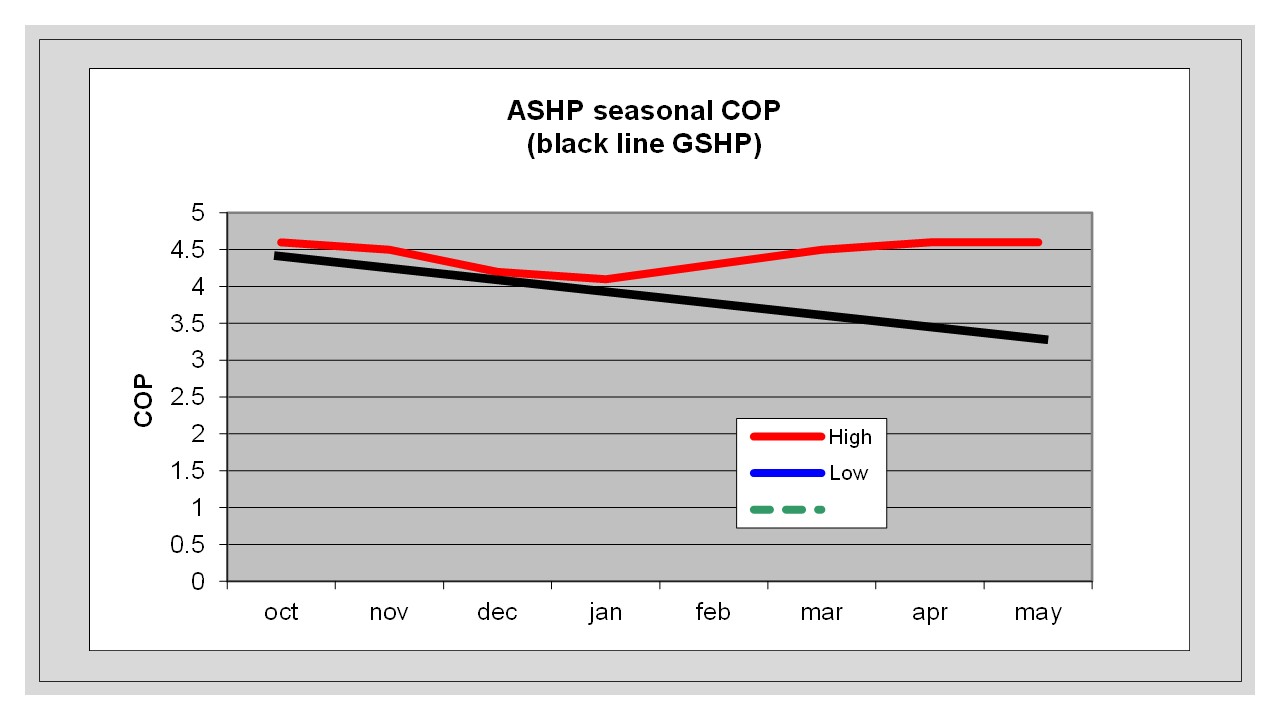
First lets join the debate about ASHP vs GSHP by comparing the COPs of both across the season.

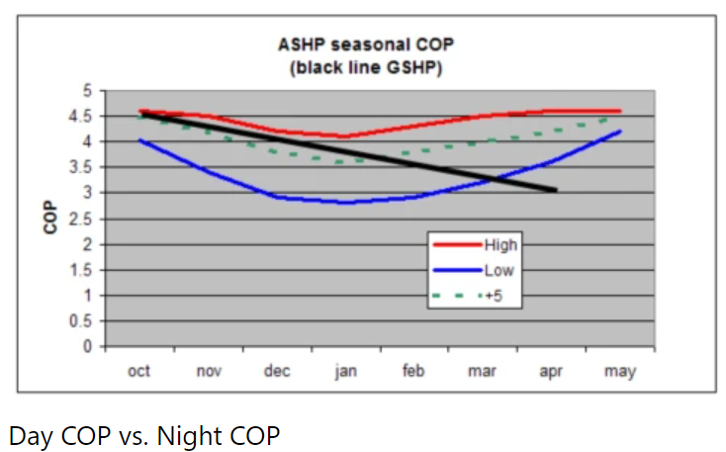
The ASHP operates in a wide temperature range between the red line (day time running) and the blue line (night time running). Cold night time temperatures look pretty disastrous but warmer day time running produces consistently high COPs. On the black line the GSHP does without the wild swings and gently declines in performance as it sucks the heat out of the ever cooling ground.

showing the COP difference between ASHP and GSHP
Day COP vs. Night COP

While the GSHP (black line) gradually loses performance over the winter the ASHP can always do better on warmer days (red line) making the two systems closely matched during the daytime, up until Christmas anyway. Soon after that the daytime COP on the air source starts to improve while the ground source continues to deteriorate.  The only redeeming feature of the ground source is that it is miles better than the air source blue line on dark and cold days or, as some might call it, winter

Even though the GSHP rules the night an ASHP system geared towards more daytime running would be a match for the much more expensive GSHP which, let’s face it, doesn’t always need to run at night at all.

However, some new electricity deals for electric car charging (7.5p/kW.hr at night) make a GSHP, with more night time running, quite compelling. It might be thermally less efficient but the running cost is only 25% that of daytime rates. So while this system favours daytime running it also supports the concept of running cheaply at night and storing the energy in big tanks. See Off-peak energy storage for cheaper heating

If only there was a system that could cherry pick the best COP line on the chart for any given moment. It would need to extract heat from the air on most days – red line – and extract heat from the ground at night – black line. The air side would not run at night so the blue line can be ignored and the system would cherry pick between the red and black lines. The average COP over the season would be around 4 which is better than either system on its own, so best in the world then. Luckily designing such a system is easy really and not particularly expensive either.

 Original Twist Hybrid heat pump.

GSHP unit

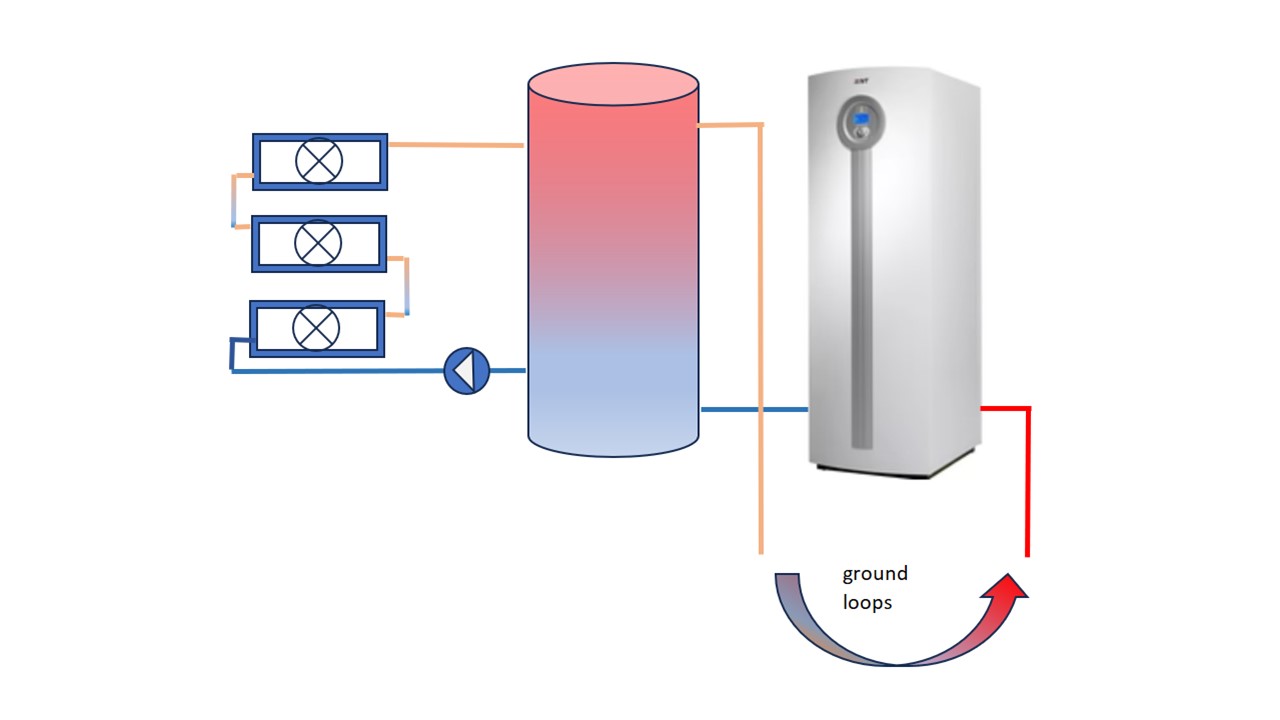
For the core of the system we start with a GSHP unit.  As the name implies we need to feed it with some warmed water from a ground loop or slinky and more on that later.

Air source module

There is already water going in and out of the GSHP unit so warming it with air is simple.

There’s a pipe coming out of the GSHP unit and to the slinkys and we need to insert a buffer tank here. So far there is no change to the performance at all until we go on to warm that tank with air. Just connect a circuit incorporating an air handler unit, that is to say, a large heat exchanger with a fan on it. This is only connected to the buffer tank and is completely independent.

A few car radiators (surprisingly cheap) and a fan or two to make the equivalent of an air handler for about £200. 12v fans for cars are waterproof and easily available. It starts on a simple solar controller  whenever it can contribute. Any time the air is warmer than the tank -click – the pump and the fans kick in. While the size of the buffer tank is not critical, bigger is better and 1,000 litres would not be unreasonable.

Warm air is a great resource so we decouple the air source module and let it run whenever there is a benefit, whether the heat pump is on or not. The tank will nearly always be available to charge when the heat pump is running and supplying an icy return flow on its way to the slinkys. That return flow will usually be around 0c or even less and the ambient air is usually above freezing so the air side will be making a usuful contribution most of the time.

When the tank is warmed up the flow back into the slinkys is highly beneficial by raising the COP line slightly and delaying that end of season fall off in performance. The straight black line on the COP chart will bend upwards into better COP territory as shown in the new chart  and it  should  even  flatten  out  completely at around 4. Note how close that is to the daytime red line a bit higher up and how much better than the blue line we discarded in the first chart.

 Slinky coils

Normally the ground starts the winter at around 12C then the GSHP and cold weather gradually take that down to around 0C. Permafrost around slinkys is not unusual. Normal ground loops are designed to perform at the worst end of this so they have to be huge. Not so with ours which can be smaller because:-

  • The ground starts the winter overcharged. We dump heat into it in the summer.
  • Frequent recharging takes place.
  • The cold return is usually pre-warmed by the air side before going back to the ground.
  • Towards the end of winter, as the air warms up, the Air Source contribution matches most of the load. The end of season performance stress on the slinky is avoided so the design is less critical and it can be considerably smaller.

I’ve done a job where the slinky was trucked down from Switzerland along with a man in a white coat and a bill for thousands; a bit over the top when polyethylene tube from the local builders merchant is just as good and costs under £300.

N.B. The pipes are filled with antifreeze and there are regulations about ground pollution so you can’t be too casual about pipe specification.

Pipes for the air side and the slinkys

It’s important to note that the power eventually delivered by the heat pump has to come from the air side or the slinky or both together. A quick look at my model for power and flow shows that for the air side the pipes will have to be 1″ at least to flow enough to raise 10kW on a Dt of 6 degrees. Same goes for the slinkys where on the same parameters the water would be in one pipe for around 2 minutes so it would almost certainly be better to have 2 slinkys in parallel to make that 4 minutes and 3 slinkys would be even better. A rule of thumb is that 10m of slinky trench makes 1kW so 100m for 10kW. Most of the time the air side and the slinky would run together so reaching 10kW would not be a problem even if the slinkys were cut down a little. However if the space is available I’d still go for the 10m =1 kW rule to be sure that there is no stress during prolonged cold weather.

Solar powerhouse.

Just a thought. If all this kit were built into a small shed with sun facing glass sides it would be easy to fit the fans into the back wall and the heat pump onto a shelf for easy access. The solar input would raise the COP slightly and a few black water containers would store heat to ward off radiator frosting. To go even further, the air side could be boosted by big ground heated tubes which typically are good for a lift of 5 degrees. There would be wooden slatted duck boards on the floor to let the air up. So, with all this, not just best in the world but best of the best in the world. Picture below.

Summary

So that’s it. Better COPs than a GSHP or an ASHP, aircon, ground loop recharge, smaller ground loops and a better match to PV panels (more day time running).  The smaller ground loop might just swing this for owners of regular sized gardens.

ultimate eco heating
Ultimate Eco-heating system

If you are looking at heat pumps then I’ll assume you will have seen this heating system which particularly favours daytime running of Air Source Heat Pumps, a feature in keeping with the free power from PV panels.

This system has been revised and simplified. Revision 2

overclock and tilt PV panels
PV overclock and tilt

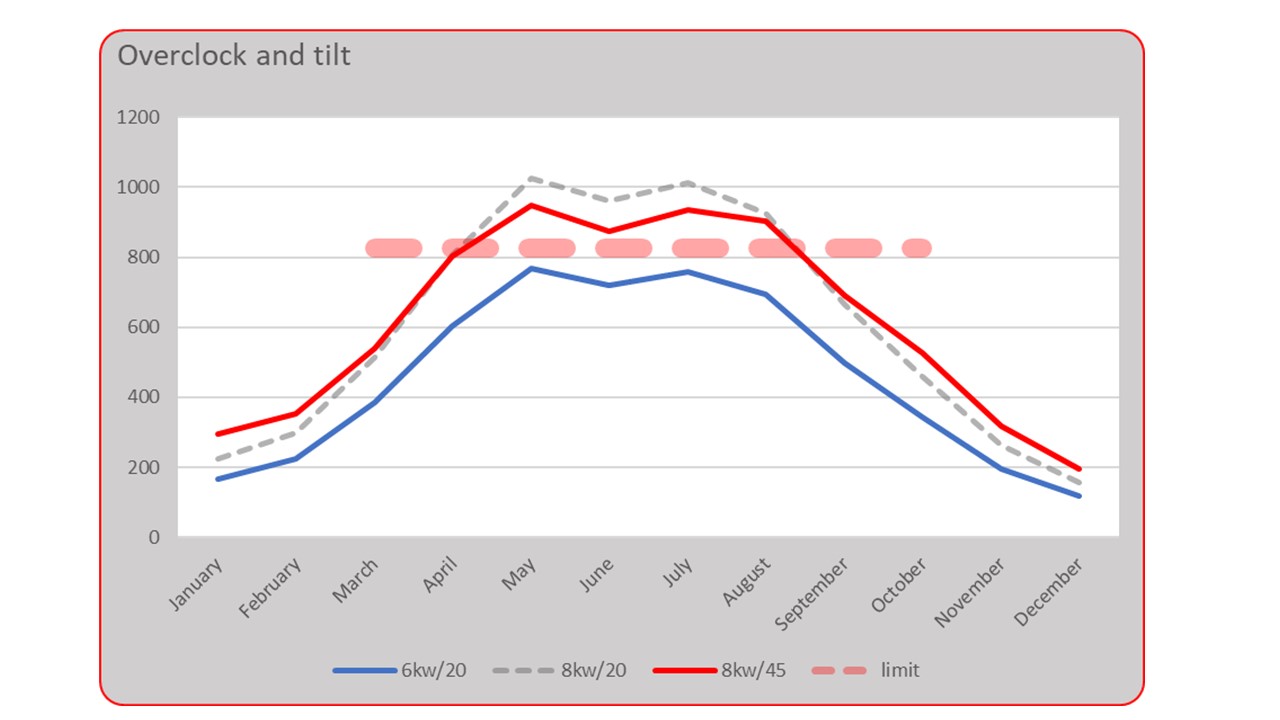
Using big PV to go off-grid – or nearly off-grid – makes sense especially when driving a heat pump. You’ll need every trick to make a limited energy supply go further so make sure you check out the 6kW overclock and tilt concept.

These ideas are now wrapped up in The Grand Designs Heating System and now every concept in the ultimate ‘Big house heat pump system’

Inglenook fireplace design

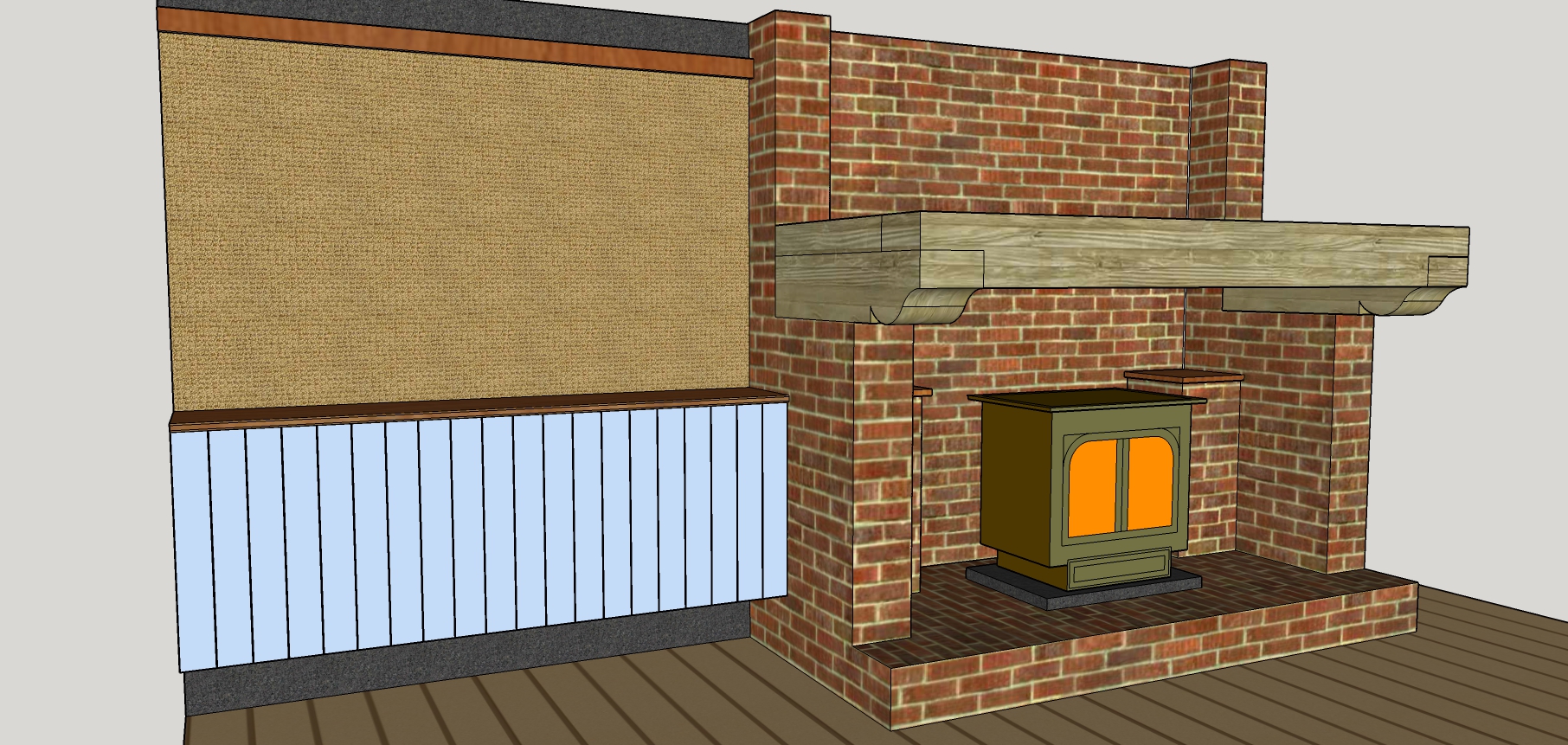
Here is a large brick fireplace that pairs well with a wood burning stove and adds a bit of ‘wow’ to any room. Shown here, part finished, the brick construction is a structural part of the house with the essential offset from the main wall allowing the exposed brick to be part of the room behind. You were going to build a wall anyway so here a little bit of thought yields an expensive looking fireplace doubling up with a characterful wall on the other side.

Perfect fireplace for a wood burner.

A few dimensional suggestions: The front buttresses are 225mm or one brick wide and thus the wood sections are 225mm square. The width between buttresses of 1.6m gives room for logs to be stacked by the stove and the 1.5m height between the floor and the main cross beam works well.

fun with the band saw

The Zampi (Italian: paws) profiles go like this:

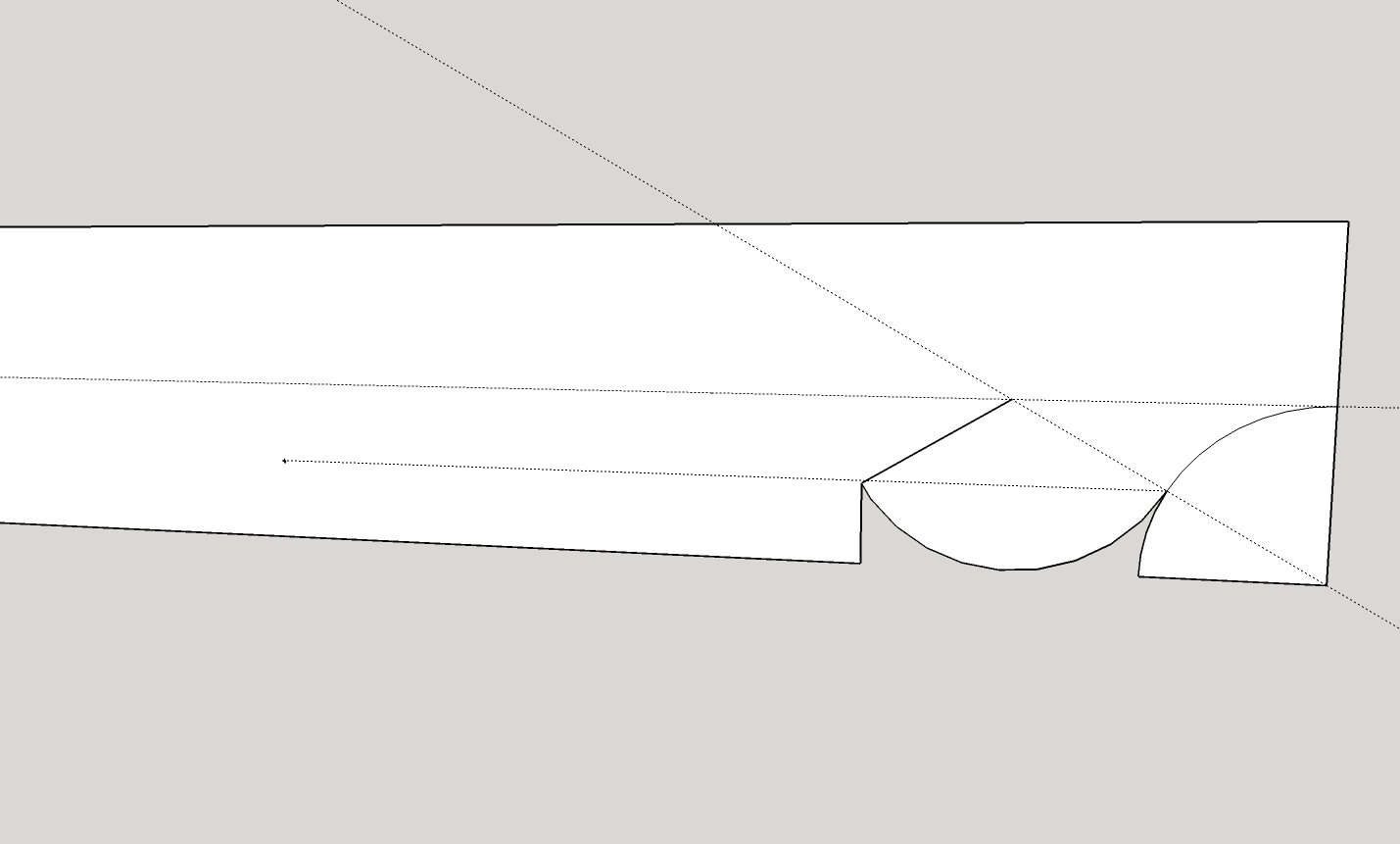
Draw a centre line, mark the radius from the corner, draw a 30 degree angle from the corner, the big curve follows from the centre line intersection.

Double click for a closer look.

You might be going to use a flexible flue and this will need supporting above the stove. A steel ladder frame that can be slid forward and back a bit will make lining up the stack and the stove really easy. Between this and the stove fit a removable flue section to make cleaning easy.

A big stove like the 14kW Clearview shown here is best connected to water or it will make the room far too hot. To get a simple gravity feed put your tank on the other side of the wall and inside an airing cupboard. That’s another lot of plastering avoided and the core of your heating system done.

P.S. Here is a 2m wide version drawn with the non plastered wall theme – i.e.with low cupboards that can incorporate the DIY fan-coil heater.

Inglenook fireplace

Heating for your eco-house

For more straight thinking, this time on heating, have a look at the ultimate Eco heating system which integrates heat pumps stoves and solar.

You really should get this right and there are many wrong turns where multiple energy sources are integrated.

If you are reading this the chances are you have a large house and are wondering how to heat it. The latest thinking on heat pump solutions here.

More on this topic in LIST OF POSTS

Alternative to plaster wall finishing

The clean, white, boxy rooms of modern architecture are all very crisp and neat but the reality for the occupants can be that they make for clinical, boring and echoic spaces without much sense of warmth and homeliness. All too often money is spent on plastering which is then covered up. Think long and hard before plastering a kitchen wall before cupboards and splashbacks make that work redundant.

Similarly, there is no need to cover up plasterwork with a fitted bookshelf or cupboards especially double sided ones serving a room on the other side. Hey, you might not even build a wall here let alone plaster both sides, just leave a large opening.

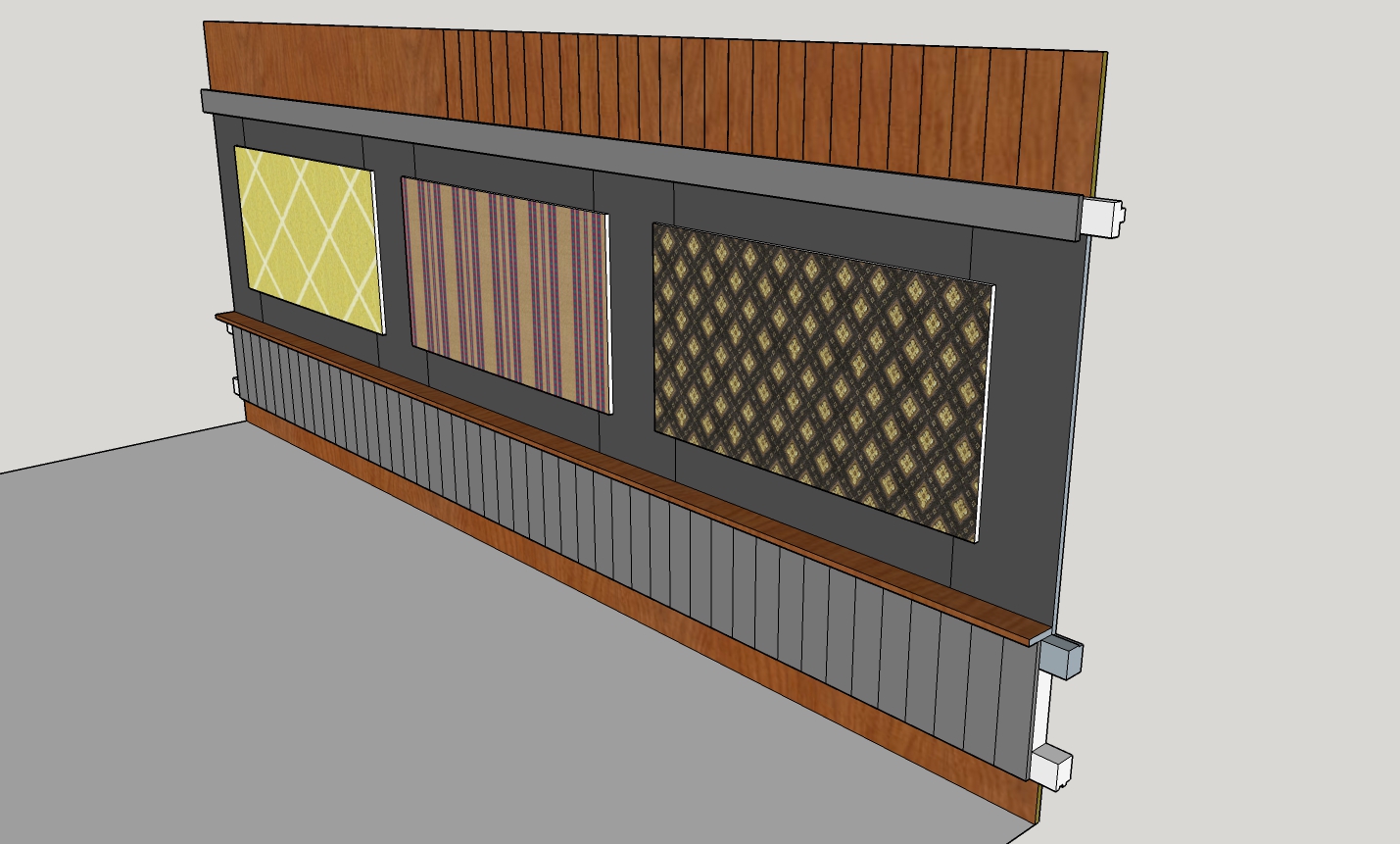
The Original Twist integrated concrete beam system can make a beautifully lit ceiling with wooden beams and boards …. but what about the walls? You might be wondering how to finish the stack of Durisol blocks you built with. The usual plastering solution needs a certain amount of organisation; the first fix plumbing and wiring has to be done and then the plasterer booked for some slot later. From start to finish it could be at least a couple of weeks before the plaster has dried and been painted. Even then there are many things a plain plastered wall does not deliver, so let’s have a look at the Original Twist concept wall and see what extra benefits can be achieved. Here are some ideas incorporated into one picture – it doesn’t have to be this busy.

This or plaster?

Basically there are three or four transverse wooden beams fixed to the wall and then panels fit somewhat loosely and quickly onto them. Extra insulation can be particularly easily added at this stage.

The top beam section

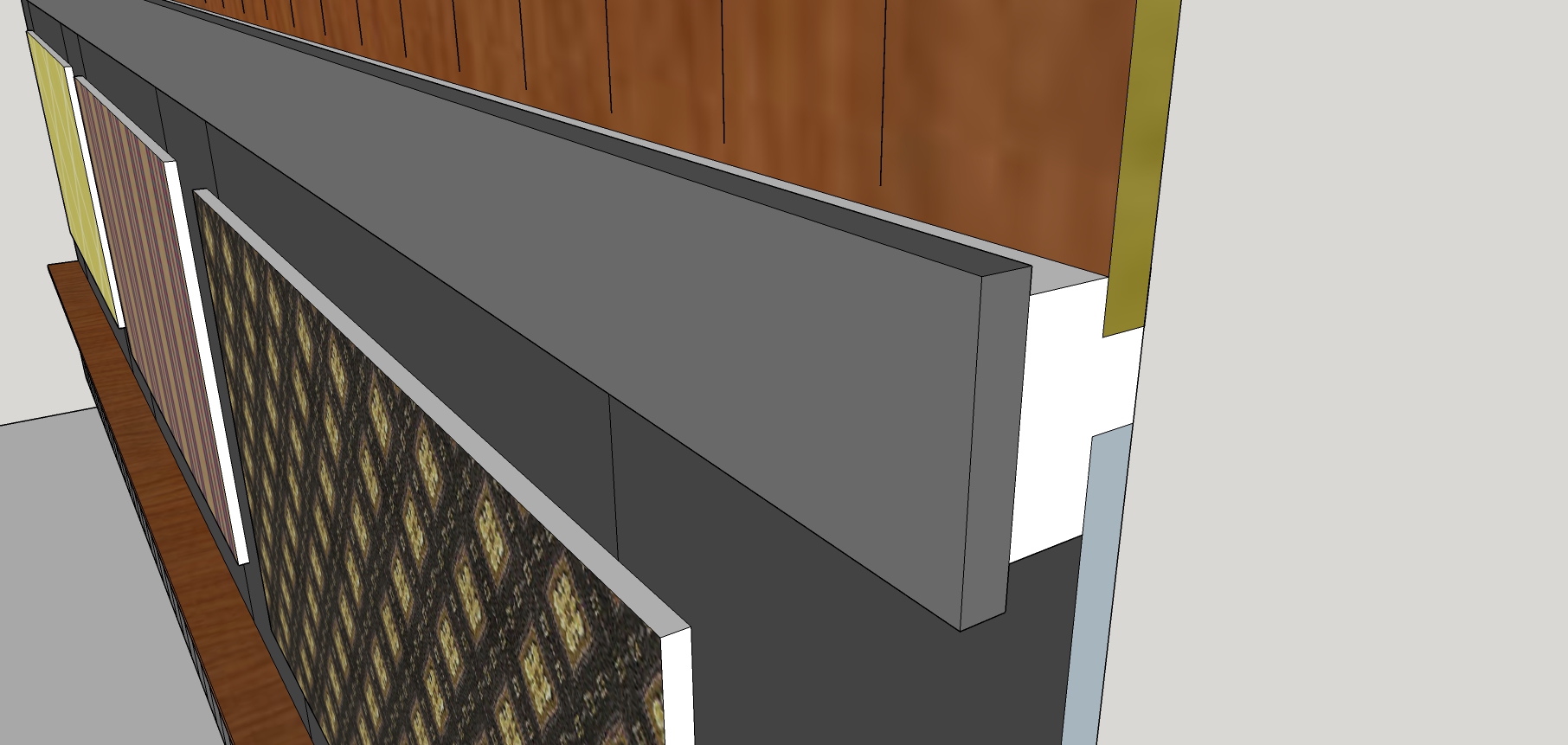
This top beam has a rebate sawn at the back to allow the top panel to be held in place then dab bonded to the wall or a top batten. Pictured is a strip of plywood with vertical marks scratched to resemble boards; quick and inexpensive. Strip LEDs are then laid on top of and under the beam and hidden behind the pelmet board – an inverted strip of skirting board would be good for this. Note how lovely the panels will look when the lights go on.

The next beam down has a similar rebate and here the larger panels are pushed up first to hook under the top beam before dropping into place on the beam below. Our top picture shows an example of black ash faced panels with OSB panels fitted on top. The latter can be covered in anything from wallpaper to fabrics and give unlimited scope for decoration; they could even match a TV screen. If engineered floor boards are being used for this section remember that many of them come in 1.2m lengths so designing for that might save a bit of time and not leave any waste.

The lowest section takes on a colonial look with tongue and groove boards under a shelf. The point of this is that wires and pipes can be hidden as can tubes for integrated dust extraction. Fan coil units for heating and air-conditioning can be fitted into this space with the inlet and outlet vents facing down and hidden. If possible the height of this section should be like kitchen cupboards so that doors and hinges can be incorporated and some mini cupboards too. The underside of the lowest beam has a routed slot for another LED strip light which will highlight the lower panel which acts like a deep skirting board.

So there we have it; loads of character, good sound absorption, sensational lighting, lots of utility and all quite easily done by any DIYer.

Internal walls in blockwork can be visually tied in by using the same beams but leaving the blockwork as the finish. Blocks can be painted in different shades before they are laid to make an interesting textured look. Any other wall incorporating a fireplace can be made in exposed brickwork to give a structural element with exposed brickwork on the reverse side. By the time all the remaining areas are covered by glass doors and a bit of wood panelling there may be very little plastering to be done at all.

Like what you’ve read? Find more essential reading on my e-book

‘Dream House – Down To The Details’ 101 things you should have thought of.      here:-

https://originaltwist.com/2017/02/16/1370/

Heating for your eco-house

For another example of sensible thinking, this time on heating systems, have a look here.

You really should get this right and there are many wrong turns where multiple energy sources are integrated.

More on this topic in LIST OF POSTS