Amazing AirBnb driveable house

It’s a house Jim but not as we know it

Planners usually allow you to build a pod within the curtilage of your house. This one follows the rules but it comes on wheels. So what’s the point of that? Well for a start there are no foundations to worry about, just a bit of hardstanding will do. Then there is the ability to drive it; an electrified Landrover chassis enables you to go for a trundle, down to the pond to watch the sunset for example. Steering is done from the front or remotely from outside.

With the front wheels turned to full lock the whole house can rotate to track the sun, making full use of the 4.8kW photovoltaic array. So yes, it’s all off grid and only needs to dock occasionally to empty some tanks and to refill others.

Design – To make it all really feasible the design is based on off the shelf parts. So the house part is a modified 20′ shipping container supplied from a specialist constructor. They will make it just how you want and drop it round for you. The chassis part is from a 110″ Landrover with all the steering, gearbox and axles – a simple electric motor to drive it (cheap 240V, nothing fancy). Wheels are small and fat from a lawn tractor. The drawings are to scale to give a bit of an idea but the real thing will look miles better.

The solar panels are offset to make a canopy over the front porch.

Is it worth all the bother? Absolutely, for rental to eco enthusiasts this is a thrilling bit of kit. Imagine their delight when their pod comes round the corner to pick them up and take them to some lovely spot – all filmed from various points to give them a memento of an amazing experience. You can charge a lot more for that than if you were just offering a shed (I think they call them shepherd’s huts these days)….. is this a self powered off-grid shepherd’s hut then?

If you want to use this on your piece of land you might put a hitch on the back and call it a tractor – great to sit in a comfy chair while you mow the lawn!

12 panels, 4.8kW makes another 14% through tracking the sun so it’s effectively a 5.5Kw array. It makes a useful UPS with it’s Fogstar 15kWhr battery. This machine will easily run its mini-split heat pump or could send power to your home heat pump so it’s going to solve your heating problem too – at least an extra £1,000 in your pocket every year from that. Once hooked up to your main house the power can flow either way so the mini-split heater in the driveable house will always be useable, even after prolonged dark winter days.

Let’s tot up the benefits. £1,2000 worth of electricity, £1,000 heating savings and over £1,000 a week on Airbnb + sales of the book and the experience video. About £30,000 a year then from a build cost of circa £50,000 it doesn’t seem so mad after all. You could get your money back in 2 years and then live off this thing.
 
Guests are filmed as the house arrives, they get in and drive away to the viewing spot where there is a facilities block along with power and TV hook-up. Part of the drama is the house slowly turning to face the sun 🌻 a few times a day; all automated of course.
 
There’s a nice design for the hook-up to the facilities block. Ask me for details when you build this.
 

Leave a comment

This site uses Akismet to reduce spam. Learn how your comment data is processed.

Inglenook fireplace design

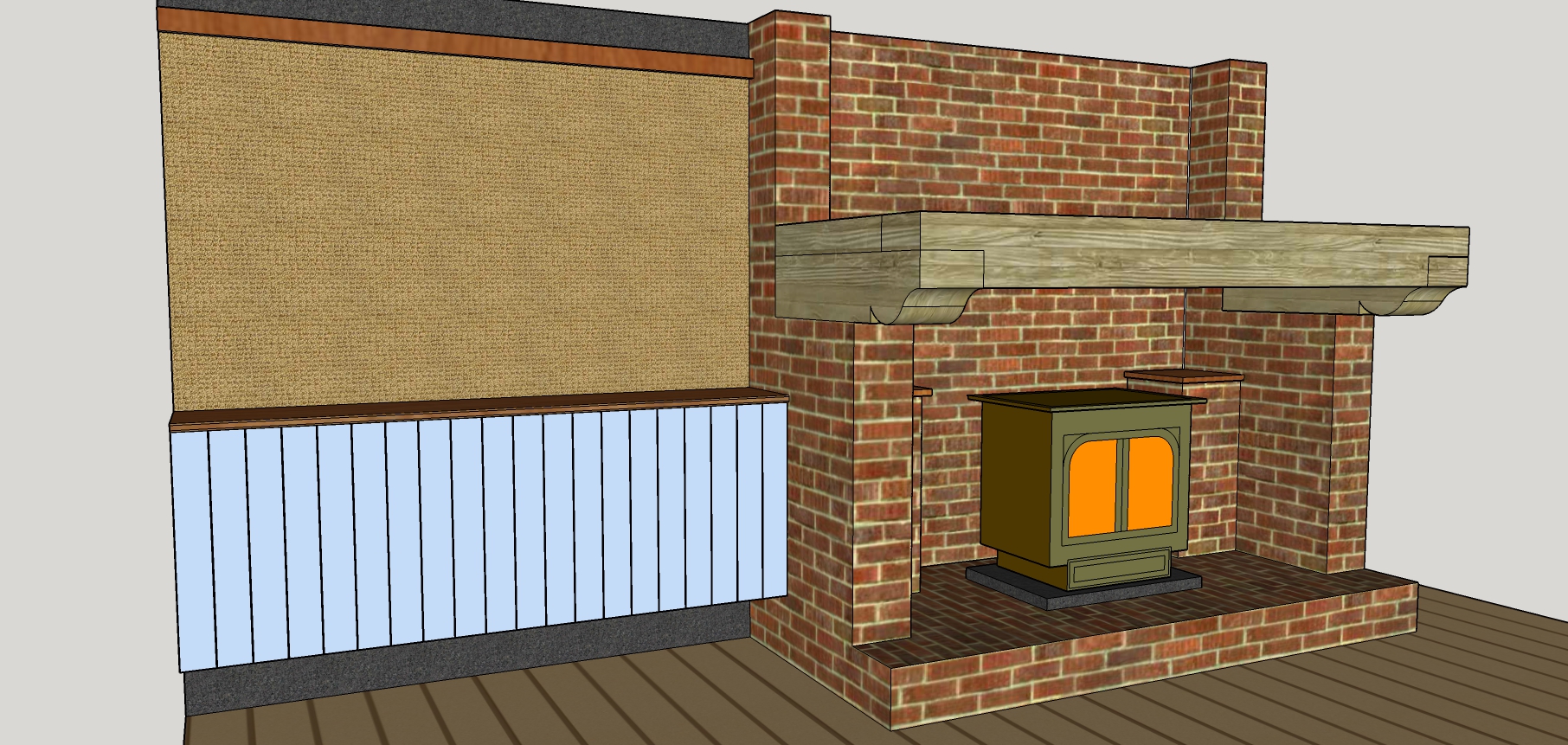
Here is a large brick fireplace that pairs well with a wood burning stove and adds a bit of ‘wow’ to any room. Shown here, part finished, the brick construction is a structural part of the house with the essential offset from the main wall allowing the exposed brick to be part of the room behind. You were going to build a wall anyway so here a little bit of thought yields an expensive looking fireplace doubling up with a characterful wall on the other side.

Perfect fireplace for a wood burner.

A few dimensional suggestions: The front buttresses are 225mm or one brick wide and thus the wood sections are 225mm square. The width between buttresses of 1.6m gives room for logs to be stacked by the stove and the 1.5m height between the floor and the main cross beam works well.

fun with the band saw

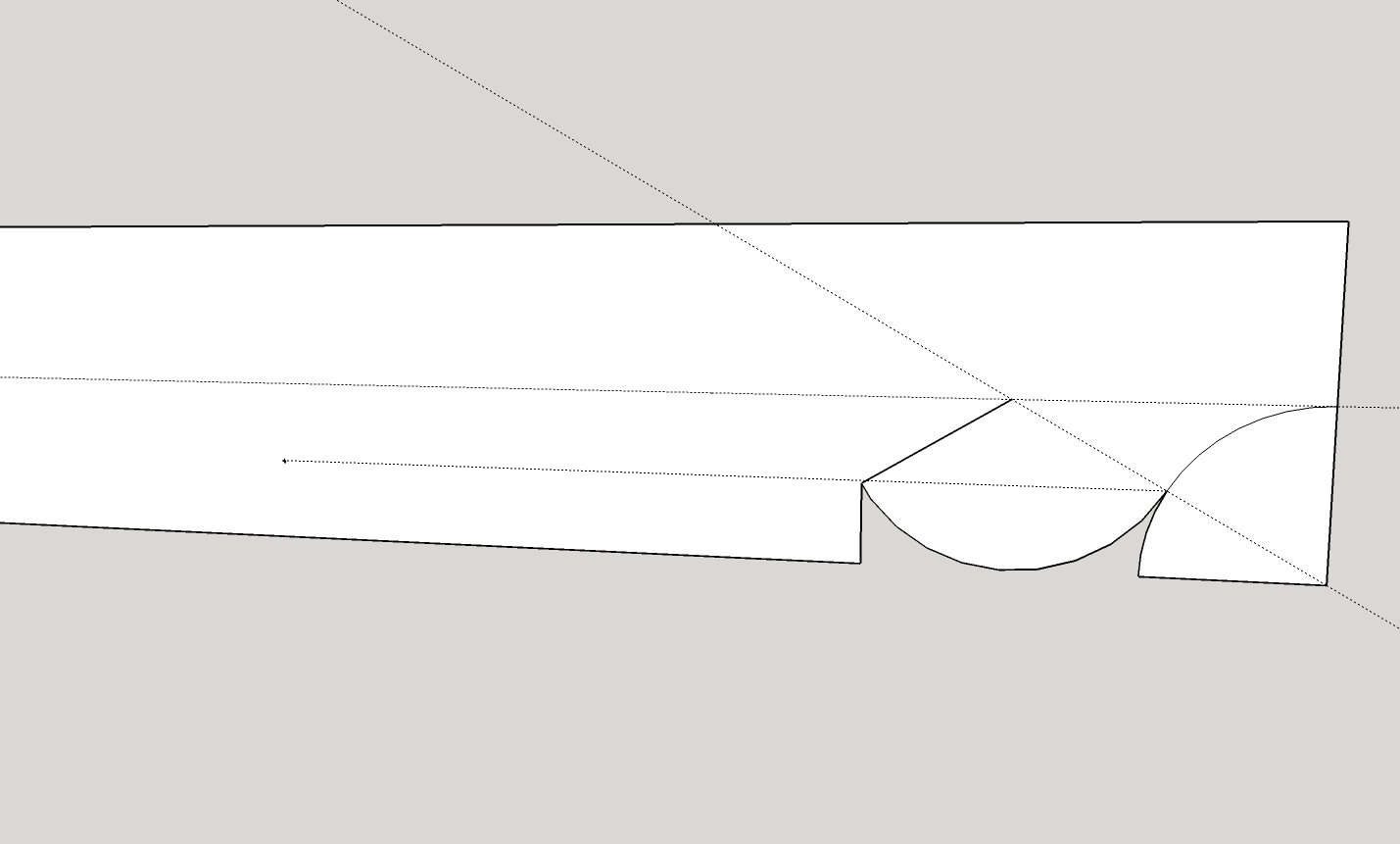
The Zampi (Italian: paws) profiles go like this:

Draw a centre line, mark the radius from the corner, draw a 30 degree angle from the corner, the big curve follows from the centre line intersection.

Double click for a closer look.

You might be going to use a flexible flue and this will need supporting above the stove. A steel ladder frame that can be slid forward and back a bit will make lining up the stack and the stove really easy. Between this and the stove fit a removable flue section to make cleaning easy.

A big stove like the 14kW Clearview shown here is best connected to water or it will make the room far too hot. To get a simple gravity feed put your tank on the other side of the wall and inside an airing cupboard. That’s another lot of plastering avoided and the core of your heating system done.

P.S. Here is a 2m wide version drawn with the non plastered wall theme – i.e.with low cupboards that can incorporate the DIY fan-coil heater.

Inglenook fireplace

Heating for your eco-house

For more straight thinking, this time on heating, have a look at the ultimate Eco heating system which integrates heat pumps stoves and solar.

You really should get this right and there are many wrong turns where multiple energy sources are integrated.

If you are reading this the chances are you have a large house and are wondering how to heat it. The latest thinking on heat pump solutions here.

More on this topic in LIST OF POSTS

Alternative to plaster wall finishing

The clean, white, boxy rooms of modern architecture are all very crisp and neat but the reality for the occupants can be that they make for clinical, boring and echoic spaces without much sense of warmth and homeliness. All too often money is spent on plastering which is then covered up. Think long and hard before plastering a kitchen wall before cupboards and splashbacks make that work redundant.

Similarly, there is no need to cover up plasterwork with a fitted bookshelf or cupboards especially double sided ones serving a room on the other side. Hey, you might not even build a wall here let alone plaster both sides, just leave a large opening.

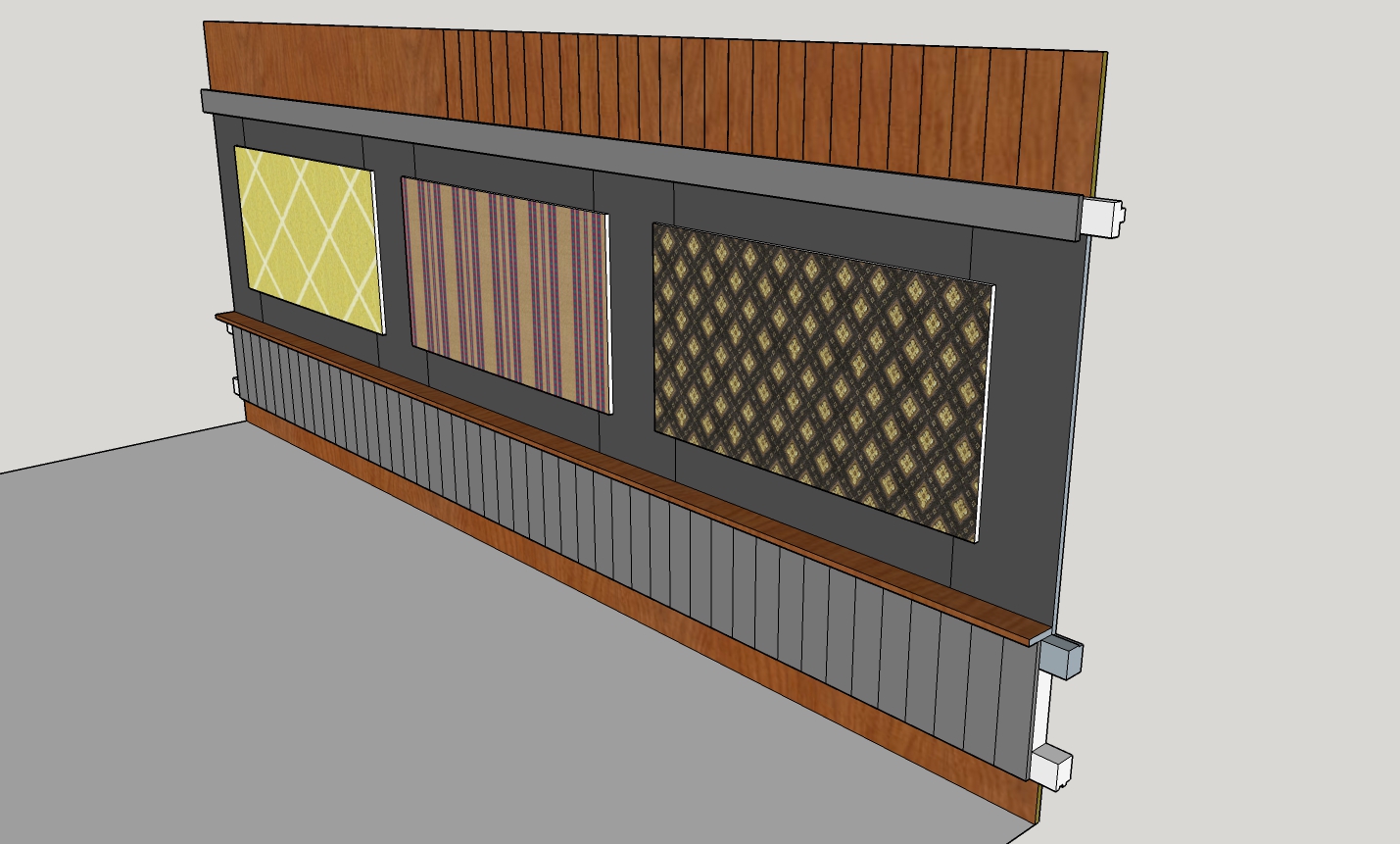
The Original Twist integrated concrete beam system can make a beautifully lit ceiling with wooden beams and boards …. but what about the walls? You might be wondering how to finish the stack of Durisol blocks you built with. The usual plastering solution needs a certain amount of organisation; the first fix plumbing and wiring has to be done and then the plasterer booked for some slot later. From start to finish it could be at least a couple of weeks before the plaster has dried and been painted. Even then there are many things a plain plastered wall does not deliver, so let’s have a look at the Original Twist concept wall and see what extra benefits can be achieved. Here are some ideas incorporated into one picture – it doesn’t have to be this busy.

This or plaster?

Basically there are three or four transverse wooden beams fixed to the wall and then panels fit somewhat loosely and quickly onto them. Extra insulation can be particularly easily added at this stage.

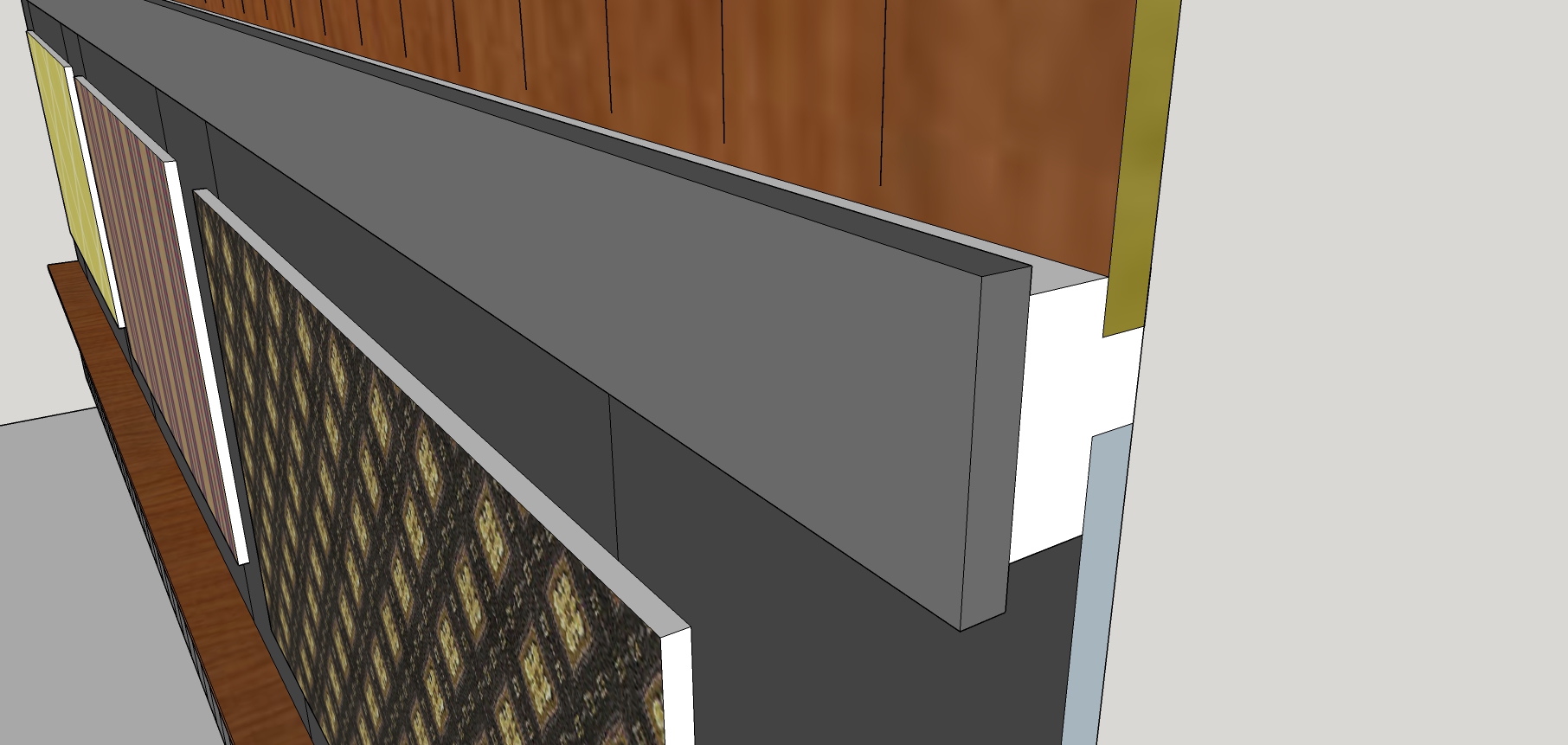
The top beam section

This top beam has a rebate sawn at the back to allow the top panel to be held in place then dab bonded to the wall or a top batten. Pictured is a strip of plywood with vertical marks scratched to resemble boards; quick and inexpensive. Strip LEDs are then laid on top of and under the beam and hidden behind the pelmet board – an inverted strip of skirting board would be good for this. Note how lovely the panels will look when the lights go on.

The next beam down has a similar rebate and here the larger panels are pushed up first to hook under the top beam before dropping into place on the beam below. Our top picture shows an example of black ash faced panels with OSB panels fitted on top. The latter can be covered in anything from wallpaper to fabrics and give unlimited scope for decoration; they could even match a TV screen. If engineered floor boards are being used for this section remember that many of them come in 1.2m lengths so designing for that might save a bit of time and not leave any waste.

The lowest section takes on a colonial look with tongue and groove boards under a shelf. The point of this is that wires and pipes can be hidden as can tubes for integrated dust extraction. Fan coil units for heating and air-conditioning can be fitted into this space with the inlet and outlet vents facing down and hidden. If possible the height of this section should be like kitchen cupboards so that doors and hinges can be incorporated and some mini cupboards too. The underside of the lowest beam has a routed slot for another LED strip light which will highlight the lower panel which acts like a deep skirting board.

So there we have it; loads of character, good sound absorption, sensational lighting, lots of utility and all quite easily done by any DIYer.

Internal walls in blockwork can be visually tied in by using the same beams but leaving the blockwork as the finish. Blocks can be painted in different shades before they are laid to make an interesting textured look. Any other wall incorporating a fireplace can be made in exposed brickwork to give a structural element with exposed brickwork on the reverse side. By the time all the remaining areas are covered by glass doors and a bit of wood panelling there may be very little plastering to be done at all.

Like what you’ve read? Find more essential reading on my e-book

‘Dream House – Down To The Details’ 101 things you should have thought of.      here:-

https://originaltwist.com/2017/02/16/1370/

Heating for your eco-house

For another example of sensible thinking, this time on heating systems, have a look here.

You really should get this right and there are many wrong turns where multiple energy sources are integrated.

More on this topic in LIST OF POSTS


Modern floating staircase

DIY floating stairs

How hard would it be to make a modern staircase to embellish your new build house? Not too hard is the answer, as long as you design it to be DIYable from the outset.

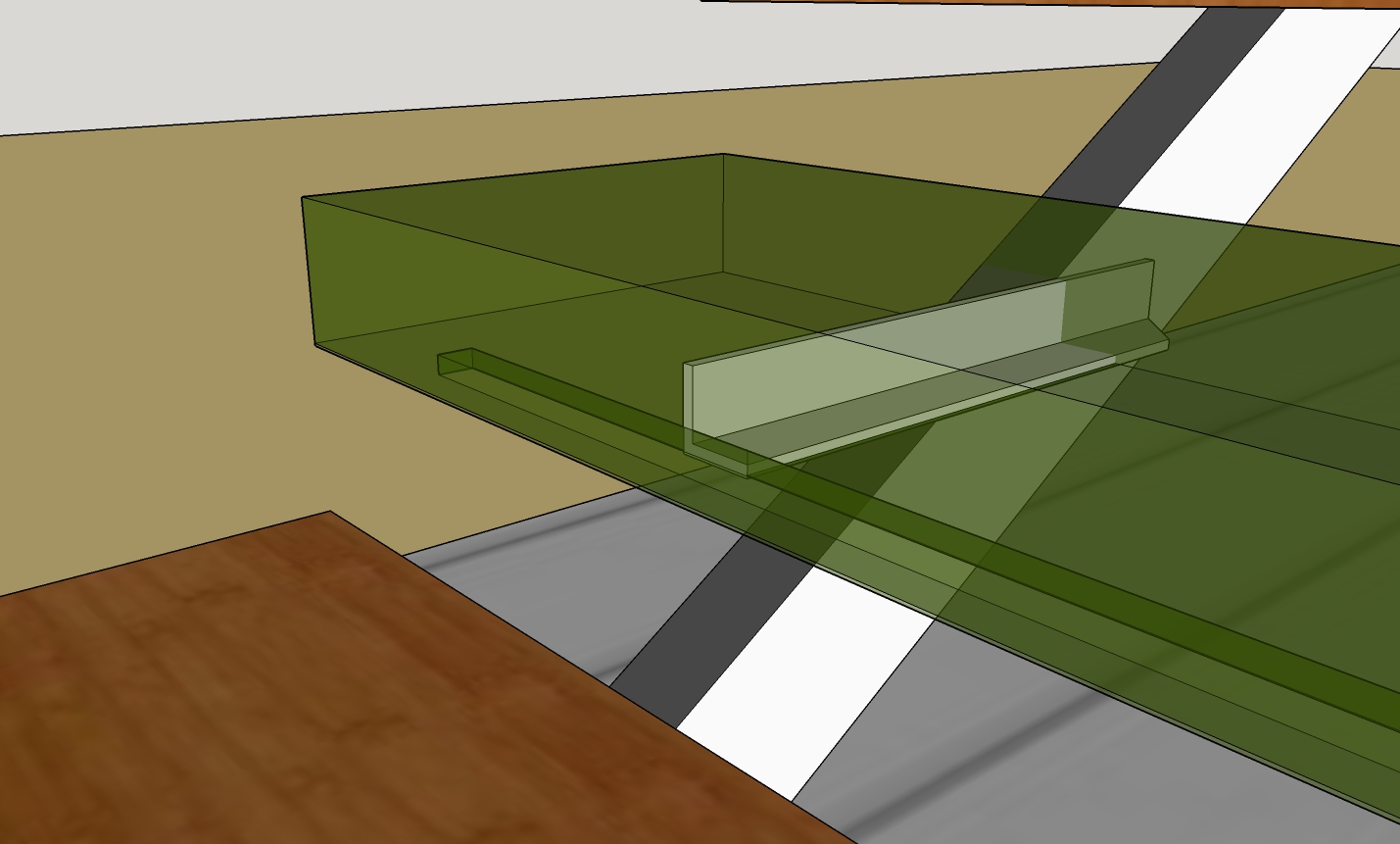
This modern staircase is based on two 100×50 HRS hollow steel box beams with chunky wooden treads supported on 40x40x6 bright mild steel angle iron support bars welded onto the beams. If you are handy with a router and a welder (MIG is easy) then the construction should be quite straightforward.

The angle iron bars are completely hidden inside the treads which appear to float without any means of support. Double click the image for a closer look.

The slot shown under the front of each tread is for LED strip lights which can be bought in aluminium channels with diffuser covers. Leave a little space around and under them for cooling and rout out a channel under the angle iron for the wires. You also need a hole through the angle iron and the box section for the wires to pass into the box section, preferably with a rubber grommet. All the wires go down to the bottom step which will house the control elements for making the lights do all the tricks you can imagine. The stairs lit with any colour you chose will be absolutely stunning.

A bought in staircase like this would cost at least £5,000 – £10,000 so you can afford to sub out some of the work to make it easier and buy any tools you need. The routing work is very repetitious and it would be worth getting a local CNC router on the case; there is only about an hour of machining time and accuracy will be perfect. Get the angle iron brackets cut to length too. There will be many chamfered holes to make so I’d say a pillar drill will be essential.

The Design

stairs geometry

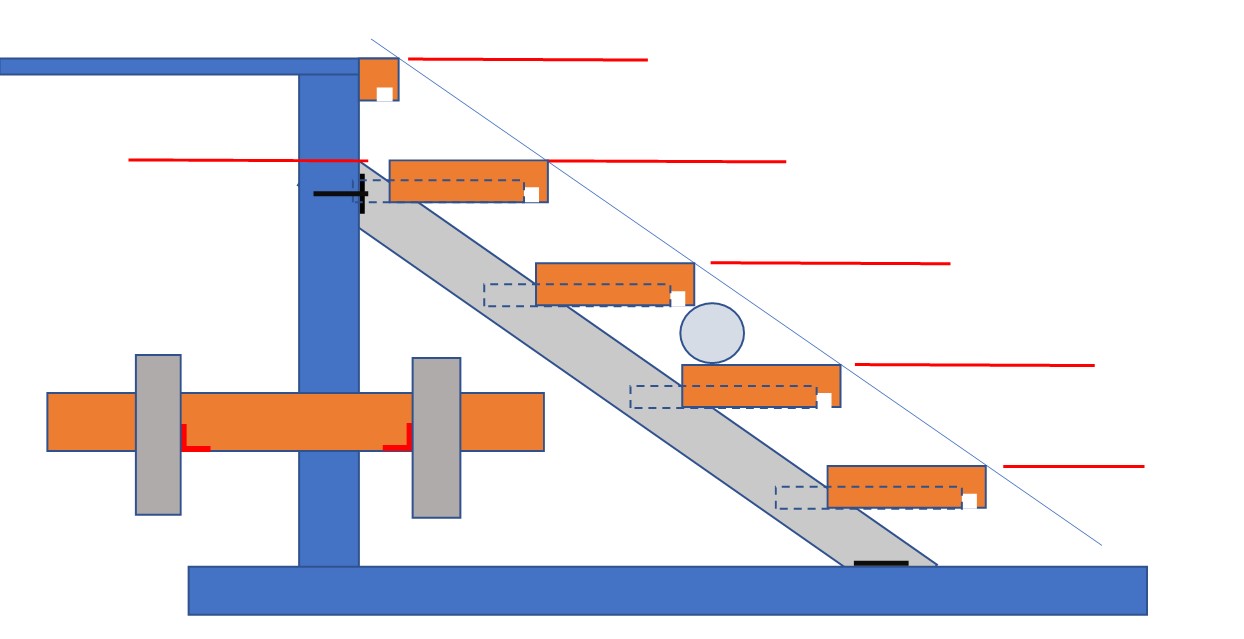
Tradition has it that a comfort stair is 7” x 11” for rise and going. Rounding up slightly that’s 180 x 280mm. B.S. regulations give ranges for rise of150 -220mm and 220-300mm for going G. The ratio of rise to going gives an important angle which here would be around 33 degrees and must not exceed 42 degrees. You’ll need this angle to saw off the ends of the beams.

The distance H between your two floor levels will set the rise. Find which whole number divides into H to give a rise R near to 180mm or what you prefer. That whole number is one more than the number of treads but note that the bottom tread might be a platform like the one on the sketch above.

Tread thickness T.  B.S. regs state that a 100mm ball must not pass between stairs or guards so if we say that the open gap between the treads will be 98mm then T = R – 98 or more.

The Going overlap. B.S. regs state that the overlap on open stairs must exceed 16mm but too much spoils the design, as you will see when you draw yours. So tread width W = G + 20 will do for a start.

So the treads will be something like 300 x 80 in section. As for length just bear in mind that stairs over a metre wide must have hand rails on both sides. I think 85cm looks about right.

Length of box beams L. To make life easy you could set the top of the box beam level with the top of the top tread, so; The base of our triangle is (no of treads -1) x G / R and then just use Pythagoras to get the longest length of box…. or, frankly, just draw it and see what you get. The drawing will reveal what angle to cut on the ends of the box beams too.

Make a note of all your numbers then make a drawing of the side elevation to scale. Sketchup is perfect for this and is free and easy to use. Note the intersection of the top of the angle iron, the beam and the back of the tread. N.B. Sketchup can repeat copies easily so draw and colour just one tread then copy it upwards by the rise and then across by multiples of the going.

Safe assembly with no cock ups.

After drawing the beams etc, cut the angles on the beam ends and with the beams lying on a flat surface weld on a few cross stabilisers to secure the shape; they must remain dead parallel. The beams have cross plates welded across the ends but bolt these on to the wall/floor first then weld on the beams assembly in situ. So far no risk. Now take a fully assembled tread unit and fit the only tricky tread, the top one. Make sure that is going to work with the top floor level then clamp and tack it on. All the rest are easy and risk free. Start from the top to prevent weld spatter from spoiling lower treads and grind off the stabilisers as you go. Don’t do the final welds until you are sure it is all perfect. N.B. it’s the tread positions that matter; any minor inaccuracies on the angle iron supports are hidden anyway.

If you make these stairs I’d be very glad to hear about it and to put  your photo with this article.

Like what you’ve read? Find more essential reading on my e-book

‘Dream House – Down To The Details’ 101 things you should have thought of.      here:-

Heating for your eco-house

For another example of out of the box thinking, this time on heating systems, have a look here.

You really should get the heating right and there are many wrong turns where multiple energy sources are integrated. More on this topic in LIST OF POSTS

Go back

Your message has been sent

Warning
Warning
Warning
Warning

Warning.

Integrated Concrete Beam System

Integrated Concrete Beams

Building with Durisol, Quadlock or any other ICF blocks? Here’s the easy way to do a poured concrete floor.

Concrete first floors are good; low noise transmission, high thermal mass and suitable for under-floor heating. The trouble is the shuttering required is elaborate and expensive both in materials and time and once the floor is poured there is usually more work involved in boarding, plastering and painting. Concrete block and beam systems look easier but you do need to be very organised and get delivery of exactly the right beams and after paying for heavy lifting gear they won’t look like a cheap fix. Again there will be final finishing to do. Plastering and painting ceilings – no thanks.

The Original Twist Integrated Concrete Beam system is so suitable for the self builder that it is hard to consider anything else. It couldn’t be simpler. You make up some hollow beams out of easily sourced planks, put them up in a row, fill the gaps with wooden floorboards and pour. That’s it.

Concrete floor system

Step 1/.

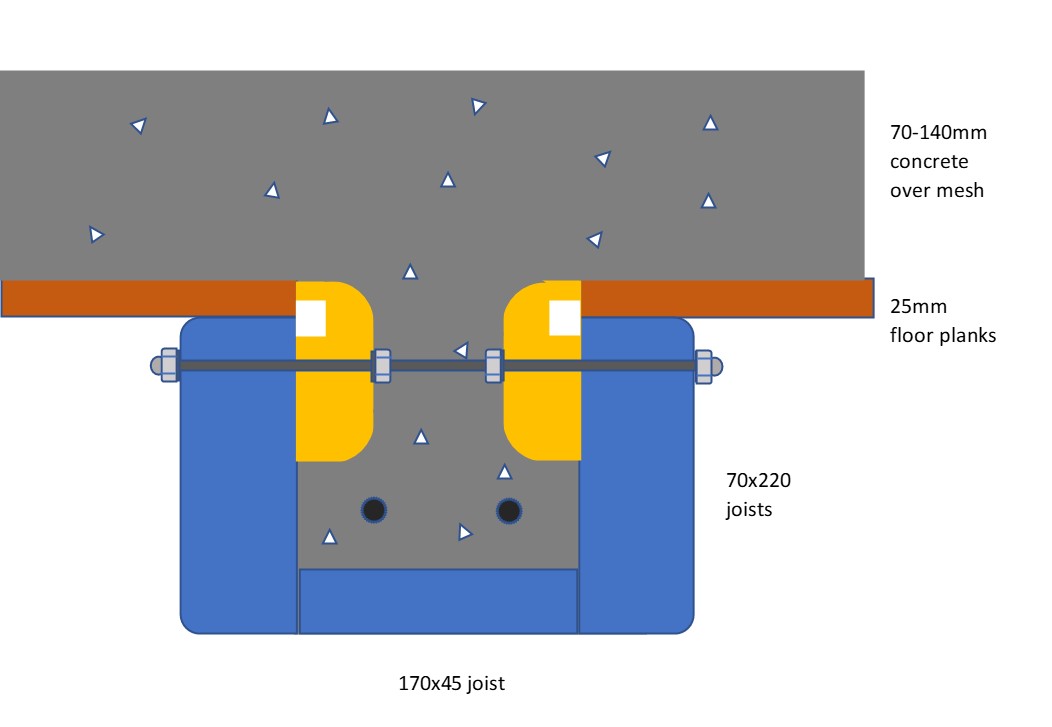
Make up the wooden beams as shown in this cross section. The blue and yellow bits are your choice of regular timber from your local supplier.  The slots sawn out of the yellow sections are for wiring channels and it makes sense to insert the wires while the beam is being assembled. The threaded studding stops the beam spreading when the concrete pours in and is part of the construction with the outside acorn nuts making a decorative feature. Use a spindle moulder or router to round off the edges and then apply your choice of finish after distressing with chain, hammer, belt sander etc. You will see that the yellow sections stick up by the thickness of your floor planks and make a perfectly curved transition between the concrete floor and the integral ‘I’ beams. The rebar at the bottom of the ‘I’ section needs to be held in position prior to the pour and this can be done easily and cheaply with pairs of cup hooks screwed into the bottom plank. Use cable ties across each pair to hold the rebars in. Finally, paint the inside of the beam to isolate it from the wet concrete. The beams are then ready to be placed in position, typically on a one metre pitch (Durisol blocks are half a metre wide) and each propped with one or two Acrow props. If you are using ICFs like Durisol for your walls you should cut out large slots on the inside face to take the beam ends. You might want to pour the walls up to the level of the beam bases now.

Step 2/.

The floor planks can be cut and finished at ground level before fitting between adjacent beams. Now is the time to fit any pockets for spot lamps and take the wiring back towards the slots pre-cut in the main beams. The floor planks need to be strong enough to resist the weight of the concrete without sagging; they don’t need to be jointed together as a layer of building paper over the top will stop any leaks. Unlike concrete blocks they are light and easy to pass up to your helper.

Step 3/.

With steel mesh over the beams and planks the floor is ready to pour.  The outside of the Durisol blocks sets the top level of the floor so you don’t even need any shuttering. Once the pour is done and set, the walls and floor are all integrated with the homogeneous ‘I’ sections in the beams giving enormous strength and stiffness. The ‘I’ section parts of the floor could be up to 360mm deep which makes them into a row of significant beams in their own right. At this point the lower part of the house is waterproof which makes for a good working environment from which to finish off the rest.

Step 4/.

Nothing much to do now. Just take down the props then go down to the pub to celebrate all the money and time you’ve saved. There is no ceiling finishing to do, no shuttering to take down, even the lights are fitted and wired. And all this was done with simple hand tools and without waiting for special parts to be delivered. And just look; lovely lovely beams adding character and value to your home.

Notes:

A small spacer between the top of the beam and the floor joists will create a gap to house some LED strip lights. As you have a lovely wooden ceiling you might as well show it off.

N.B. Wood shrinks. A tiny air gap could eventually appear between the concrete floor and the wood floor. A very thin rubber membrane between the floors (instead of the building paper) will prevent any ‘thwack’ as the upper floor is walked on.

Ground floor block and beam – alternative system

Block and beam systems are commonly used for ground floor construction but again they can’t compete with our integrated beam system. Block and beam materials all have to brought to site and then assembled – lots of work there. All those blocks are more gap fillers than strength givers and they are followed by a poured screed anyway. With the integrated beam system you just string out the wooden beams, fill the gaps with plywood and then pour – not only much quicker but stronger too. Use adjustable legs from kitchen units as props, to prevent sagging, and leave them there forever.

With both floors quickly and cheaply constructed and the walls easily made with ICFs it is easy to see that a fully waterproof house up to the first floor could be made in a matter of just a few days. That saves time and money and less exposure to problems with bad weather.

structural fireplace and stove.

While the rest goes up the internal finishing can start on the first level. Some comments on this here…. and an internal wall cum fireplace design here. … and a floating staircase here.

While this system is great for under floor heating, I’m really not in favour of it for bedrooms as it is a big waste of money for an unwanted result. More on that in the eco-heating link below.

N.B. As usual do your own evaluation for suitability.

Heating for your eco-house      For essential reading on heating systems, have a look here:

You really should get this right and there are many wrong turns where multiple energy sources are integrated.

More house building topics in LIST OF POSTS

Go back

Your message has been sent

Warning
Warning
Warning
Warning

Warning.

Fan car – Ring record threat

The notes below were written in 1986. Since then a few notable fan cars have appeared (McMurtry Speirling, Ariel Aero P, GMA T.50) and a student project car even did 0-60 in one second. None of them have attempted a Nurbergring record and maybe with one particular reason. When a car is ‘sucked’ down hard on its springs it will be ready to jump back up if the downforce is released in any way and that only serves to break the sucktion even more. Rough circuits are just not suitable for fan cars. So far, no one has followed the OriginalTwist answer to this problem; does it make sense – read on and please feel free to comment.

1986 There’s a good reason why fan cars have been banned in motorsport. Cars sucked to the ground will always produce astonishing cornering accelerating and braking performance but any disruption to the skirt contact with the ground – such as running over a kerb – is likely to see a very rapid accident under way. Of course, a car that literally scrapes along the ground can only be used on very smooth race tracks and would be impractical for the road. The engineers at Original Twist don’t entirely agree and think a new approach is called for. Here is the Original Twist fan car design. The usual idea is that flexible skirts on the car scrape along the ground to maintain a seal, the air pressure inside the skirt is reduced with a fan and the pressure differential forces the car down. The Original Twist idea deviates by separating the skirt from the car; an independent suction pad is held under the car and with its lightness and agility this pad is free to track the road contours even if the car is in more vigorous motion.

The suction pad is circular in order to keep the air bleeding edges to a minimum. A 60” diameter area with a 1 psi pressure drop will produce 2,800lbs of downforce; about the weight of a car then.

The suction pad is not directly attached to the car. Instead it rides on 4 small wheels like a circular go-kart which is towed under the car.

Fan car suction ring

Fan car suction ring

The skirt edge is held very slightly off the ground so there is no horrible scraping noise as you move along. The skirt is different too and employs hovercraft principles in reverse. Apart from the main extraction fan, air is blown out of slots round the edge against the air that is trying to get in and that makes an inertial barrier. The blowing can be done with an extra fan in the nose of the car for example. The extractor fan probably won’t double up as the blower because the pressure/flow characteristics are different but it would be worth investigating. A concertina bellows connects the skirt edge to the underside of the car floor and the seal is complete. The skirt/kart is pressed lightly to the ground by the trailing links that locate it and although the relatively heavy car might be jumping and jiggling the skirt will tend to remain flat on the ground and unlikely to reveal a sudden and potentially deadly pressure change.

With an electrically driven fan the downforce on the car can be tightly regulated and as aero downforce comes with speed the fan speed can be decreased accordingly until eventually there is no need for it and the whole underkart can even be retracted. The retraction feature makes the fan car suitable for the road; a fan car that can cope with humps and farm tracks and then pop round the Nürburgring in 5 minutes has got to rewrite the book somewhat.

While all this is alluringly simple there is one complication. Cornering with 8 wheels instead of four is going to be out of this world but the kart wheels will need to be steered unless they are on castors. A supermarket trolley under the car won’t add much dynamically but a steered go kart, pushed down very slightly by the trailing arms, will make a major contribution to the cornering forces.

The potential for electric sports cars has been examined in

https://originaltwist.com/2015/11/04/electric-sports-car-2020/

but the main point is that all the performance extremes of current supercars, in terms of acceleration, cornering and braking , can be exceeded by a factor of two or more. That means forces on your body, and head, of over 2g. It’s like doing press ups with someone sitting on your back so you’d need to be immensely strong to try the brakes without a full harness seat belt on. Cornering and braking at the same time would see you clawing your way out of the passenger footwell.

Formula One drivers experience forces like this but now a moderately priced sports car will be able to deliver the same. Headline figures of 0-60 in 1.5 seconds and 120mph in around 3 or 4 seconds will reset the performance bar in a shocking way. A 5 minute ring time is technically possible – just a question of who and when?

Note: Suck is a concept for when the force of atmospheric pressure – or other – acts against an object with lowered pressure on the opposite side. Really there is no such thing as a sucking force; when you ‘suck’ on a straw it is atmospheric pressure pushing your drink into your mouth.

With any fan car it is the weight of the atmosphere above the car which is pushing it down.

Atmospheric pressure is 14.7 psi at sea level so this sets the theoretical upper limits of our skirt with a total vacuum on one side. That would be about 18 tons in this case so the 1 psi pressure drop that equals the weight of the car is not too much to aim for and might easily be exceeded.

2025 revision

To make the skirt/kart simpler and neater I have revised my ideas as follows:

More rectangular in shape and made of box section. Holes are drilled all round the lower outside edges and the lower lips of the holes are peened down to give the counterflow jets a downward component.

Leading edges of the frame are angled back to deflect road debris and the front wheels go outside in the resulting space. This allows easier access for the steering mechanism. The frame will inevitably suffer the odd scrape so a sacrificial strip is screwed to the underside – dense polyurethane probably, like skateboard wheels.

Watts linkages front and rear give lateral stability and two large trailing arms give fore and aft location and also apply some downward pressure. They also lift the whole assembly to retract it.

The two fans can be driven by one motor and belt drives.


Leave a comment

This site uses Akismet to reduce spam. Learn how your comment data is processed.

Eco-heating system for heat pumps

Ultimate Eco-heating system

Ultimate Eco-heating system

Ecological heating (Eco-heating)

NOTE: Dec 2019 This design will still suit many configurations but much cheaper PV panels have changed the rules somewhat. Suggestions for an update, and a simpler diagram, are here at the 2020 revision

Also the RHI incentives have all changed so by all means have a look below but the 2020 revision is more up to date.

The Eco-heating goal is simple.  To use free or green energy (solar/wood) so effectively that expensive fossil fuels, energy bills and the carbon footprint disappear.  The only reason to be attached to the grid is to supply it; well not quite, we might need the grid to smooth any fluctuations but we certainly don’t need much of it or, even better, none of it.

Modern houses are well insulated and need a lot less energy to run than before and a few technological advances have made Eco-heating absolutely viable. PV panels are more powerful – only 3 needed to make 1kWp now.

As a starting point, a tank of water – a heat store – is required to integrate various heat sources and demands. A single heat store makes an excellent heating system but two tanks are altogether much better, especially when it comes to integrating solar and a heat pump. So much more is easily optimised with twin tanks that this is the future for eco- heating systems.

Before you start to plan your own ultimate heating system there are a few points to consider:-

Photovoltaic panels (PV) rarely produce their rated output.

On a bad day they produce only around a third of their rated output – say 100W per panel.

Background electrical demand (fridge, computers, lights, TV etc.) can often be as high as 1kW

The PV panel array will have to be much bigger than the usual 4kWp (12 panels) for there to be enough surplus power to make an eco-house.

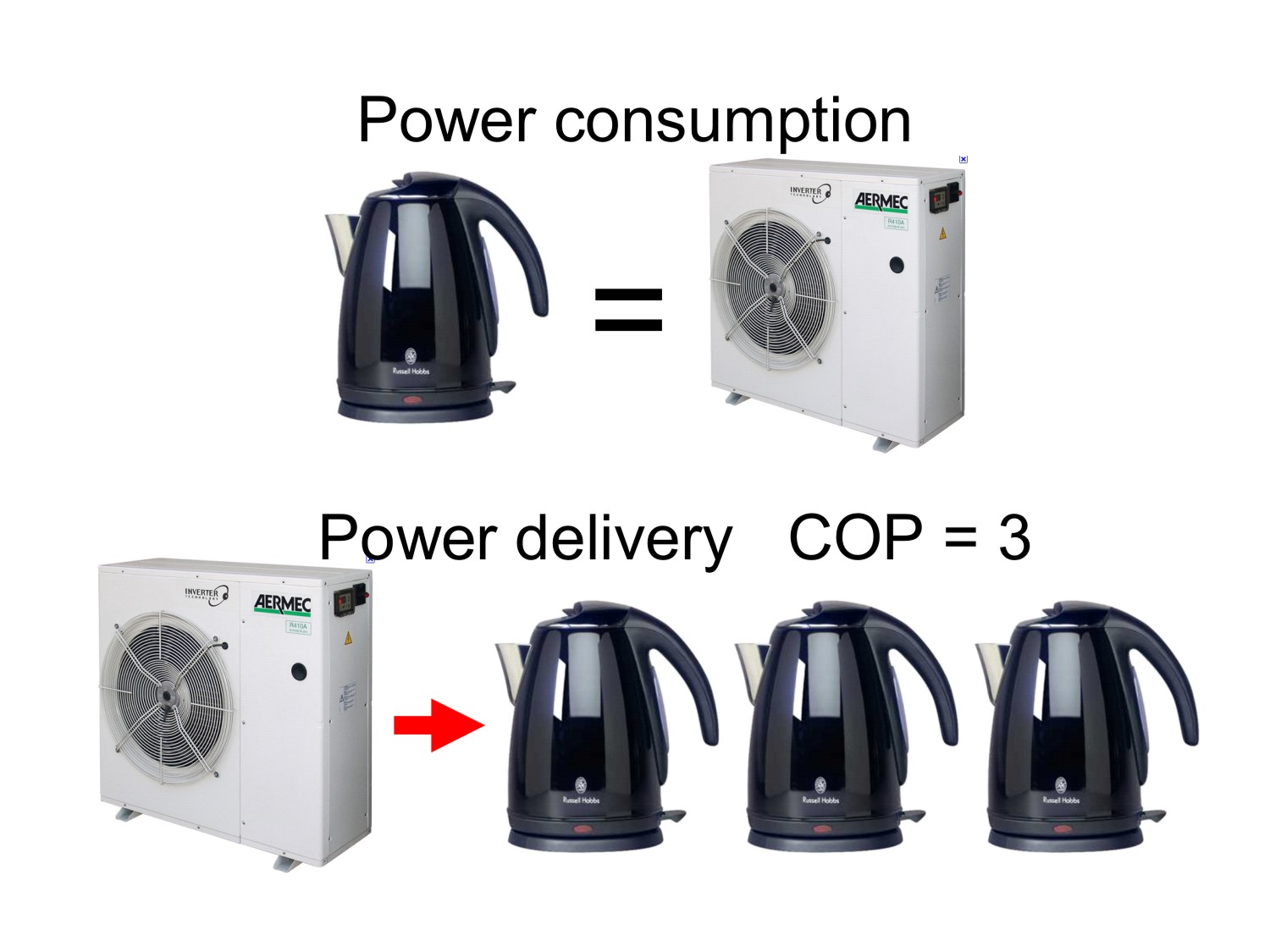
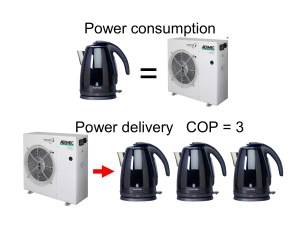
 A heat pump takes electrical power and delivers around 3 times as much more energy in the form of hot water. This engineering miracle might be the core of the system, but …
The power multiplier

The power multiplier

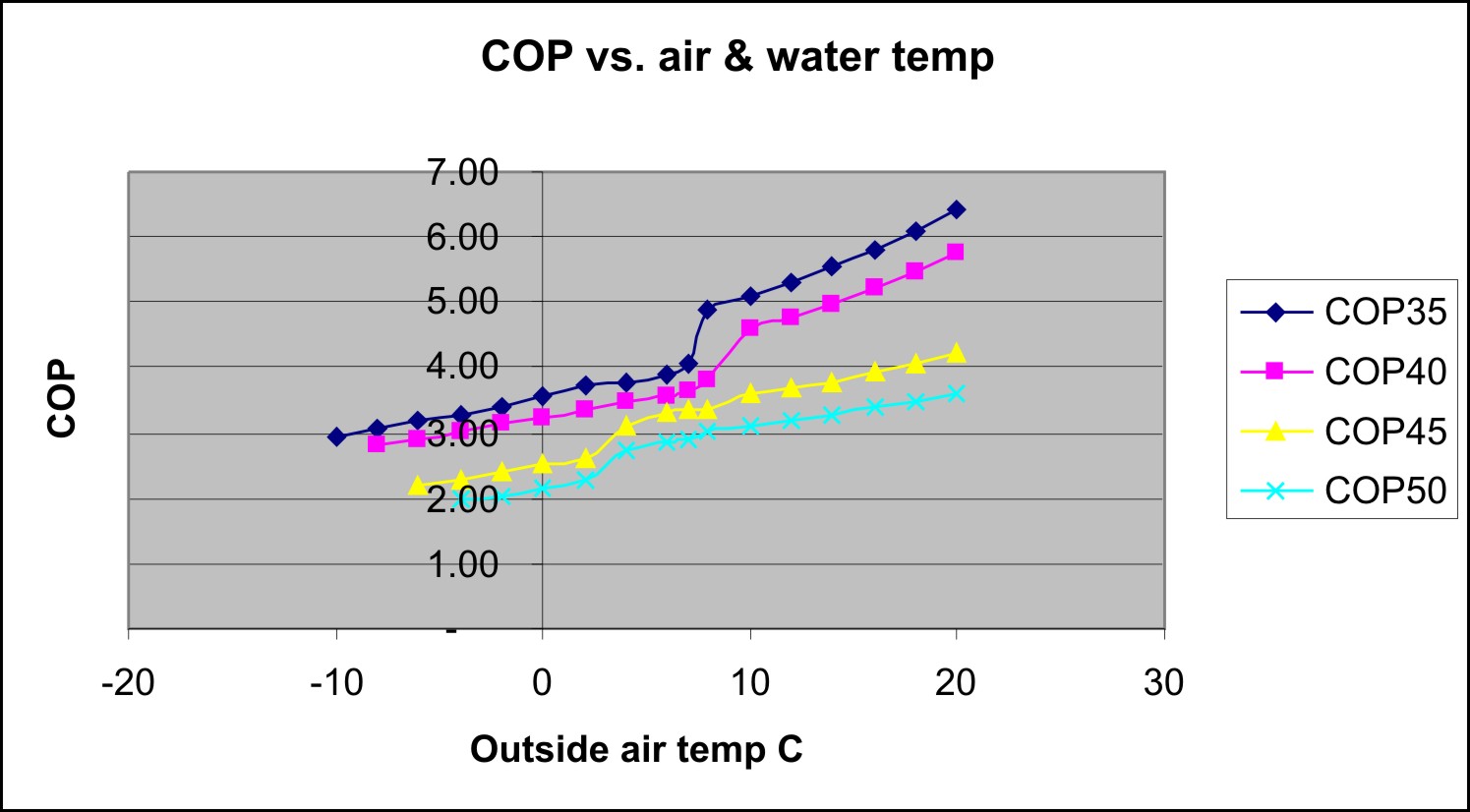
…. the times 3 trick (coefficient of performance or COP) is highly variable, and depending on outside temperatures and delivery temperatures, can vary from 2 to 5. The manufacturer’s quoted COP is for very specific conditions which you might not see very often.  Even the quoted power output of a heat pump will not be reached when it is very cold outside.


Air source heat pumps are a better choice than ground source heat pumps

They cost less and are easier to install. For the full argument see:-

https://originaltwist.com/2015/02/27/air-source-heat-pumps-and-the-renewable-heat-incentive/

https://originaltwist.com/2014/03/19/heat-pumps-in-southern-europe-air-or-ground/

Unfortunately the RHI payments are biased heavily towards ground source which will skew the decision. Even the government is confused about efficiency and we can punish their oversight with the Original Twist Hybrid Heat Pump … four tanks now – how exciting.

PV + heat pump = Free heating

A heat pump on a COP of 3 redresses the shortcomings of the PV panels on that bad day, so a PV and heat pump combination can deliver 300W for each panel and two or three times as much on good days.  This energy, in the form of hot water, can be delivered to underfloor heating which usually uses about 50W per square metre of floor and never more than 100W (which would make your feet hot).  So, for a rule of thumb, 8 PV panels will do 50 square metres of heated floor area. Then add up to another 10 panels to cover background consumption.

Two things to take on board at this point.

1/.If you are going off-grid your energy storage (in batteries and the water tanks) will tide you over for the bad days and the wood burning stove will always cover all the heating and domestic hot water demands.

2/. A popular size (and so a cheaper size) of PV rig is based around 6kW and this implies a matching 18 panels. Have a look at the overclock and tilt theme here to see why you’ll increase that to 24 panels.

Therefore, most self-supporting Eco-houses are likely to have 20 – 24 PV panels on the roof; a lot. The calculation for a Passivhaus is scaled back considerably; there might be no floor heating at all and just fan-coil units , even so there will still be a lot of panels to cope with the bad days.

Air source heat pumps run much more efficiently during the day when the air is warmer.

Not only more efficiently but combined with PV panels much of the daytime energy produced is free.  Obviously big PV and a slightly oversized heat pump can produce excess energy which could keep the heating on after the sun goes down. The surplus energy will need to be stored in tanks of water – big ones.

A house with high thermal mass will also work better in this respect.

Solar thermal panels are much cheaper and much more efficient than PV. and, given some sun, they do produce very hot and free high grade water heating. Cheaper P.V. panels are challenging this space but this system leaves both doors open. Massive solar is hard to manage and here again big tanks are part of the answer.

Solar thermal panels can be made to run more efficiently.

Solar panels can only heat a tank that is cooler than they are. In winter when the tank is usually already hot and solar is weak the panels often stop working altogether.  Given 2 tanks however – one hot and one cool – the panels will run almost daily throughout the year and this dramatically improves effective panel efficiency. The Original Twist solar stripper circuit decides which tank, or both together, can use the available heat more favourably.

A pair of 500 litre tanks are only 2m high and together under 1.5m wide.  Tanks up to 500 litres can be made of light gauge steel so they are relatively cheap and easy to handle. However there is a case for making the cooler tank 1,000 litres – it’s a cheaper energy store than batteries.

Gas boilers – not quite redundant for big houses

On the coldest night the heat pump with reduced power output and the lowest COP might be struggling, especially if it was sized within the limitations of single phase electricity. A gas boiler is a towering powerhouse by comparison, producing instant high grade heat at a low(ish) price. Hot water recovery times are just minutes and a shower could run hot forever if required.  For a larger eco-house, a gas boiler for very occasional use makes sense and ensures that there are no compromises to comfort whatsoever.

Under floor heating is not always best.

Bedrooms need to be heated quickly, usually briefly, and preferably not with a hot floor under the bed.  Floors of upstairs bedrooms are often reasonably warm already because they are above rooms which are heated all day so paying to heat them more makes little sense.  The answer for bedrooms is the fan-coil unit which is essentially a hot water powered fan heater. Not only will they heat the room in minutes, but connected to a suitable heat pump they will cool it as well.  Air quality can be enhanced by UV purification, a boon to asthma and hay fever sufferers.

Towel rails are different.

After your shower the towel rails will need to be on long after you have got up or gone to bed. The timing and heating requirements for towel rails is completely at odds with the rest of the system and they need to be properly integrated with a dedicated pump and timer.

Wood burning stove

Mankind has been sitting round fires for thousands of years; for many people it is unthinkable not to have a real fire in the home.  We are talking eco-heating here so an open fire is out of the question but a good stove is much nicer to live with anyway.  A big stove with a big view of the flames will be too hot for most rooms so it will need to be connected to the water tanks in order to take some heat away. That’s no bad thing as high grade hot water is not so readily produced by the heat pump. A well matched stove can usually cope with all the hot water and heating needs which relegates the heat pump to an auxiliary role and certainly means that smaller heat pumps can be used.

Controls

Although it is not an absolute requirement, the eco-heating system will work much better with a home automation system such as the Z-Wave Vera. The hot water circulation system, for example, can be activated by sensors in the bathrooms when they turn on the lights. Temperature sensors and relays to activate pumps and valves can be found in the Qubino Z-Wave flush relay which has a built in temperature sensor.  The destratification routine (see below) can be triggered by the integrated temperature sensor and the short pump runs monitored by a controller which easily copes with ‘if this then that’ situations.

Efficiency – the humbug

Just a reminder; the sun is free. There is no need to agonise over panel efficiency. Flat plate thermal panels are cheap and reliable so if you need more power just add more. Anyway, during the hotter months they are more efficient than evacuated tube types.

To store daytime heat pump production, the target temperature needs to be raised and that is less efficient than driving the under-floor heating directly. Again the pump is usually running free, courtesy of the sun, so the efficiency doesn’t matter.

Aircon and the renewable heat incentive

The RHI only applies to heating only heat pumps. If you want aircon you should add a separate chiller unit. The diagram above will only be a little different.


The Eco-heating system

Considering all of the above your ultimate Eco-heating system should be like this:-

Much of the suitable roof surfaces will be covered in PV and thermal solar panels.

An air source heat pump

Air conditioning via heat pump

Under floor heating on the ground level

Fan-coils in bedrooms

Fan-coils in some living rooms for air conditioning

A gas boiler (optional)

A twin tank heat store system. 1000 litres + 500 litres.

A wood burning stove connected to the tanks

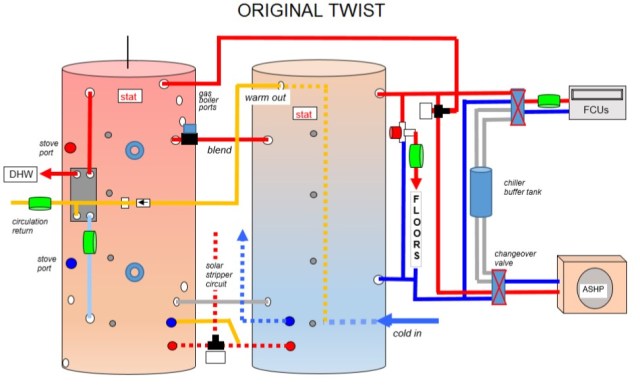
A system that can optimally integrate all of the above with no compromises at all is a tall order.  Here it is though; the Original Twist Eco-heating System.

Two tanks it is then – one hot one cooler – but with some sound thinking around the connections to the heat sources:-

Domestic hot water delivery.       

Fresh and pressurised water is heated by the hot tank via a plate heat exchanger – standard heat store practice. However, as the hot tank water will be rather modestly heated by the heat pump, the ability of the plate heat exchanger to cope with icy fresh water can be compromised. So to warm the incoming water it first runs through an internal coil in the cooler tank before getting to the external heat exchanger on the hot tank. The pre-warming is not mission critical so there are no controls or pumps to worry about. It’s just a passive coil in the cooler tank.

Back on the hot tank the usual temperature limiting valve – anti scalding – has been dropped in favour of electronic regulation of the heat exchanger flow pump with a Steca  TF A603 MC+ controller. This modulates the pump to give a precise output temperature and so leaves more water at the top of the tank ready for more showers. The flow out of the heat exchanger and to the bottom of the tank is also cooler which aids cooling of the solar coil.

Water circulation around the house is essential to save water wastage and eliminate that annoying wait for hot water.  The same Steca controller also regulates the circulation pump speed.

Preheating the domestic hot water via the cool tank not only makes a heat pump a feasible hot water maker but it also raises the efficiency in a subtle way. The water in the cool tank is heated just enough to supply the floors and fan-coil units and a heat pump does that very efficiently. Blending this cheaper energy into the hot tank system gives an efficiency boost and also allows the hot tank to be maintained a little cooler which gives another efficiency boost.

Other potential heat inputs to the hot tank (wood, solar and gas) are not disruptive to stratification so hot water drawn from the top is always ready for service.

The solar stripper circuit.

Solar thermal panels connected to a hot tank which is already hot – as it would be with a stove or heat pump keeping it ready for hot water delivery – will be effectively switched off in weak sunlight.  But given access to a cool tank they will leap into action at the first glimmer of sunshine, practically every day of the year. Low temperature solar flow addresses the coil in the cool tank first but as soon as it is hot enough it is switched to the hot tank. The flow emerging from the hot tank is usually still very hot so the return flow to the panels goes back via the coil in the cool tank to strip out some more energy.  The panels not only run throughout the year but more efficiently due to a cooler return feed.

The Original Twist Solar Stripper Circuit achieves all this with a special 3 port Coster valve that does not interrupt flow as it changes over. The solar pump is started by the cold tank sensor and everything is managed by the Steca TR 603 solar controller which also modulates the pump speed to keep flow temperatures up.

With two solar coils in use, a bigger solar array can be used without resorting to the absurd remedy of using an external plate heat exchanger and circulation pump. Absurd? Imagine sunrise, the panels and the pump start up, the tank is destratified and your morning shower is there no longer. Dooh!

Heat management

With high grade heat sources connected – wood burning stove and solar – the hot tank can get very hot. High grade heat is valuable so the system hangs on to it as long as possible but excess energy will have to be moved eventually. The system does this in 4 stages, each triggered by a cascade of temperature levels.

Destratification  – First the pump for the hot water plate heat exchanger is activated for short bursts. This moves hot water down the tank and effectively increases its capacity.  The process is limited to the maximum return temperature a wood burning stove can tolerate before the back boiler starts to kettle.

Blending the tanks – If surplus energy is still arriving, a valve connecting the hot and cool tanks opens and the cool tank starts to warm up via a thermosiphon. In this way a wood burning stove would provide for masses of hot water first and then go on to address the central heating. The valve sets to open in a power cut and is controlled by the overheat stat on the hot tank.

Overheat thermostat 2 – In the unlikely event of the cool tank reaching 70 degrees, the overheat thermostat starts the heating pump to dump heat to the heating system or a purpose heat-dump fan-coil.

Power free heat dump – As a last resort, and in the case of a power cut, a power free valve in the hot tank is activated to flow cold mains water through a small coil and send energy down the drain.  It is hard to envisage a system where this would really be required but the option is there.

Heat pump integration

The floors pump and the fan-coils pump first draw water from the tank, the repository for free energy. The heat pump starts when the tank temperature becomes too low and then the flow goes directly to the floors or fan-coils. The latter can only be achieved if the heat pump circulation pump flows slightly more than the demand pumps and there are a couple of ways to ensure that. When the heat pump is running under PV energy during the day it will top up the tanks or supply heating depending on demand. Heat pump set points to suit fan-coils or floors will be triggered by the relevant circulation pumps and by the PV output.

Controls

You might imagine that a sophisticated control system would be needed but that is far from the case as many of the functions are independent of each other with only temperature levels causing any interaction.  For example, the circulation pumps for floors and fan-coils are only activated by programmable thermostats which do not control the heating.  The heat pump is timed and only tops up the tanks if temperatures fall enough to call it, otherwise the wood and solar do the job. Destratification and blending are all independently triggered by temperature levels.

Simplicity is a major benefit. Should any problems arise there is no need to call in a specialist expert.

Who makes it?

In the first instance I will help you to specify and match the various elements of the system so that a bespoke specification is readied for production by the British manufacturer.

The system is based on a standard heat store with a few additions and those additions contain nothing new or untested.

Despite the simplicity this is the absolute cutting edge of Eco-heating systems.

Pre-wired and plumbed this is a quick and cost effective way to solve all your heating issues. The successful integration of wood and solar means a smaller and less expensive heat pump can be used with fewer P.V. panels to drive it. Considering all these savings and minimal running costs the Original Twist Eco-heating System is what every new Eco-house needs.

To see if this, or a single heat store, would be suitable for you just use the contact form and we can discuss your requirements.


The Original Twist Eco-heating system

Features summary

Stainless steel tanks – should last a lifetime

Total of 1,000 – 1,500 litres for energy storage

One cool tank for virtual stratification.

Mains water pressure is maintained but tanks are unpressurised

No hot water is stored – legionnaire’s avoidance

2 stage hot water heating for heat pump compatibility

130Kw heat exchanger for hot water making – more if required

Hot water circulation

Anti scalding

Suitable for solar input of up to 14kW

Solar stripper circuit for dramatically enhanced panel efficiency

Special large ports for wood burning stove gravity connection

Extra sensor pockets for home automation compatibility

DHW prioritised with energy overspill to heating

Condensing gas boiler optimised – controlled return flow temperature

Heat pump optimised and compatible with other heat sources

Heat pump COP raised through extra daytime running

3kW immersion for backup heating

4 stage safety system for energy control

A mix of under-floor heating, towel rails and fan-coils can be used

Fan-coils and a suitable heat pump can give air conditioning

Find more essential reading on my e-book, an easy download on Amazon. Over 100 detailed tips for less than the price of a pint!

‘Dream House – Down To The Details’

…. and check out the LIST OF POSTS for more like this

Go back

Your message has been sent

Warning
Warning
Warning
Warning

Warning.

Modern canal boat

click to enlarge

click to enlarge

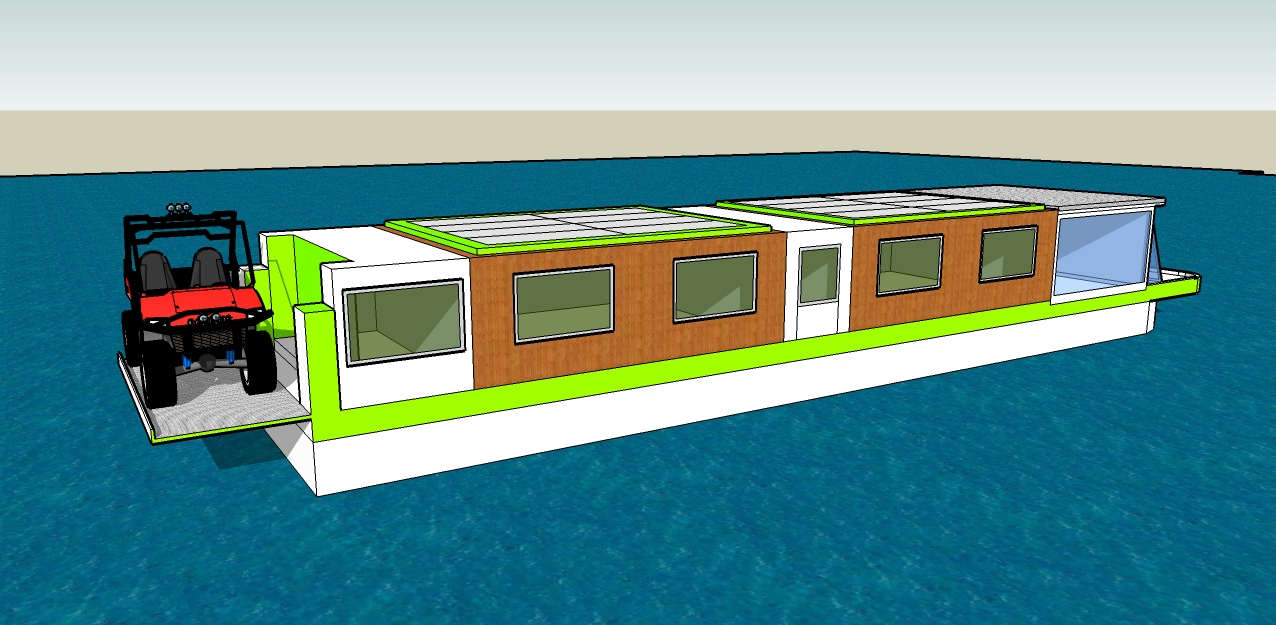
Introducing the Original Twist canal going house boat; in the style of a narrow boat only bigger, better and absolutely modern. As a living unit it presents an economical lifestyle choice. For around £160,000 you get very low cost housing and maybe some change left over for a holiday house, long ski breaks and other good things. A comparable land based house or flat would be twice the price because of the cost of land, a boat on the other hand effectively rents the river via the canal licence and avoids council tax. This one avoids energy bills too which is a good start.

A house boat might be small but as well as reduced outgoings there are some great advantages. You are never stuck anywhere you don’t like; if you need a change you can just cruise to somewhere else, maybe near a cosy riverside pub. River life can be like an aquatic pub crawl but without the driving. You’ll make more friends among the friendly and hospitable canal community too, especially with the most interesting boat on the water.
There is more scope for travel than just the English waters as you can get a tow across the channel to use the huge French network extending all the way down to the South of France where winters are not so harsh. Otherwise the house boat is an attractive proposition for a house swap so the whole world is your lobster.
It’s a tough life being retired!

The Original Twist Eco-house boat is all about, modernity, comfort and enough economy to make a modest pension go far. Many traditional boat ideas have been updated to achieve this.

Construction
Unlike a go-anywhere narrow boat ours is 10 feet wide and 55 feet long – we’ll forgo visits to a few stretches of narrow canal in exchange for a lot more room and the garage – yes that’s right, a garage.
The shell of the boat is normal steel but without the enclosing steel roof parts. The front saloon and the rear transom are full height steel as is the central bulkhead that separates them. The two open parts between the steel constructions are connected at roof level by tubular trellised ladder frames which run the length of the boat interrupted only by the central bulkhead. The open parts of the boat are then covered by 2 insulated wooden rooms made of plywood and foam panels (SIPS).which are factory prefabricated – complete with windows, pipes, wires etc. This makes the boat lighter, cheaper and better insulated.

The two central living spaces house the kitchen a bedroom and shower room, all with heated floors. Each has a large pop-up roof (just like on a camper van) to give a more spacious feel while being flattened whenever a low bridge is encountered. These roofs carry the solar panels and can tilt sideways in either direction to catch the sun – the simple mechanism to switch hinge points is activated by the flick of a switch – an air cylinder shoves a cradle from side to side.
The steel and glass front saloon is very light and airy with a door giving access to the front deck. Standard fan-coil units are turned on end to make a pair of powerful demisters for the huge windscreen and to heat the room too.
A flat sun deck on the roof of the saloon makes a great place to watch the world go by and as we shall see later the boat can be steered from up there too.
The steel rear transom accommodates the propeller shaft, engine mounts, rudder mechanism, a niche for the air source heat pump.  A tail hoist mounted across the back (like on delivery trucks) supports a light vehicle such as a Polaris RAZR side by side.  After adjusting the height the ramps are dropped and locked onto a nearby bank so one can drive off in style and comfort. What is life without wheels?  Because the hoist can be folded up, the length of the whole boat can be shortened to navigate some of the tighter locks. An awning can be extended over the vehicle and there we have it; the first house boat with a garage.

Eco-tech
The real point about eco-technomologicalness is to get along as cheaply as possible without damaging the planet. The 20 solar panels on the top produce a nominal 8kWp; a lot more than most domestic arrays and enough for the small air source heat pump and to charge the batteries for the electric hybrid drive system. The hybrid drive is almost identical to that on the Original Twist hybrid 3-wheeler found on this site; here with a Lynch motor and a Kohler water cooled diesel. The usual benefits of a hybrid drive are there; the batteries give a few hours silent cruising and the diesel can take over indefinitely. The batteries are mostly solar charged or sometimes diesel engine charged with the Lynch motor doubling as a generator. Many moorings supply electricity so the batteries can be charged on cloudy days. With the air source heat pump the heating will run cheaply and conveniently off connected electricity or the batteries.  So there are 3 sources of heating power; the PV panels, outside electricity and engine cooling . Most boat engines are cooled by river water but here a second coil in the heat bank uses the 60% of wasted heat to make hot water. There is no connection to the river or the gunk that blocks up the filters (boat owners nod knowingly here).
Heating is supplied by the little 2kW heat pump which delivers about 6kW. N.B. River water is not used as the heat source. See ‘Air source heat pumps in Southern Europe’ also on this web site. here
Notable omissions are a wood stove and any gas as there is no need for either. Cooking is all electric.

Controls
Control of all the lights, heating, entertainment and even the steering is done by i-pad and Z-Wave meshed radio modules which are cheap, reliable home automation items. Narrow boats are usually driven from the back, a bit like a bus driver standing on the rear bumper. We can sit at the front in the saloon and steer from there or from anywhere else within range of the wi-fi; perhaps the sun deck even from the nearby pub! The Z-Wave controller allows for plenty of home automation tweaks like lighting control, security and leak detection, all from anywhere in the world. Theoretically the boat can be driven from anywhere there is an internet connection.
Actuators to move things like the roof panels and the rudder are operated by compressed air which is cleaner and easier to maintain than hydraulics. An i-pad and Z-Wave relays makes child’s play of these things; even a simple dimmer switch allows proportional control of the rudder.  The motorised satellite dish also needs to fold into a recess in the centre section when a bridge is encountered.

Neat extras
To make the kitchen a great place for eating while admiring the view the picture window on one side tilts up and out and a table is pushed outwards to make use of the outside space. Once parked up an extending awning over a drop down side deck, complete with an extending Barbie unit, makes an outside cooking area.

Central dust extraction – The centre section houses a fixed dust extractor plumbed to outlets around the boat to make cleaning much easier.

With a boat like this life will certainly be rich and varied.

ECO-HIPPY – One who is sufficiently off-grid to live almost cost free.

More on this topic in LIST OF POSTS

Go back

Your message has been sent

Warning
Warning
Warning
Warning

Warning.

Silent PC

Top view

Top view of the case

Fanless PC case by Original Twist

A totally silent Mini ITX PC case made from low-cost, off the shelf components with an easy progression from prototype to large scale production.

Things are moving on in the world of desktop computers; they should be cheaper and simpler, but, would you believe it, they’re not. Why?

Main CPUs run much cooler and use less power so, unless you need a powerful gaming rig, you don’t need big fan cooled power supplies or case fans. Heat pipes can remove all the heat most CPUs make.

Solid state discs (SSDs) are cheap and clip neatly into the motherboard M.2 slot. Hard drives are not required at all when data is stored in the cloud.

Delete the SSD and HDD parts on the drawing and what is left? Just a mini -ITX motherboard and (maybe) an open power supply; two components then.  No moving parts, no noise and much less cost.

The Original Twist fanless PC case

The extruded fin case side is glued onto extruded aluminium corner sections; both are available from stock.  The corner sections have slots to accept side panels in any material – the blue parts on this drawing could be marble, for example, or wood.

The huge finned extrusion makes one side of the case.  By huge, I mean really huge. 40mm deep and 160mm wide with a 10mm thick base all ready for embedding 6mm heat pipes. Heat transfer is via 6 heat pipes.

There are multiple disc drive mounting options opposite the motherboard and also higher up the case if required.

The open case power supply (PSU) is mounted low down in the side channel extrusion.  Any heat produced from this and the motherboard drives the updraft.  The case is deliberately like a chimney and needs a bit of heat to get going.

Cooling

Side view

Side view

The Magic Power (PSU) in the drawing is only 80W so we’ll probably drop that. A better solution will be a Pico-PSU i.e. an external (sometimes internal) brick with internal ATX distribution leads. The case can easily cool the 65W of the popular Core i5 8400 which will make a very high performance machine at a reasonable price. The 6 heat pipes only use the top half of the case.

When standing up the tall chimney case draws air up through the bottom and expels it at the top so cooling is effected both inside and outside the case. The aluminium corner extrusions are part of the heat sink and are bonded on with heat transfer glue.

The finned  clamp for the heat pipes on the CPU sits neatly in the airflow as do the heat pipes on their path to the side wall. The mother board, mounted at the bottom of the case, heats the air at the lowest point. Full height cock’s-comb RAM coolers also heat the air low down and the same for clip on fins on the SSD.

Case size 124.5 x 240 x 375mm

The components dictate the shape.

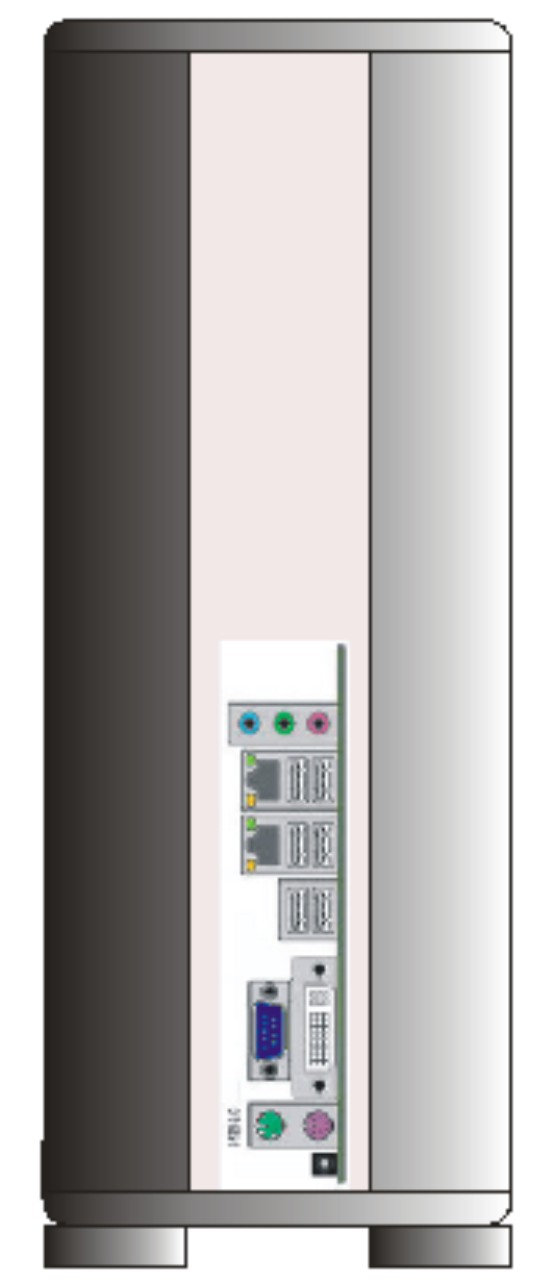
Width – the I/O shield between 2 corners

44.5+40+40 = 124.5mm.

Side length – the finned extrusion between 2 corners

160+40+40= 240mm

Height/length – 170mm motherboard with space for HDD above and masses of heat sink

375mm.

Design notes

The corner extrusions come with threaded inserts for the ends and these are used to bolt on the top and bottom plates.

4 big round feet enable the start button to be fitted in the base plate as well as the ‘power on’ LED and an angled power plug.

The radiused corners on the end plates match the case style.

Market position

There are many contenders for this silent PC slot but they are generally expensive and don’t have as big a heat sink. They are computers with heat sinks – ours is more a heat sink with a computer attached.

The beautiful, contrasting black and aluminium finish looks truly modern making this ‘the computer you want’ and in every way better than ‘the computer you need’.  Design flexibility allows the non cooling sides to be in various materials such as wood, aluminium or marble, none of which requires special tooling to produce.

Flexibility

This case provides excellent flexibility for product variation and expansion. The side panel with the I/O plate is long enough to mount DVD players or removable drive bays.

Marketing

Our philosophy is simple. Cut waste and spend the difference on better components.

Designed in solid aluminium this PC brings you beautiful modern looks that reflect the quality and performance of the internals.

To bring you the best value for money with absolute reliability we removed all the moving parts. All discs and fans have been replaced by top quality components to bring you the best value, high performance, totally silent PC.

The solid state drive gives exceptionally fast boot times and application loading.

Super fast USB-3 ports are available for you to plug in your external media storage devices or there is room inside for a hard drive.

The side plate holding the PSU can also house an optical media drive bay (41x146x185mm- dotted line on the drawing). A blue ray player built in makes the perfect HTPC.

The Technical stuff  below … read on if that’s your thing

Assembly

heat pipe layoutThe computer is assembled with the finned side down. The heat pipes are cranked down once clear of the motherboard and are pressed into the machined slots in the side. After that the PSU channel and the opposite face plate are fitted along with the I/O plate.

Any SSDs or HDD are screwed onto the lid with their looms running neatly up the side so as not to impede airflow. This lid and attached corners then bolts on and finally the end plates hold it all together.

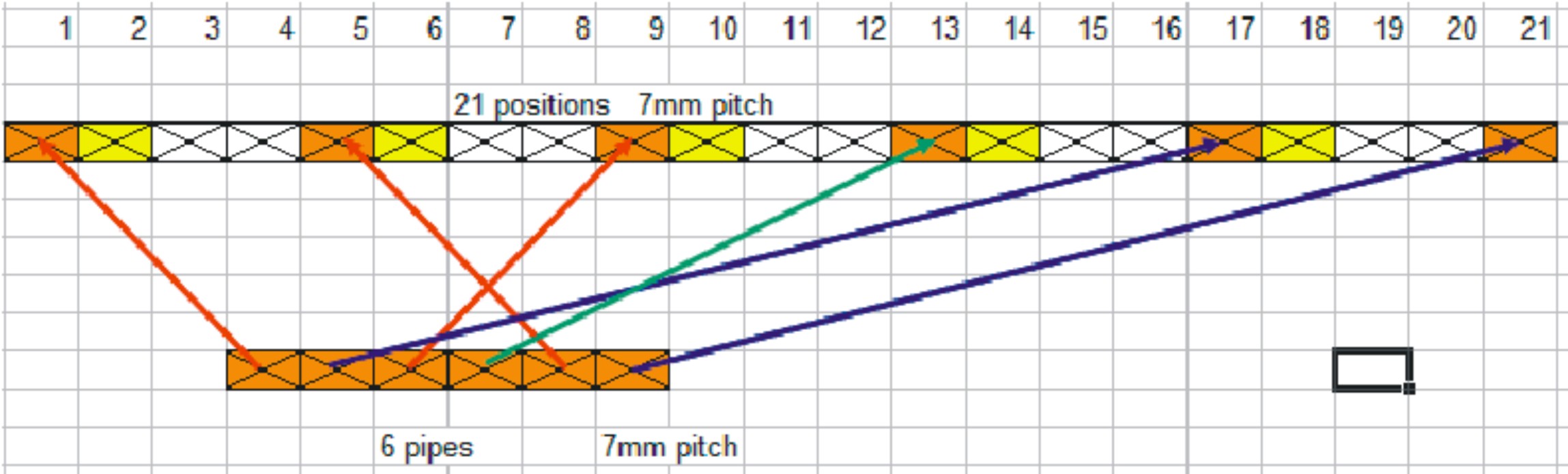
The bending of the heat pipes is fairly minimal but it is, none the less, quite critical. The sketch above shows how just 3 shapes of bend are needed to fit all six pipes. The yellow positions show where additional heat pipes could be laid to increase the effective heat sink. The pitch of the heat pipe slots on the heat sink have to be exact multiples of the pitch on the CPU block.

Thermal performance calculations

The 6 heat pipes on the CPU block can remove at least 15W each and almost double that with the case in the upright position. Additional air flow through the case in this position will also remove some 10W from the CPU heat sink. So the pipes can remove well over 100W but, of course, we need to dispose of this heat through the case.

The heat pipes only lie in half of the finned side and the manufacturer’s figures suggest a DegC/W of 0.45 for this length. With the CPU at 50C and a room at 22C we would be looking at 65W cooling power which is in line with the 65W Core i5 8400. Actually CPUs can run much hotter and the cooling power would be equally higher.

The heavy aluminium heat sink side has plenty of room for five additional heat pipes to be placed between the existing ones and with heat pipes embedded along its entire length the case would be able to remove around at least 80W.  It is hoped that the case will be able to lie flat for 55W chips and be good for practically anything while standing up or on a VESA mount. The added cooling power of the corner extrusions has not been taken into account in these calculations so real world performance should be much better than indicated.

Theory is all very well but we can be sure by comparing with several existing silent PCs which work perfectly well. The Original Twist design has cooling surfaces of around 5 times that of the others so this should be the best of its kind. Some PCs have heat sinks; this PC is a heat sink!

This case is not in production yet. If you would like to own this design and the business of producing it please get in touch using the Original Twist contact form.

Go back

Your message has been sent

Warning
Warning
Warning
Warning

Warning.

Magic disappearing table

Now you see me

Now you see me

Now you don't

Now you don’t

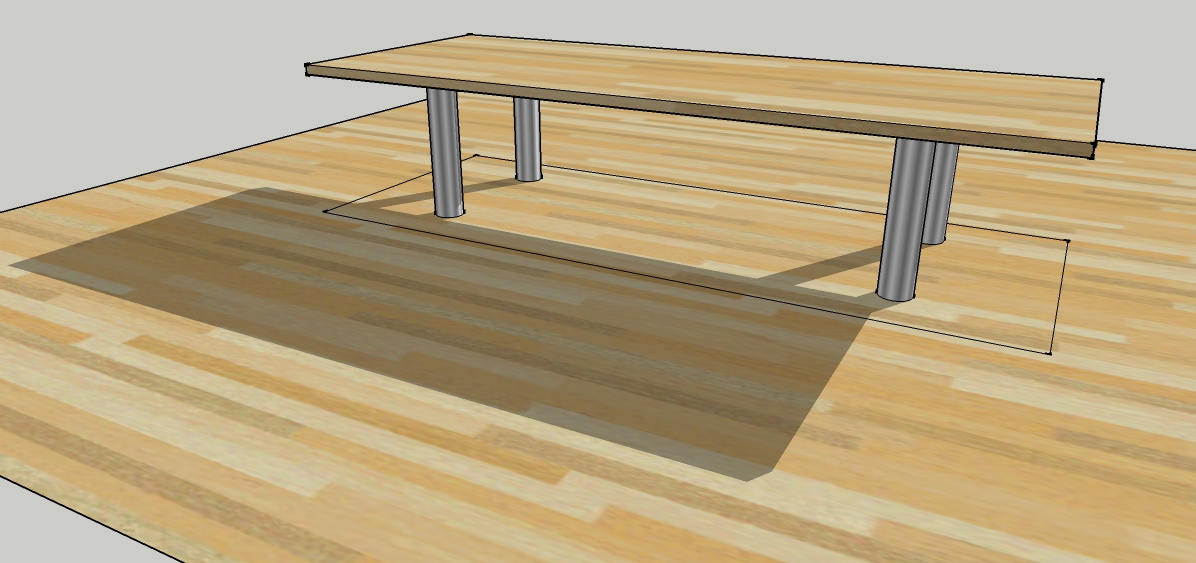
You’ve been one of eight guests for dinner in a very modern eco-house. You all dined on a lovely heavy wooden table standing on four polished steel pillars; all very much in keeping with the modern house. You help to clear away the last plate into the kitchen and when you return 10 seconds later the table has completely disappeared. What? Your hosts were in the kitchen too so where has it gone?
OK, here’s the secret of the Original Twist magic table, and strangely, to make one table disappear you need 2 tables. Every conjuring trick needs a secret prop.
To start with imagine the original floor – for me, wide lime-washed oak boards – and this is where the table starts off; at this moment it is the floor. Underneath there is a small pit just big enough to accommodate the 4 steel pillars the bases of which screw into a rectangular frame which is raised and lowered by screw jacks and an electric motor. To go techie for a moment, there is an upper frame too with big DU bushes in blocks to steady the legs. When the floor/table is raised up you don’t see a hole in the floor because immediately under the first table there is a second identical floor section with 4 holes through which the legs move. When the legs base frame comes up to the top of the pit it pushes the second floor up to exactly the right height and the illusion is complete. The table has appeared from nowhere and the floor is exactly like it was before.
Hygiene would be an issue but with a rubber backed rug over the floor the table will never have been walked on and double protection would be afforded by a tablecloth as well.
Servicing can all be done from above and would be even easier done from below if the pit had a side hatch accessed from the floor below.
There is more to this concept that the sheer theatre of it. The easy removal of a substantial table makes grand entertaining in a downsized house all very possible without having that old hat idea of a largely unused dining room.
There is a business waiting to be started here. Precast pit and frames etc waiting to be fitted to the floor. If you are interested please contact me on the form below.

More on this topic in LIST OF POSTS

Go back

Your message has been sent

Warning
Warning
Warning
Warning

Warning.