You’ve been one of eight guests for dinner in a very modern eco-house. You all dined on a lovely heavy wooden table standing on four polished steel pillars; all very much in keeping with the modern house. You help to clear away the last plate into the kitchen and when you return 10 seconds later the table has completely disappeared. What? Your hosts were in the kitchen too so where has it gone?
OK, here’s the secret of the Original Twist magic table, and strangely, to make one table disappear you need 2 tables. Every conjuring trick needs a secret prop.
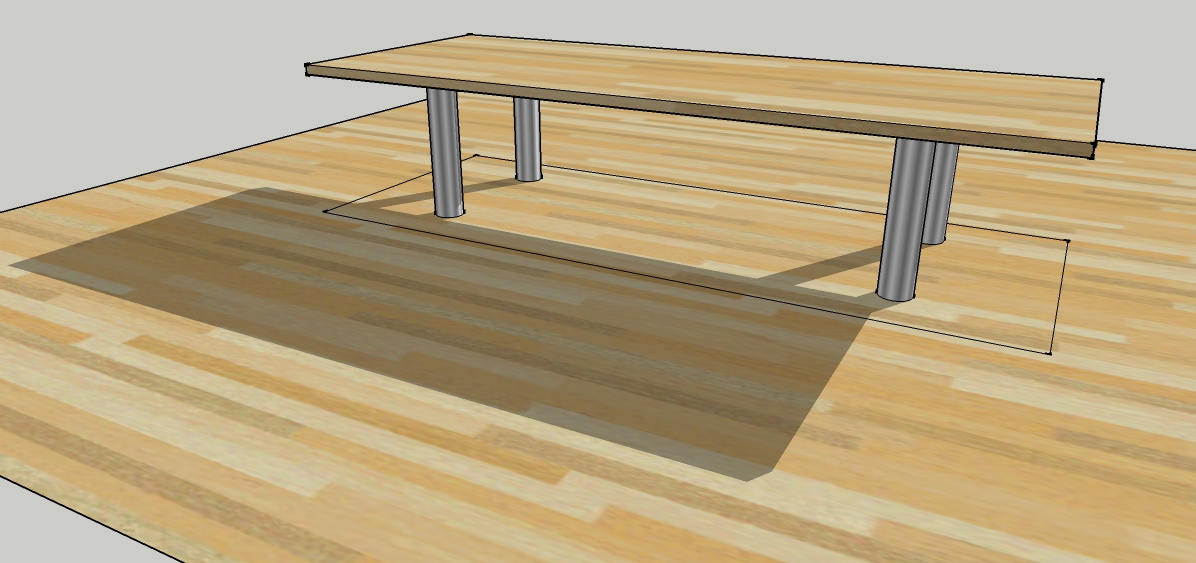
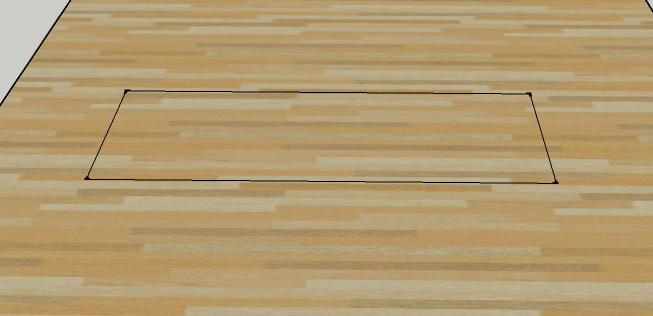
To start with imagine the original floor – for me, wide lime-washed oak boards – and this is where the table starts off; at this moment it is the floor. Underneath there is a small pit just big enough to accommodate the 4 steel pillars the bases of which screw into a rectangular frame which is raised and lowered by screw jacks and an electric motor. To go techie for a moment, there is an upper frame too with big DU bushes in blocks to steady the legs. When the floor/table is raised up you don’t see a hole in the floor because immediately under the first table there is a second identical floor section with 4 holes through which the legs move. When the legs base frame comes up to the top of the pit it pushes the second floor up to exactly the right height and the illusion is complete. The table has appeared from nowhere and the floor is exactly like it was before.
Hygiene would be an issue but with a rubber backed rug over the floor the table will never have been walked on and double protection would be afforded by a tablecloth as well.
Servicing can all be done from above and would be even easier done from below if the pit had a side hatch accessed from the floor below.
There is more to this concept that the sheer theatre of it. The easy removal of a substantial table makes grand entertaining in a downsized house all very possible without having that old hat idea of a largely unused dining room.
There is a business waiting to be started here. Precast pit and frames etc waiting to be fitted to the floor. If you are interested please contact me on the form below.
First the bad news for heat pumps. The Energy Saving Trust heat pump survey in 2009 found that many users were not impressed at all. The follow up in 2013 improved the results but the final average system COPs of 2.45 (air source) and 2.82 (ground source) were still way below the headline figures quoted for these machines a lot of which are claiming over 4 these days. So maybe heat pumps are intrinsically good but tricky to install?
Despite all that, what is really good about heat pumps is that they can deliver more energy than they consume in electricity.
The power multiplier
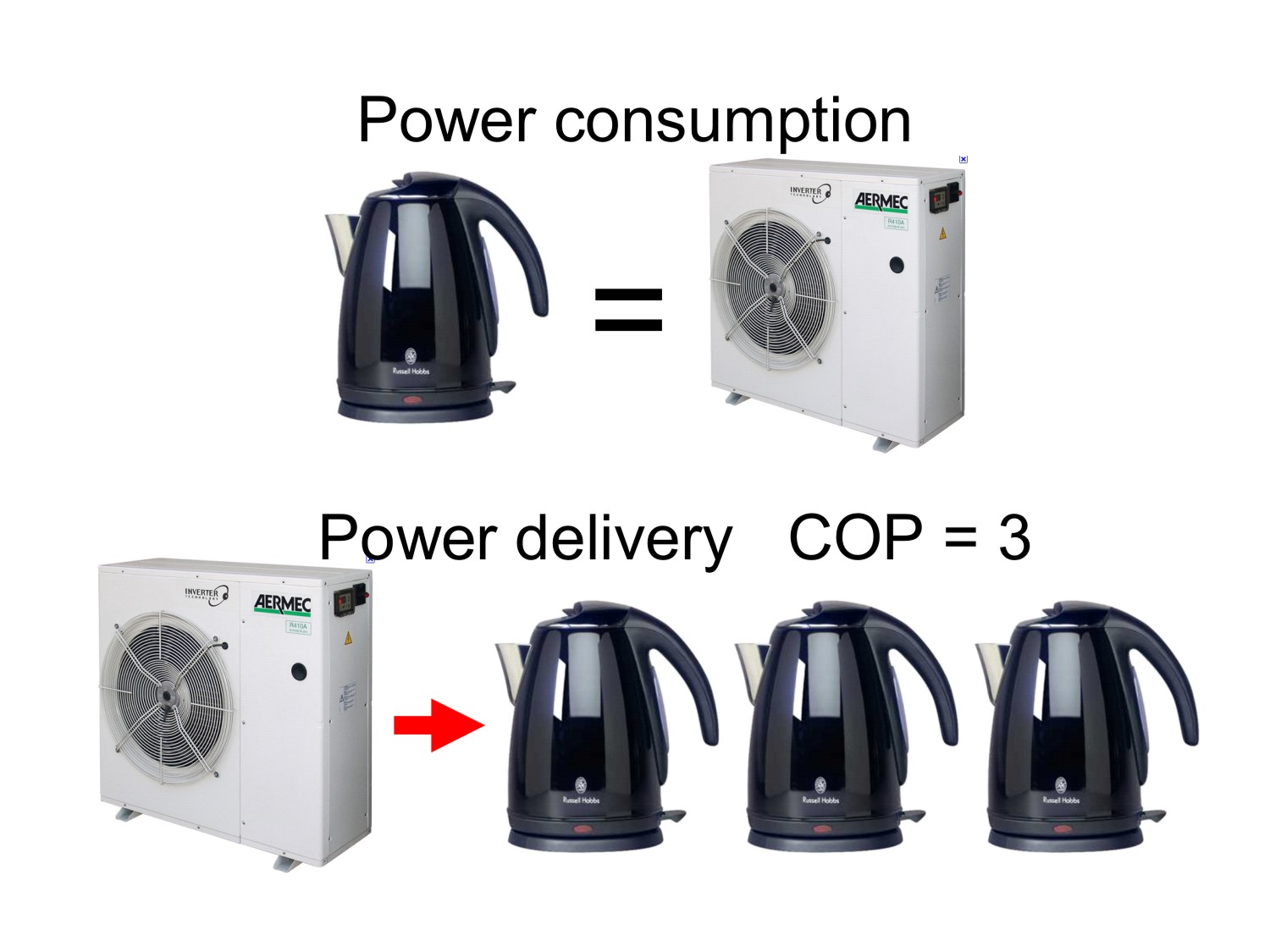
So a small one would be just like this; working on the power of an electric kettle but delivering the power of 3 to your hot tank – a COP (Coefficient Of Performance) of 3 then. By contrast your immersion heater delivers and also consumes the power of an electric kettle so it has a COP of 1.
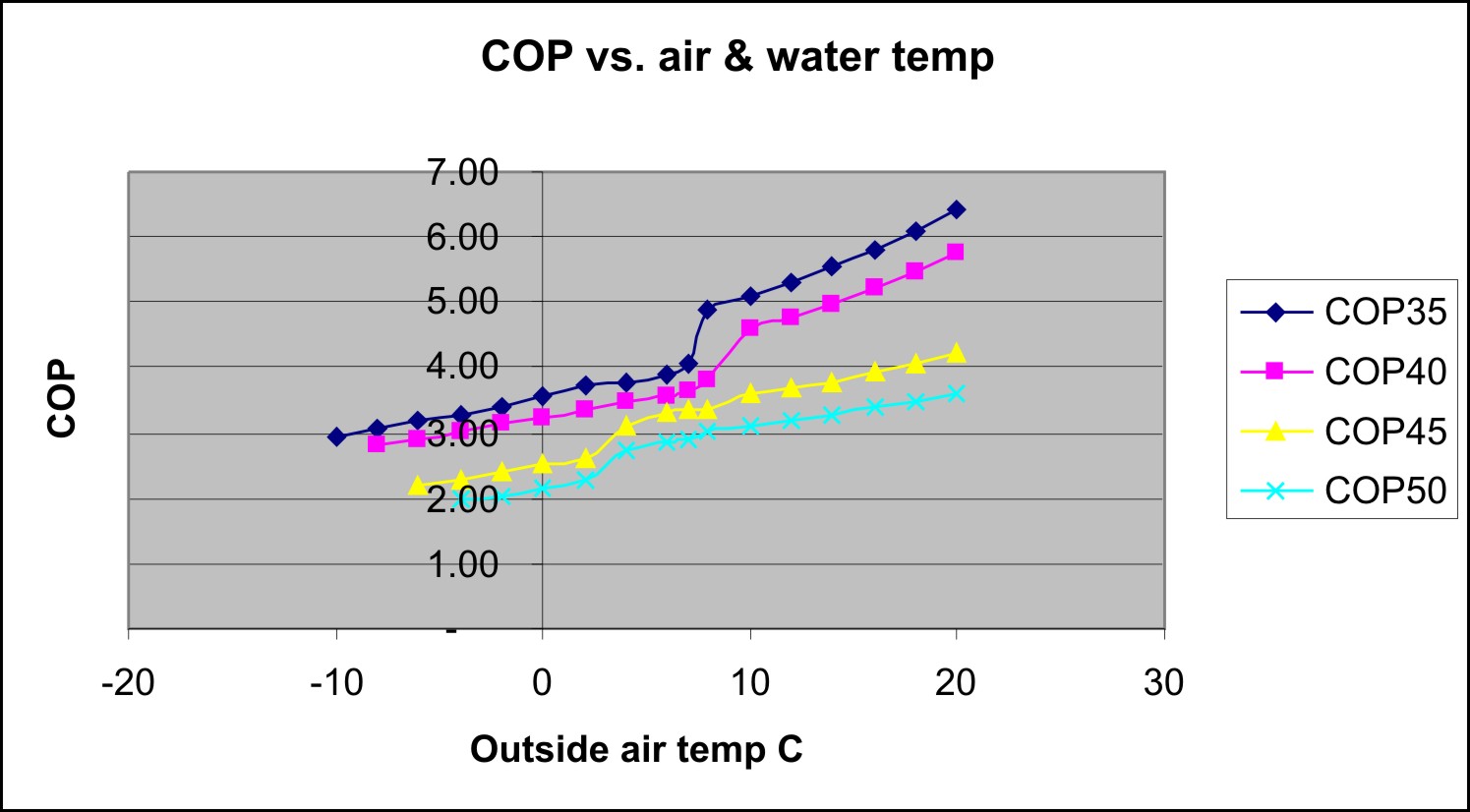
Heat pumps are all sold with an industry standardised COP. This is misleading to say the least and the reason why optimism is defeated by experience. Far from being a fixed figure the COP actually swings widely depending on outside air temperature and temperature delivered in the home. The COP plots here show how a kick is engineered to give a good headline figure; that kink in the graph is exactly at the publication point.
A sneaky kink
You might buy a machine with a quoted COP of say 3.75 but while making domestic hot water on a cold night it will be working at less than 2. There are benign swings however and given a sunny winter day with some warm air to chew on an ASHP can see COPs almost up to 5. You can see this on the dark blue line on the graph. Delivering 35c water to the underfloor heating the COP goes over 5 as the outside air goes over 10c. Note that the pale blue line (delivery temperature 50c for radiators) still only goes to around 3 so for most of the time the average COP will only be near 2.5. So, heat pump with radiators – think carefully.
Gas per kW.hr costs about a third of electrical power so after adjusting for efficiency a gas boiler is similar to a heat pump with a COP of 3. Many people in the survey would be comparing their new heat pump to a gas boiler; a formidable opponent when running on cheap gas. A gas boiler is much more powerful than most heat pumps and delivers at usefully high temperatures so a heat pump must have an overall COP of over 3 to justify a hefty purchase price. Perhaps the performance could be lifted further?
The next bit is a bit dull – you might want to skip on to conclusions below.
To winkle out some ideas we’ll take daily temperature data for January in Guildford (http://www.wunderground.com/) and relate that to a COP matrix made from the published data from a modern ASHP (inverter drive scroll, r410a, delivering to under floor heating at 35 degrees). We will be looking to lift the COP by running the ASHP at the warmest ambient temperatures possible. A look at a January temperature trace shows: There is usually a 5 degree swing between the mean night time temperatures and the daytime mean. Night time temperatures are flatter and longer than the sharper daytime peak at 1-2pm. The morning transition from lows to highs is halfway there by 10am. Temperature rises coincide with sunrise, not surprisingly.
Relating the above to the COP matrix: Running a 7hr shift from 10am gives an average COP of 3.86 – much better than gas. The equivalent night time shift only gives a COP of 2.92 – but almost as good as gas. If the pump has to make hotter water for radiators these day/night figures drop to 2.7 and 2.11 and for 55 degree hot water making 2.3 and 1.85– gas beats this hands down. Storing daytime running means that delivery temperatures probably need to be around 50 degrees leading to an average COP of under 3 although bigger storage tanks improve this. ASHPs can be smaller if they run continuously day and night on an average COP of 3.4 – still 13% better than gas. Direct electrical heating is often used to boost hot water making (COP = 1) and this can lower the average COP. If we can avoid this practice and run predominantly in the daytime it should theoretically be possible to get a COP of 3.35 (7hrs day, 2hrs night, 2hrs hot water).
Transmission: Put 100W/square metre through your floors and your feet will be uncomfortably hot so somewhere near half that will be a good yardstick for calculating the power you need.
Conclusions A small ASHP can run a bit more efficiently than a gas boiler in a modest well insulated house. Fan-coil units in bedrooms and underfloor heating elsewhere are essential. The heat pump should run in daylight except maybe for a boost before dawn to guarantee morning showers and take the chill off the floors.
Of course, with PV solar panel prices falling relative to electricity prices, the time is coming when your heat pump will run for free while the sun shines. At the moment it looks like we are firmly in no brainer territory and it is certainly worth checking now to see how the sums stack up.
A tip to make your heat pump installation cheaper. Use the PV panels and an energy diverter (e.g. Eddi) to heat your existing immersion heater. then you won’t need the special tank to accompany the heat pump which will just do central heating. Your installation might get a lot nearer to the £5,000 grant.
And while we are at it, don’t forget to consider a mini-split heat pump air conditioner; It’s an air to air unit that makes heat as well as cooling. They are relatively so cheap it’s hard not to go and get one right away. I did, bought and installed for under £1,000.
so, probably nothing conclusive so far. Have a look at ‘off-peak energy storage’ and you’ll instantly become a heat pump convert.
This idea was first published here in 2015. A pity there has been no interest. Remember that long Russian convoy menacing Kviv? What if a few hundred drones had blown the tyres off those vehicles and any supply vehicles?
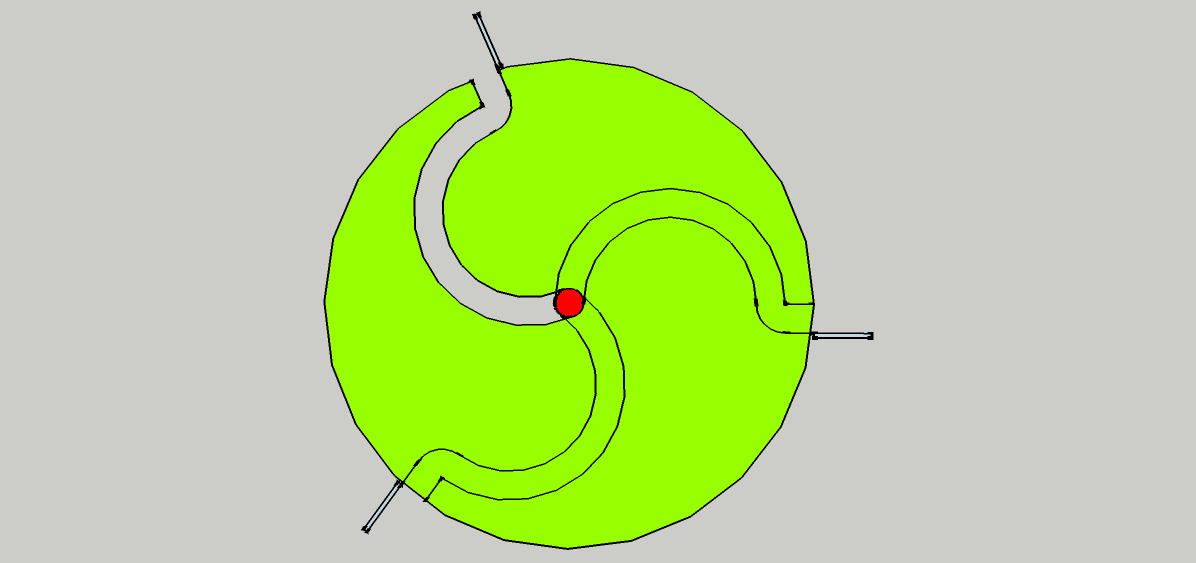
The Original Twist concept looks like a fat Frisbee or puck, at least it does for the first few hundred metres of flight with not an arm or propeller in sight. Transportation: The propellers and arms are all tucked safely out of harm’s way, folded into the base of the puck. The folded puck can then be handled roughly and easily stacked up in racks. Launching: Here lies the real Original Twist. As you will see in the launcher description below, the robust pucks can be flicked out like clay pigeons at the astonishing rate of 600 a minute. There is no battery power used for taking off, getting under way and reaching height which adds to their range. Neither is there a warning howl as hundreds of drones start up, just a line of discs silently darting across the sky to a location away from the launch site and therefore no giveaway of the origin. At the end of the launch trajectory the propeller arms flip out and the journey towards the enemy continues using onboard GPS. The propellers sit at a slight angle to the body so that when in flight the puck is perfectly aligned to the airflow. Reduced drag with some lift from the domed top allows a good range of at least 12 miles which allows one launch vehicle to cover an area of over 400 square miles. Attack: The quadcopter/puck bodywork is made of moulded plastic explosive so they are very much like intelligent flying bombs. They can, for example, fly to a given location and using infra-red cameras locate human sized heat signatures for immediate targeting; no sniper will be safe from being blown out of his hiding place. Pucks can communicate with each other and with the host computer using a meshed network where signals are passed down the line. Other pucks can be programmed to cluster into a much larger bomb before simultaneously exploding. Pre programmed pucks will be immune to radio jamming and execute their missions come what may. Tactical use: The near silent deployment can have a myriad of other uses. Surveillance from on high or with sound and vision lying on the ground, simulated radio transmission sources to attract enemy fire, diversionary attacks from various directions and overhead flares to light up the enemy. They can even provide ‘Shoot me’ targeting information to overhead drones and airborne weaponry.
What could be more demoralising to the enemy than intermittent attacks from the air at no significant cost or risk to the other side? The biggest fear will be a ‘Cluster puck’ attack where several successive droves are launched and are resting on the ground nearby in preparation for a massive orchestrated attack.
A set of pucks with an affinity for vehicle wheels could be launched and without any difficulty a whole convoy of vehicles could be stopped in its tracks, or what’s left of them!
A major comfort to troops in hostile territory will be escorted manoeuvres. Protection from ambush is provided by pucks flying apparently random recce patrols but in fact checking ahead for any heat signatures.
Drone warfare will cause a change to military clothing; a wetted and cool outer shell being necessary to avoid being ‘seen’ by a drone’s camera. Even so, once terrain has been optically scanned any changes in position will highlight potential targets. If a drone flies over your hiding place it is likely that you will be attacked by the next one if you move. Computers and drones together make awesome weapons and there is no doubt that ground based warfare is about to enter a new era.
The puck launcher
Imagine a Landrover carrying a few thousand pucks in racks and on the roof a 6 foot diameter Catherine wheel spinning at 600rpm (car engine tickover) and flicking out up to 5 pucks a second at a launch speed of 120mph. The pucks are introduced into the calm middle of the wheel from an overhead magazine and then nudged sideways into the 3 radial arms where they queue to be released onto the extended launch ramps where they accelerate out to the open edge and away. They gain spin from the friction side of the launch ramps which initially swing out under centrifugal force to make the diameter bigger. The curved channels enable more pucks to be in the queue and also ease the centrifugal force at the end of the curve where the release catch is situated.
The loading magazine is itself fed by conveyor that has passed through the arming station. Here a fresh battery, much like a small puck itself, is fitted into the middle of the puck while the mission computer installs targeting instructions via blue tooth.
No other system will deploy quadcopters this fast and it may even be necessary to slow it down.
Pucks not on suicide missions will return to land on a wide conveyor belt on top of the launch vehicle and from there mechanically re-folded, de-batteried and added to the stack heading for the launcher. In this way it will be possible to have hundreds of drones permanently out on various tasks. Separating the charging function makes long term storage very much easier and every puck receives a freshly charged battery just before taking off. Once deployed returning pucks can be re-batteried and launched back into the fray on a continuous basis.
With theoretical launch rates of a mind boggling 600 a minute there would never be time for a person to decide on the mix of missions being fed into the pucks just before they are launched. To do this efficiently the mission computer receives more generalised commands from several operations directors and these are collated and then automatically programmed onto the pucks.
Of course the puck concept is perfect for aerial launching too – no need for the launcher, just eject boxes of them to glide under low power for great distances. You would never see or hear the plane that launched a mass of pucks at you and it would be 100 miles away when the pucks arrive.
So to anyone who is not smelling the coffee yet here’s the question: Would you commit troops to a ground action where they can’t move, can’t hide, where attacks come relentlessly from every direction, where vehicles aren’t viable and all these things are cheaply applied by an enemy who, barring one launch vehicle, is immune to retaliation?
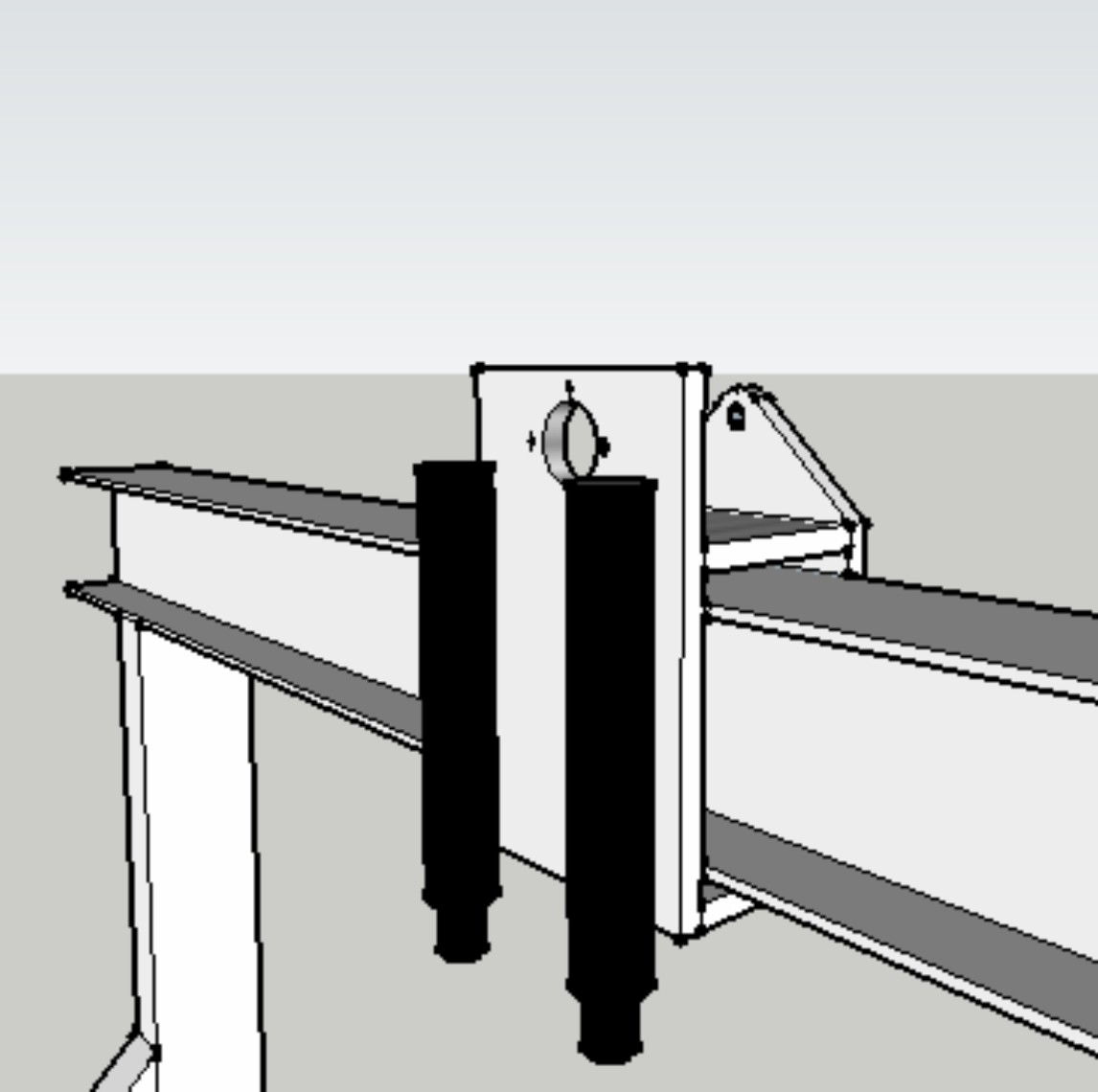
Slide box: The basis is a wrap around box of thick aluminium plates enclosing the beam.
Each of the 4 plates has a unique function. The top and bottom plates are for the absolute location of the slide box; Turcite blocks for the heavy downward loads and vibration damping, ball bearing rollers only for lateral location.
One vertical sideplate supports the entire drive mechanism – see picture. The drive motor sits over the top of the slide box and drives the big pulley on the outside. All the rest is inside the web of the RSJ ending up with the toothed belt driving onto the rack with a caterpillar drive to give more tooth contact. This plate is at the back of the machine and also supports a pair of Desoutter AFDK drills which just need a pulse from a 4mm air pipe to set them off on an automatic drilling excursion.
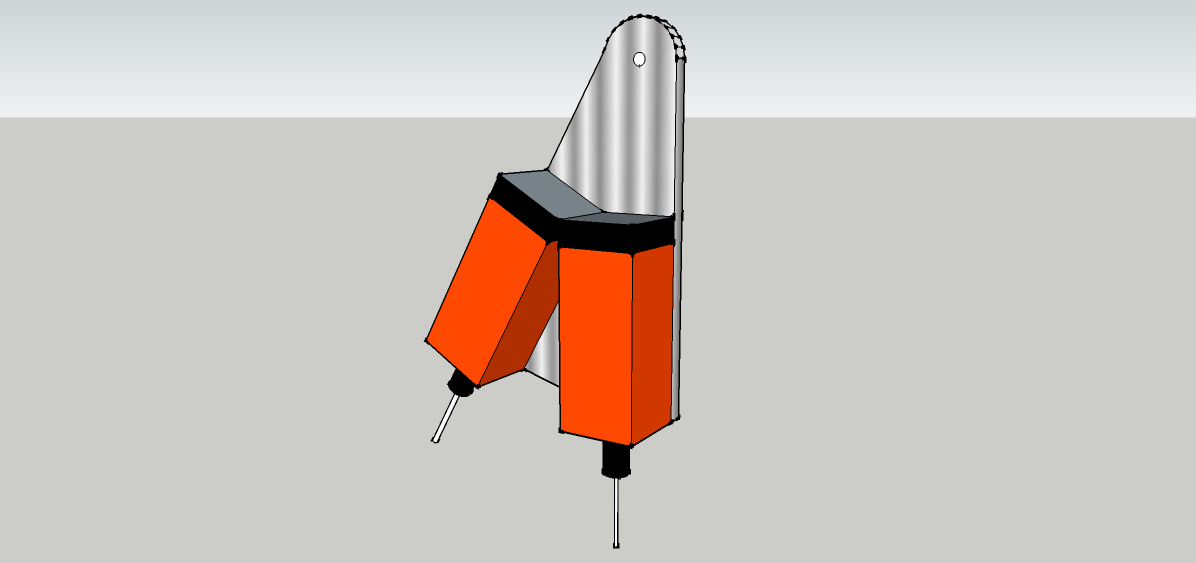
The other side plate supports a swinging plate that holds a pair of angled router motors. These are alternately selected with a push from an air cylinder; the cheapest alternative to a tool changer you’ll ever see. The tool changer: The top pivot point is in line with each router motor axis so that they both swing into exactly the same position. The pneumatic pusher cylinder is mounted inside the slide box and pushes a peg that goes through a slot – neat huh? Between the motors a round steel plug is pressed into the plate and one of a pair of electromagnets pulls this to lock the plates together (better solutions in comments please).
So there we have a heavy duty industrial quality router with 2 tools and 2 drills; about £20,000 worth if you had to buy one. One could earn a comfortable living with one of these. Not a lightweight project but still DIYable. Don’t get bogged down with cutting, welding and drilling heavy frames; the steel suppliers have all that kit and will make your frame in no time. Just send off your drawings and wait for your cnc router to arrive. Levelling the beam: There must be a few ways to do this other than sending it away for precision grinding.
A small steel block with a laser on it will show a dot moving up and down a target to reveal the bumps which will respond to a light touch of an engineers scraper.
When the beam is true adding hardened steel guide bars will provide the perfect flat finish. Panels: Professional machines come with expensive steel panels. As the central box chassis needs to be stiff and straight use MDF panels bolted to the steel to make it neat and strong too. Hammerite paint on MDF is remarkably durable and will keep it all looking very tidy. Bellows: With a rectangular box sliding on the RSJ there will be no problem in adding bellows to make the machine the ultimate in tidiness and this will be no bad thing for the unlubricated Turcite slides.
For further reading try following http://www.mycncuk.com -a fount of CNC knowledge- and please criticise or add ideas for improvements in comments.
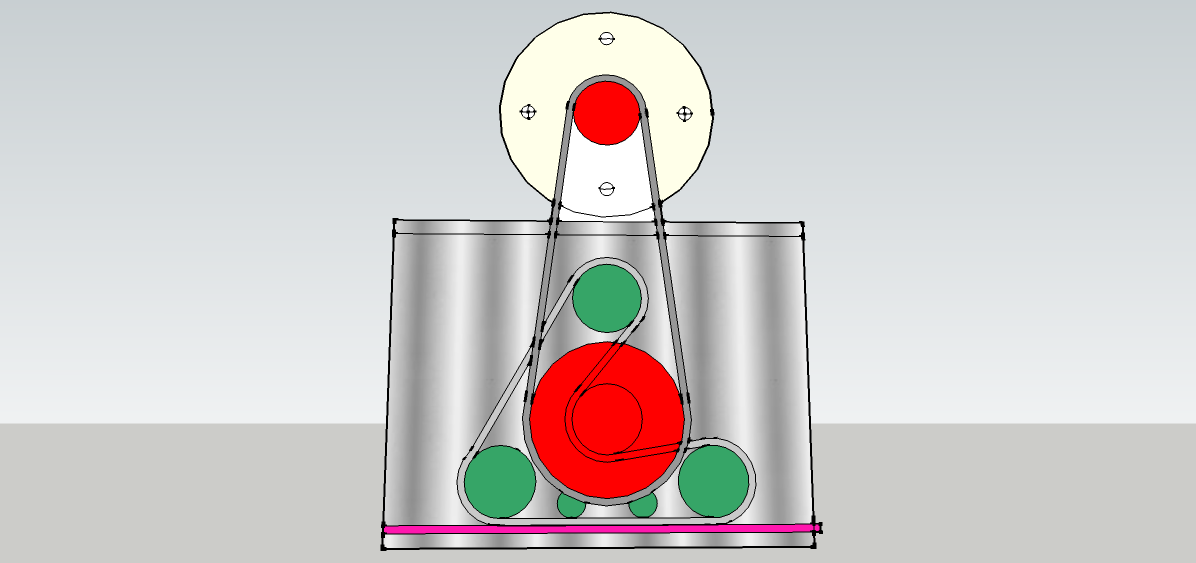
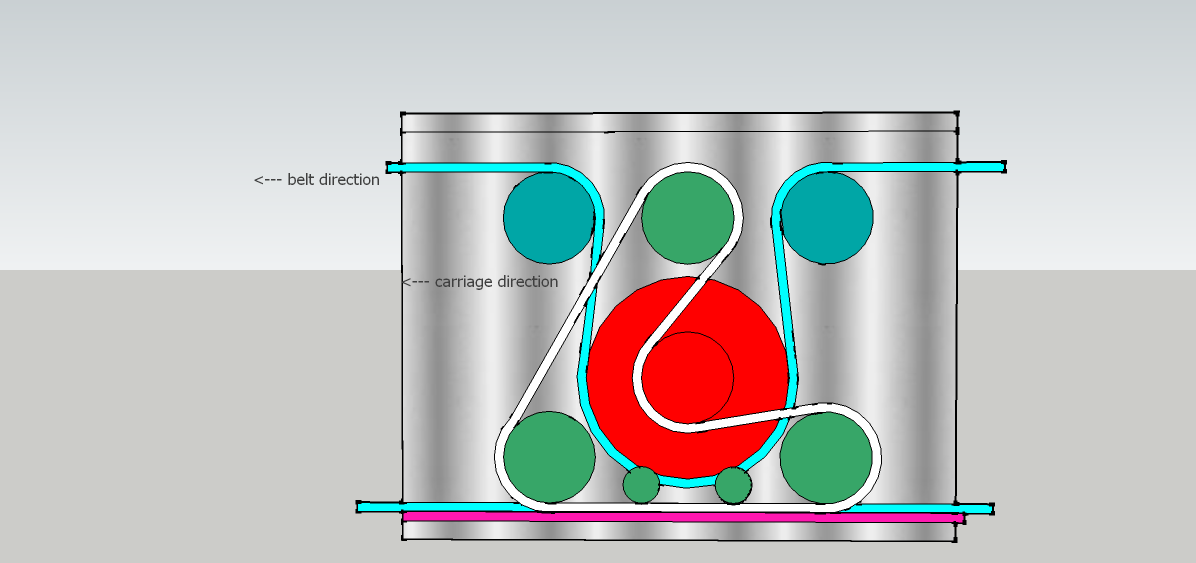
Driving both sides of a wide gantry present some awkward problems. Coupled long ball screws are expensive and prone to whipping and synchronised stepper motors on each end don’t always step in time and crabbing can occur. The caterpillar drive shown here (top left) for the slide box on the X-axis is intended to enable a timing belt to engage with a rack with the arrangement incorporating a low cost reduction drive.
The X-axis beam is supported by a slide box on each end and each one contains the caterpillar drive (top right). A single drive shaft, with a pulley on each end, pulls the slide boxes up and down the Y axis via long timing belts. The drive boxes contain reduction drives which finally engage with a rack. We call them caterpillar drives because the drive belt engages with the rack just like a tractor laying its track on the ground. Note that the pull on the belt is in the same direction that the slide box moves and that there is a differential action with the belt moving much faster.
With a couple more pulleys the main drive belt at the top can be brought down to run under the red drive pulley and just above the lower run. Thus the belt can be made to lie, and slide along a slippery nylon bed rather than flap in the air.
Cheap computers and software have brought CNC machining within the realms of DIY.
Some smaller routers are not much more than toys but for a machine that can commercially earn its keep we need some size and the ability to hang more tools.
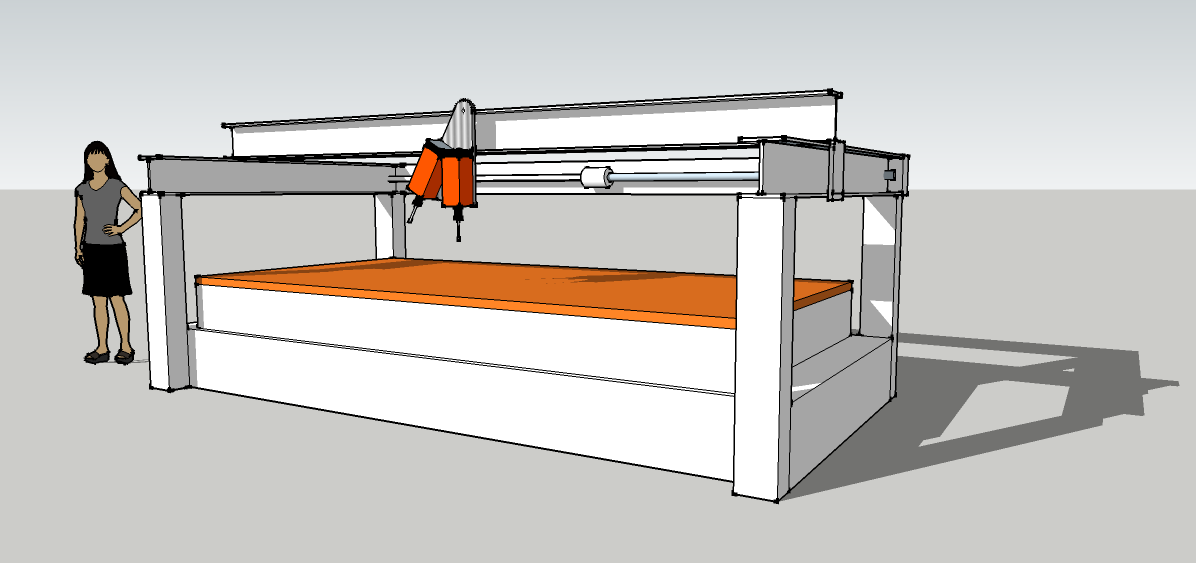
So here we have something much bigger and heavier without increasing the cost to anything like a professionally made router. Size: In order to machine round the outside of a standard 8’x4’ sheet we’ll need a long and strong X-axis. A heavy steel RSJ will resist the tendency to sag under the weight of two 4.5kW router motors and two drills. Of course a machine that holds multiple tools is ultra productive but also very expensive; usually that is.
We can get to two router motors and two drills pretty cheaply with the tipping tool changer concept. More details here
The neat thing about an RSJ is that it is not only cheap but the ‘I’ section enables us to put drive gears and the drive rack neatly inside the web. more details on drives here:
Torsional rigidity is not a strong point but is easily enhanced by welding a heavy tube inside one of the webs. Steel can pick up vibration so filling the tube with heavy chain and oil will make a cheap but effective damper. You only get really smooth finishes on a machine that is well damped. Z axis: You could buy an off the shelf Z slide and hang that off the X axis for a conventional and simple layout but the logic of that is debatable. When machining flat boards etc there is very little Z movement so it would be better to put the Z under the table so that the two major movements – X and Y – are as light as possible. The Z frame (the whole bed) is raised like a garage car lift with 4 chassis mounted screw posts rotating to drive ball nuts on the frame. Unlike the continuous chain of the garage hoist a short timing belt for each screw connects to one of a pair of drive spindles which are both driven by a central belt and the stepper motor. This way we get reduced belt stretch and a built in reduction drive. This layout enables a much bigger Z travel – 3D modelers note – and makes a fast and responsive machine with a tidy uncluttered look. Air balancing means there would be no heavy lifting for the Z stepper motor.
This unusual configuration has a lot of advantages. The sketch above doesn’t show the tractor drives or the box slides (one for the tool head and 2 to hold up the X-axis beam) which are described in detail here.
The rear mounted drive shaft drives the two differential caterpillar drives that power the Y-axis.
Panels: MDF – easy to cut, cheap, noise suppressing and remarkably robust when painted with Hammerite.
Snags?
Weight: Chassis needs heavy welding skills and reasonable accuracy.
Z-axis: Quite elaborate 4 pillar lift mechanism with guides.
The advantages.
Size: Scaleable to industrial size. Pictured as 2m x 4m here.
Visibility: Whole work table visible without moving obstructions like gantry legs.
Safety: Work table has no sideways movement. No pinning accidents.
Space saving: No sideways movement of table so roughly half the footprint.
Convenient: Router motors present themselves right to the edge of the table.
Accurate: Very solid construction gives accuracy and good machining finish.
Neat: Hollow beams accommodate wires, lights and control panels.
Responsive: Weight of Z-axis is removed from the X and Y axes.
Large Z-axis: Big range possible – good for carving.
Short Y-axis: Single stepper motor drives both ends of X-axis beam so no crabbing.
…. and isn’t it the neatest CNC router ever?
…. and check out the LIST OF POSTS for more like this
Well first let’s see what the engine is required to do. Remember the car is a light, range extended plug-in electric car with everything minimalised to save weight. Even the electric range is cut back to 25 miles to halve the usual battery pack; half the weight and half the cost. In normal use the car would do the school run or a shopping trip on battery power alone but with no range anxiety thanks to petrol back up. Most electric cars boast longer range but for the majority of journeys they have carried around a heavy stack of surplus batteries. It follows that for most of our short journeys we are also lugging round the petrol engine so weight is going to be a major consideration.
The main use for the petrol engine might come from a weekend run in the country with some fast roads thrown in. With the 20-40bhp electric motor for brisk acceleration and overtaking the 12bhp petrol motor is really just for cruising at up to 50mph. Bear in mind that the engine is charging the batteries when the car is stationary, at the lights say, so the available, combined power when on the move is higher than one might imagine.
The Honda GX engine range actually gives us the choice to go for a bit more power but with weight penalties. Thanks to the go-kart scene they can all be tuned for more revs and more power. The rev limiter is always removed and a stronger flywheel added.
The GX200 only weighs 35lbs and can produce a useful 9bhp. The Loncin Chinese clone version only costs around £250 and makes a good starting point.
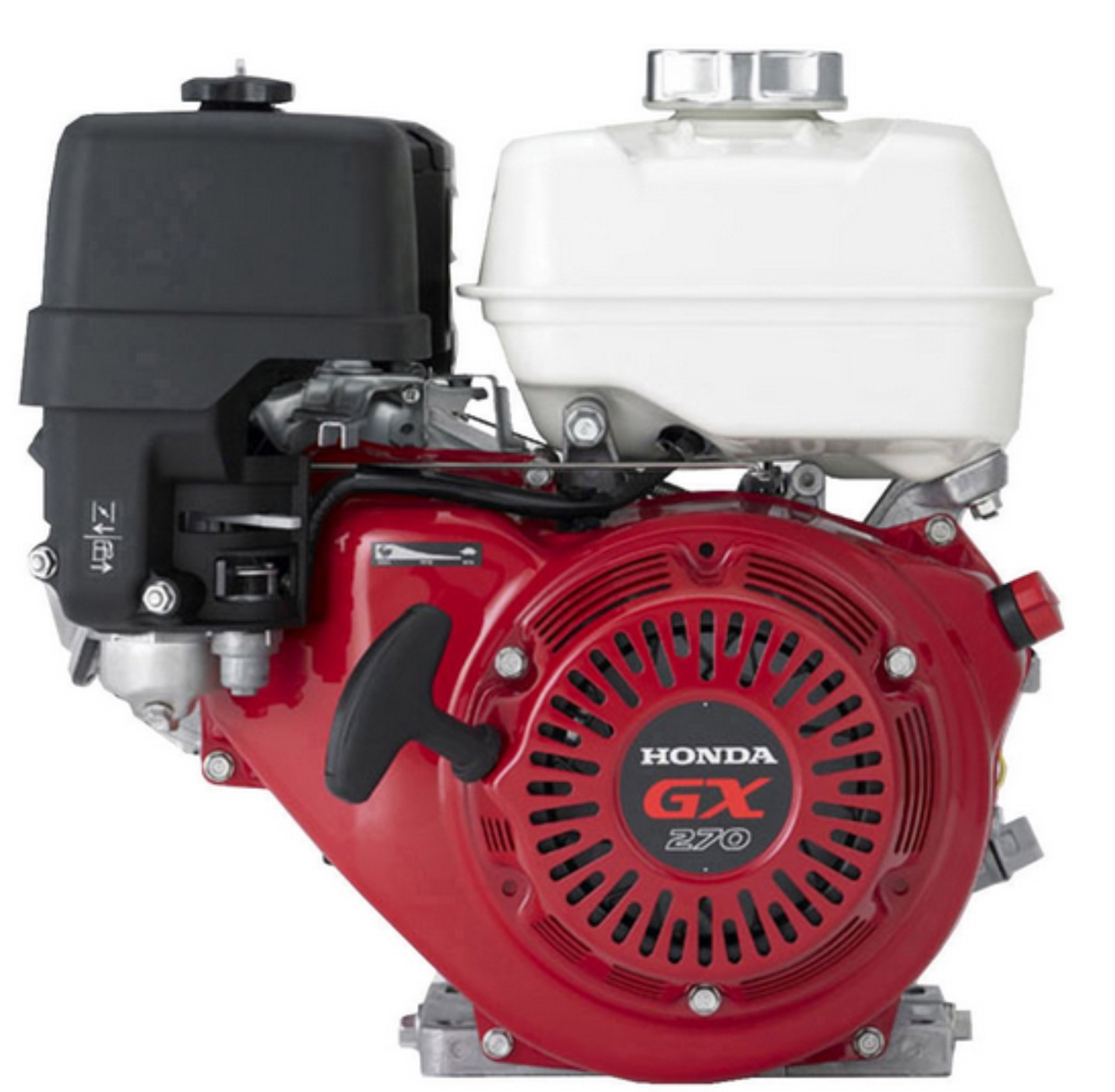
Next up is the GX270. Weighing in at 55lbs this might turn out to be the sweet spot between power and weight. With the usual modifications and the bigger carburettor from the GX390 this engine will give a good 12bhp.
The GX390 is good for up to 20 bhp but weighs a back straining 69lbs. Only testing will tell if that is departing too much from the light and minimalist idea but it would certainly be good for breaking the speed limit on the motorway. One should bear in mind that the engine and the electric motor are mounted just ahead of the rear wheel and the aim is to keep the overall weight distribution just slightly front heavy.
The engine mounting plate on the Original Twist hybrid 3-wheeler will be pre-drilled to mount all 3 engines so the choice is there. We can also consider the Briggs and Stratton racing engine with all the right bits built in at the factory – it’s called the ‘Animal’.
No doubt some inveterate tinkerers will have a spare engine for tuning experiments and, who knows, in time there might even be a racing series.
It is the intention that the engine will be pretty much clipped on and able to be changed in a couple of minutes so concepts like service exchange engines, rented engines etc are feasible. With that in mind the little 35lb GX200 that fits in a shopping bag looks attractive.
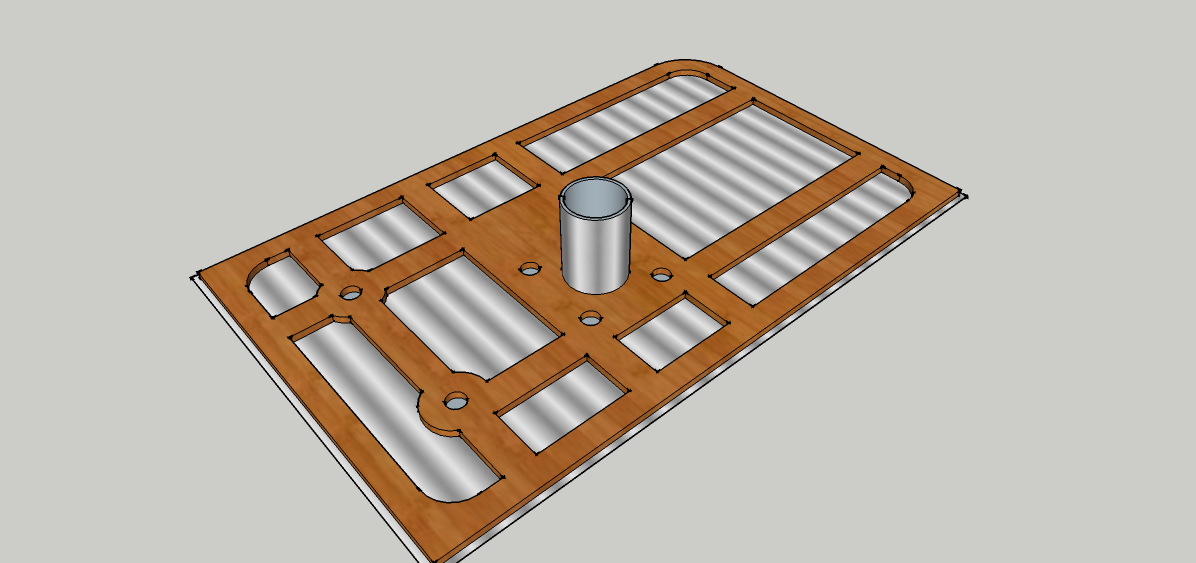
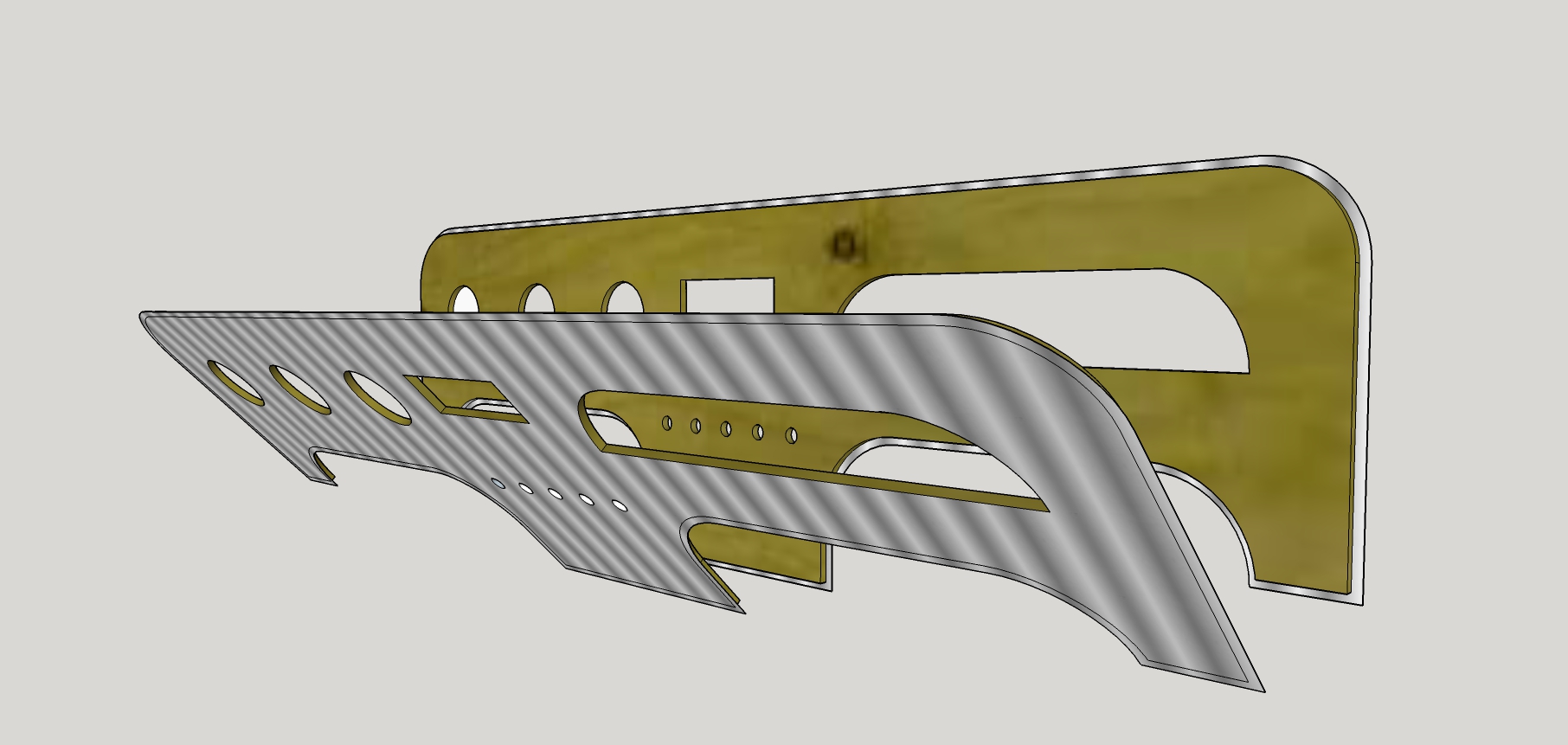
Aircraft grade birch plywood stuck onto an aluminium sheet has been CNC machined away to leave struts for load distribution and pockets for plug inserts. Loads are distributed by the remaining integral struts.
CNC machined panels
A mirror image version will then be glued on top –wood to wood- and the outside aluminium edges peened over to leave a solid looking panel (but largely hollow inside) which will not only look good with complex curves but be very strong and light. Any big holes in the panel will have the edges peened over too. Peening can be largely automated with a CNC guided rotating roller head.
Heavy loads from components bolted to the panel are fed in via plugs inserted into machined pockets so that any through bolts can’t crush the wood structure when tightened. The plugs are fitted in pairs with a larger star washer in between so that the sharp edges crush into the plywood to give even more load transmission.
Being CNC machined, identical complex panels can be produced quickly and with minimal labour cost. It pays dividends to design complexity out of the car and into the panels. Padded leather panels, a headrest for example, can easily be bolted up to the bulkhead as can other trim items.
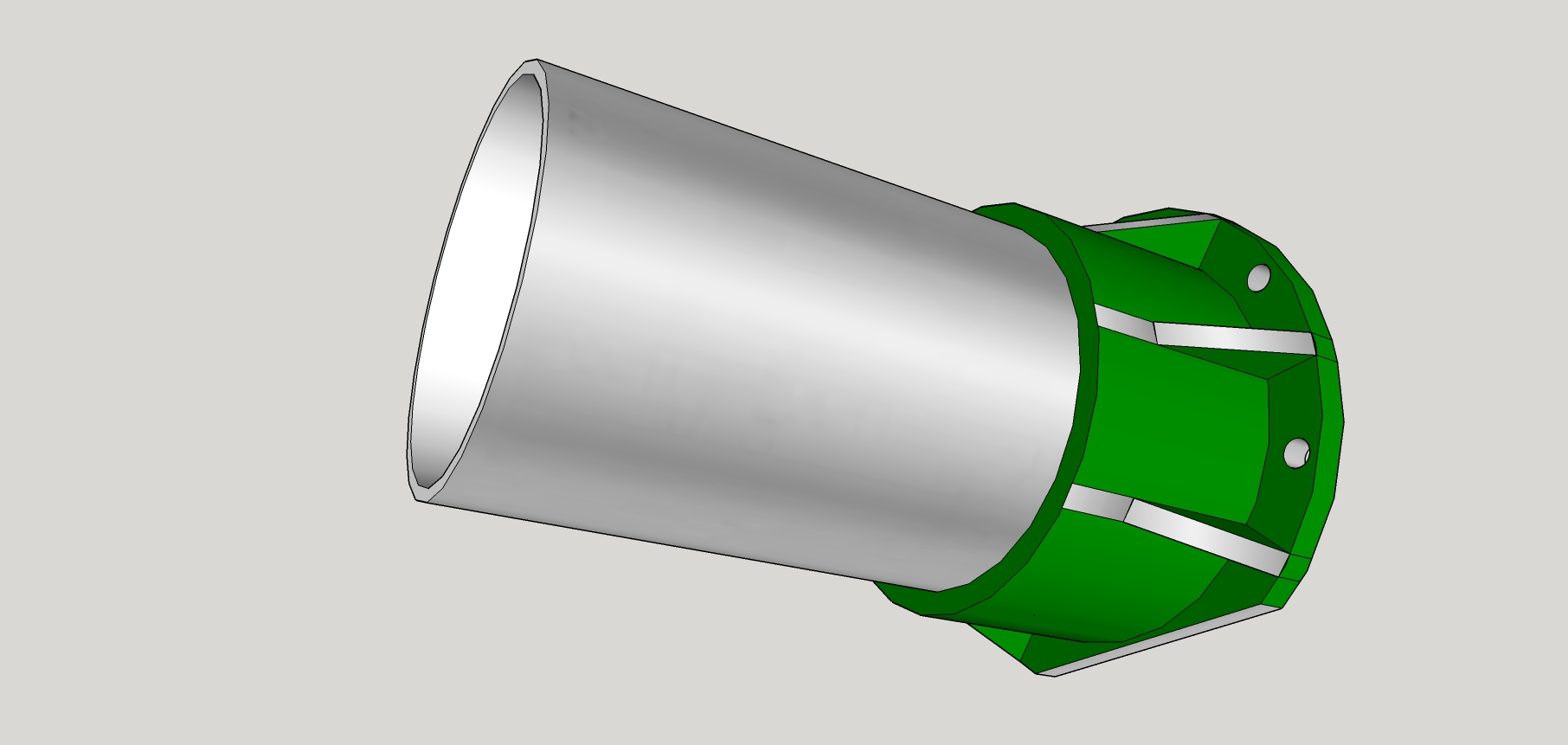
Front and rear bulkheads in our car will be connected by 3 aluminium tubes. They will be joined to the bulkheads by cast ally brackets where the tube end is expanded and glued by a tapered collar pressed into each end.
The picture here shows how a side panel wraps the tube to make an immensely strong beam affording maximum side impact protection and, of course, a nice wide arm rest as well. The folding is achieved by machining ‘V’ grooves through the plywood leaving the aluminium skin to be a bent hinge line. A more complex shape to the groove can make rounder corners too.
.
The inspiration for much of this comes from two great car designers. Colin Chapman made racing car bulkheads from opposed metal sheets with peened holes and edges for rigidity. Alec Issigonis with his Morris Minor design used a complex bulkhead to mount suspension, shock absorbers, steering rack, battery box, pedals and more. We shall do the same.
No doubt the car will be strong, stiff and light but there is more to an eco-car than that; it must come at an affordable price and these techniques get us there all in one hit. In fact the car is so simple that anyone with a modest workshop and access to a CNC router could make one. Maybe a good base for a schools project?
Ultra strong and light complex panels like these will have many other uses. Paired frames for a motorcycle and a gyrocopter immediately spring to mind. In higher volume applications the plywood core can be precut with a waterjet cutter and then glued between the precut aluminium sheets.
Plug-in Hybrid? Yes but what about a Plug-OUT Hybrid?
The Original Twist Plug-in Hybrid featured on this site has some useful components in it which can be used for many other purposes:-
12bhp petrol motor
20bhp electric motor
12kW.hr battery pack
Power shaft close to the rear luggage rack
We’re looking at such a hugely versatile mobile power house that it’s hard to imagine all the potential uses. I’ll leave that to you but here’s my first selection:-
Domestic UPS
A small inverter connected to the batteries will provide 240V a.c. which can power a house for hours. This feature will augment the battery pack that off-grid P.V. systems will have anyway.
Grid balancing
When electric cars go mainstream the grid will bid for their stored power via smart meters. A parallel hybrid will always be able to sell power when the price is right and still make the next journey.
Electric generator
The batteries can be kept topped up by the 9bhp petrol motor charging via the electric motor on the other end of the power shaft. Extended power cuts won’t be a problem.
Mobile power supply
The vehicle can deliver d.c. and a.c. power wherever it goes. The range of power tools that can be driven is endless and this will empower trades people and farmers alike.
Power shaft
It just takes an extra pulley on the power shaft to provide drive to anything bolted to the rear luggage rack. The picture here shows a compressor but it could be a lathe, a potters’ wheel, a wood chipper, a water pump ….. etc etc.
A rear p.t.o. is also easily arranged for light duty mowing, for example.
Camping
No problems with lighting and cooking when you go camping in a Plug-OUT Hybrid.
Go-Kart
The Honda GX petrol motor takes just minutes to refit into a go-kart and it’s already modified with racing parts to suit.
If ever there was an automotive Swiss Army Knife this is it.
OK – so the next automotive era has arrived and all car makers now offer some variation of an electric car. However, despite thousands of people with free home-brewed solar electricity just itching to go electric there is nothing economically viable on offer. Here then is an attempt to define what would be a workable, even desirable, alternative. A lot hangs on the price.
Anyone paying the London congestion charge could be paying an additional £2,000 a year. If one spent £10,000 on a vehicle that was exempt it would immediately give a return of 20% on capital so that suggests what the lowest price might be and even double that would still be economically feasible.
Let’s set a price target of £10,000 – £15,000 and define what sort of attributes most users would want:
Safety – very strong with above average crash sustainability. Not like a Sinclair C5 then.
Seating – for 2 adults and a rear parcel-shelf seat for occasional use, children and baggage.
Range – a normal daily commute of a 25 mile round trip entirely on battery power.
Range – a small combustion engine to give unlimited extended mileage.
Parallel hybrid – both power sources used at once if extra power is needed.
Plug in hybrid – batteries charged at home or by range extender engine.
Performance – equal to or faster than normal traffic.
Luggage – similar capacity as any other small car and much better than a microcar.
The key to economical motoring is lightness so from the start let’s begin with a 3-wheeler with two wheels in front and one behind. At a stroke this dispenses with some heavy things like a differential, axle, and one back wheel with suspension, brakes and associated bodywork.
With some heavy batteries mounted low down between the front wheels there will be no stability issues.
The power train couldn’t be simpler. The rear wheel spindle is mounted in an ‘H’ shaped swing arm, just like a motorcycle, with a chain drive to a sprocket that spins on the same inboard spindle that the swing arm pivots on. This sprocket spins alongside 2 others whose chains run up to the main power shaft where dog clutches engage either one to give high and low ratio drives. The transverse power shaft has a push on drive coupling on each end to connect an electric motor on one end and a small single cylinder petrol engine on the other – it’s that simple.
The permanent magnet Lynch electric motor produces maximum torque from a standstill so there is no need for a clutch. It also doubles as the starter motor for the engine, a regenerative braking charger and can run backwards to provide reverse gear. Dispensing with a starter motor, alternator, gearbox, prop shaft, clutch and reverse gear puts more in the ‘saved weight’ account. Electric power is a useful 20bhp with 40bhp available in 5 second bursts. By comparison the original 850 Mini had 33bhp but weighed 70% more than our target of 7cwt.
The electric motor and the 10kW.hr battery pack is sufficient for general short trips of up to 25 miles and perfect for city traffic creeping while adding in the petrol engine produces lively performance up to 60 mph for bigger trips on the open road.
The slightly modified Honda 200cc GX petrol engine only weighs 35lbs and produces 9bhp; adequate for performance boosting, charging, range extending and even as a limp home device. It can be replaced for well under £500 (clones are £200) and after 5 minutes of unclipping could be left behind for servicing.
Maximum combined power is 49bhp to give a power to weight ratio of 150bhp/ton; it will be nippy.
Of course the design could have substituted extra batteries and an extra electric motor for the petrol powered assistance but the logic is that some petrol power enables the driver to set out on any journey with confidence.
With an Indian made Agni electric motor (very similar to the Lynch pancake motor) this car would make great third world transport with India to start with. Tata this is your new super-cheap world car!
A £100 programmable logic controller is used to control gear selection via the clutches and the potentiometer throttle pedal. Regenerative braking is controlled but limited if the rear wheel tries to lock up. The same idea also provides optional launch control and safer driving by restricting wheelspin.
3 power modes are selected by a dash mounted knob;
Electric
Engine +
Range.
The ‘Range’ mode uses ‘engine +’ to drive as normal but whenever the car stops, the engine revs up and starts charging the battery ready for the next burst of power. At the first touch of the throttle the engine disengages and the electric motor stops the power shaft to select first gear.
At the front end of the car a simple subframe makes a battery box with incorporated suspension mounts. A lightweight rack and pinion and unassisted brakes take care of steering and stopping; all very simple but maybe the biggest weight and cost savings will come from the novel bodywork or indeed from the lack of it.
Central to the strength of the car is the passenger cell made from 2 CNC machined aluminium sheet and plywood bulkheads all connected with 3 fat aluminium torque tubes and further panels in the same aluminium and wood sandwich. The complex bulkheads enable the suspension loads to be fed into the extremely rigid passenger cell as well as mounting dozens of other components. Design like this not only saves weight, cost and assembly time but the bare aluminium looks so good that there is no need to paint it.
A smaller stressed panel incorporates the dashboard where a matt carbon fibre like laminate sets off the Stack instrument panel and the selector knobs for power and varying the regenerative braking.
Behind the passenger cell there is no bodywork as such; a horizontal tubular hoop supports motorcycle panniers on each side of the back wheel and a top box over the top.
At the front a one piece moulding covers the battery box with a pair of wings over the wheels and partially down the side panels.
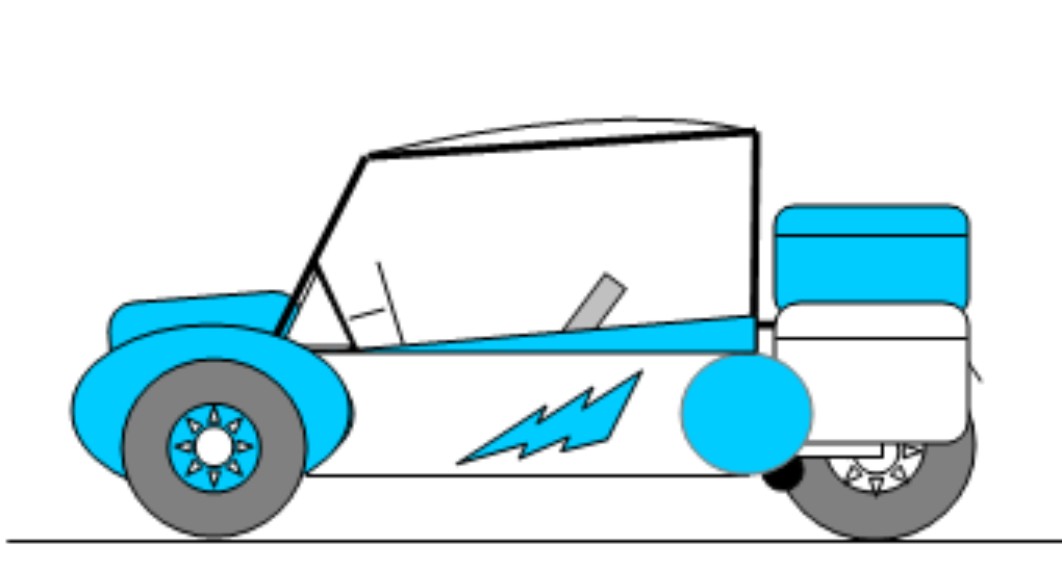
The narrow central roof panel is supported by two longitudinal roll cage bars which also provide hinge points for the gull wing window/doors. Similar to a Mini Moke (and the Mercedes SLS) there are no doors as such, just side pontoons.
To cut out the cost of regulations, crash tests etc the car will be sold as a kit car so customers will be expected to fit the engine and the wheels, perhaps with 10 minutes of help at the point of sale.
Can the price target be met? By raiding the parts bins for existing components and keeping it all minimal and simple the answer is yes. The result would be a characterful and useful eco-runabout with almost negligible running costs and at half the price of a Morgan 3-wheeler (with sales of over 1,000).
The Renault Twizy costs just £8,000 but battery hire costs £55 a month and it is hardly a useful all-rounder, and anyway similar mass production would make our car much cheaper.
This is just a sketch to hint at the full design. If you want to make one just let me know.
Tech notes: front suspension – wishbones but none sourced yet. MX5? Usual Cortina geometry from kit car uprights.
Rear swing arm – nice specials available for drag bikes at reasonable prices, just need a wide mounting to take side loads. .. easily made anyway.
Wheels etc .. 155×13” tyres at front … cheap and plentiful. 165×14” at rear.
Electric clutches … magnetic or dog clutches .. either would work … drag race air shifters?
A lock-up centrifugal clutch needed for the engine to provide limp home mode.
Roll cage; usual wide front and rear hoops connected by a close pair of tubes running from top of screen to rear and then down the rear bulkhead to pick up the engine/transmission plates. The rear frame extension is a loop of same width as the roof bars and provides a rear grab handle as well as support for top box etc.
The aluminium engine/transmission plates also provide swing-arm mounts, rear frame bracing and pickup lugs for the rear coil shock absorber units – a nice CNC machining exercise.
For a low car like this, gas-strut balanced self raising seats would be a nice touch to make getting in and out easier and the side pontoon height could then be higher for better strength and protection.
Rear corners of the passenger cell are fitted with sprung skateboard wheels to counteract any inadvertent tipping without damaging the bodywork. The Morgan F4 used to scrape the exhaust to the same effect (only tipping after C of G was raised with back seat passengers).





 Original Twist