Cheap PV panels have radically changed a few of our preconceptions about heating. The heating system layout has become much simpler (and less expensive) as under-floor heating and wet solar panels are deleted and heat pump connections are simplified.
heat pump – heating and cooling
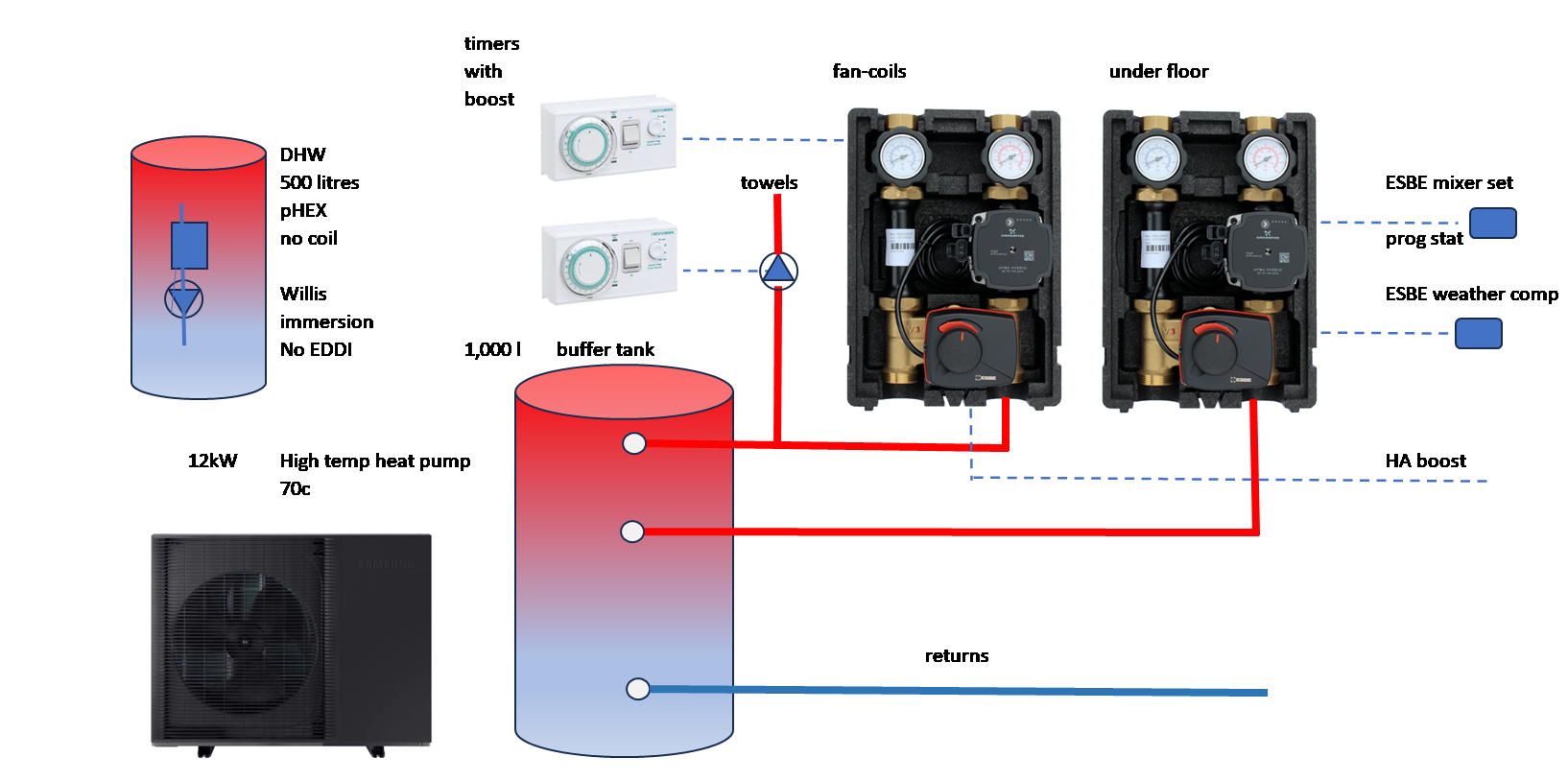
The heat pump connections are easier thanks to the Original Twist Hybrid Heat Pump which indirectly supplies chilled water without breaking the rules for the RHI incentives. Note that the system copes with 2 set points from the heat pump; hot water is routed to the hot tank while the heating is kept going with stored energy from the cooler tank. For the lower set point, heat is sent directly to the cooler heating side without disrupting the stratification in the hotter tank. The system can heat either tank while simultaneously supplying chilled air – how cool is that? An extra immersion heater helps use all that extra PV energy and for absolute perfection I’d have an external one – e.g. the Willis (no short cycling and easier to service and delivers heat to the top of the tank).
The cool tank has a large coil to preheat the DHW going to the hot tank heat exchanger and now there is a large choice of suitable tanks thanks to the heat pump drive. 3sqm of coil surface is common.
You can see the original system here along with a long list of all the benefits which still make this the best system on the planet.
You might have sussed that with 2 tanks here and another from the heat pump system your tech room is going to be large and, dare I say, impressive. I imagine all the tanks raised slightly on a low wall with wooden slats across the top. This allows most of the pipes to be hidden. The tanks are often raised when a wood burning stove is connected and gravity circulation is required.
What’s the point? Well it’s all about integration of multiple input sources, like a wood burning stove or a gas boiler along with a heat pump. Many experts say you can’t integrate all these things but they are wrong.
There is a commonly recurring problem with heat pumps and that is that existing pipework is too small to deliver much more than 6-10kW. The solution, of course, is to stick with the low powered heat pump and add a mini-split air to air heat pump.They are cheap, independent of any existing systems and they do aircon. This immediately ducks all the attendant problems with transmission and low power and makes the whole set up even simpler.
With a mini-split on board you might go really simple and have just one heat bank, a wet connected stove, a gas boiler (get one while you can) and no other heat pumps. All very simple and enough money saved to buy some PV panels.
Heat pumps of all sorts (ground source or air source) are going to save the World. The debate over ground or air rages on but is largely irrelevant when a hybrid design could cherry pick the best bits from both. Both suck heat out their surroundings and pump it to a higher level. You get 3 or 4 times more energy out than is put in, a seemingly impossible engineering miracle which still, for many, defies belief. The in-out energy ratio is the coefficient of performance or COP.
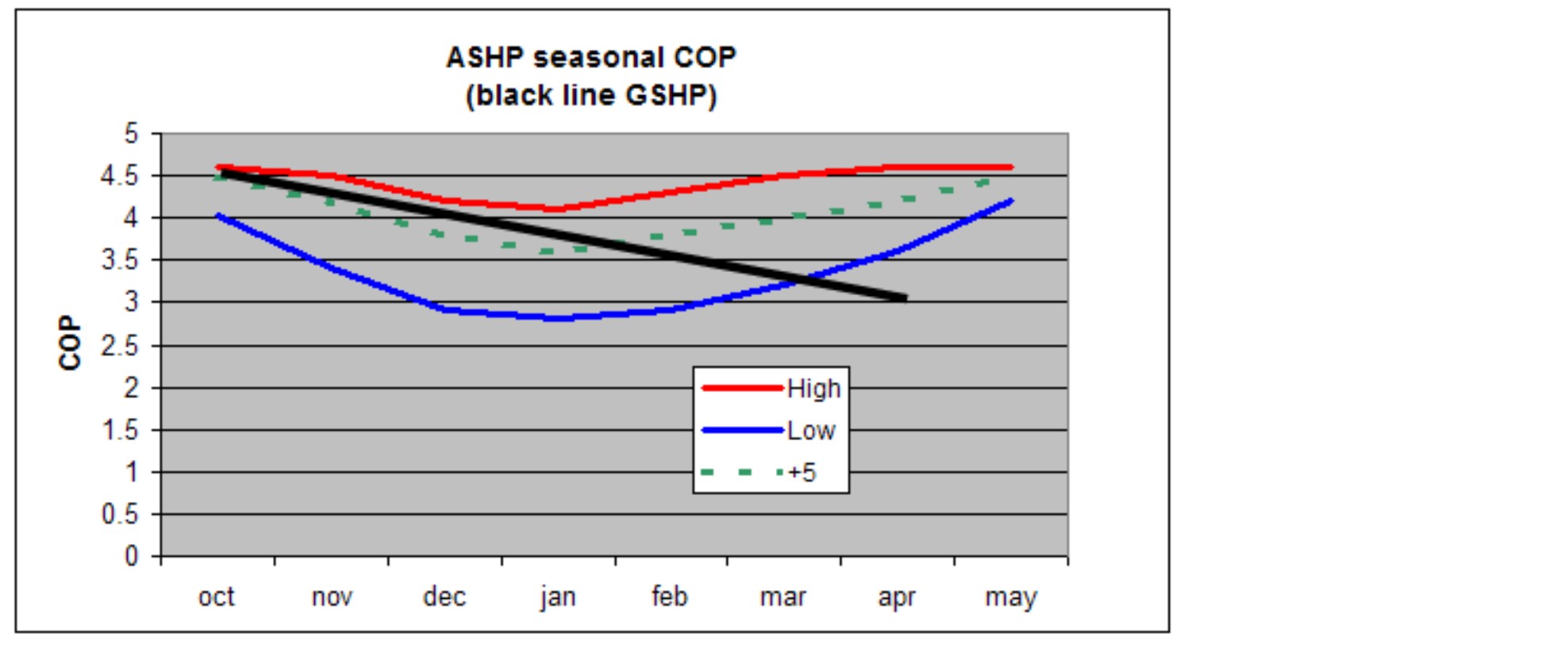
First lets join the debate about ASHP vs GSHP by comparing the COPs of both across the season.
The ASHP operates in a wide temperature range between the red line (day time running) and the blue line (night time running). Cold night time temperatures look pretty disastrous but warmer day time running produces consistently high COPs. On the black line the GSHP does without the wild swings and gently declines in performance as it sucks the heat out of the ever cooling ground.
Day COP vs. Night COP
While the GSHP (black line) gradually loses performance over the winter the ASHP can always do better on warmer days (red line) making the two systems closely matched during the daytime, up until Christmas anyway. Soon after that the daytime COP on the air source starts to improve while the ground source continues to deteriorate. The only redeeming feature of the ground source is that it is miles better than the air source blue line on dark and cold days or, as some might call it, winter
Even though the GSHP rules the night an ASHP system geared towards more daytime running would be a match for the much more expensive GSHP which, let’s face it, doesn’t always need to run at night at all.
However, some new electricity deals for electric car charging (7.5p/kW.hr at night) make a GSHP, with more night time running, quite compelling. It might be thermally less efficient but the running cost is only 25% that of daytime rates. So while this system favours daytime running it also supports the concept of running cheaply at night and storing the energy in big tanks. See Off-peak energy storage for cheaper heating
If only there was a system that could cherry pick the best COP line on the chart for any given moment. It would need to extract heat from the air on most days – red line – and extract heat from the ground at night – black line. The air side would not run at night so the blue line can be ignored and the system would cherry pick between the red and black lines. The average COP over the season would be around 4 which is better than either system on its own, so best in the world then. Luckily designing such a system is easy really and not particularly expensive either.
Original Twist Hybrid heat pump.
GSHP unit
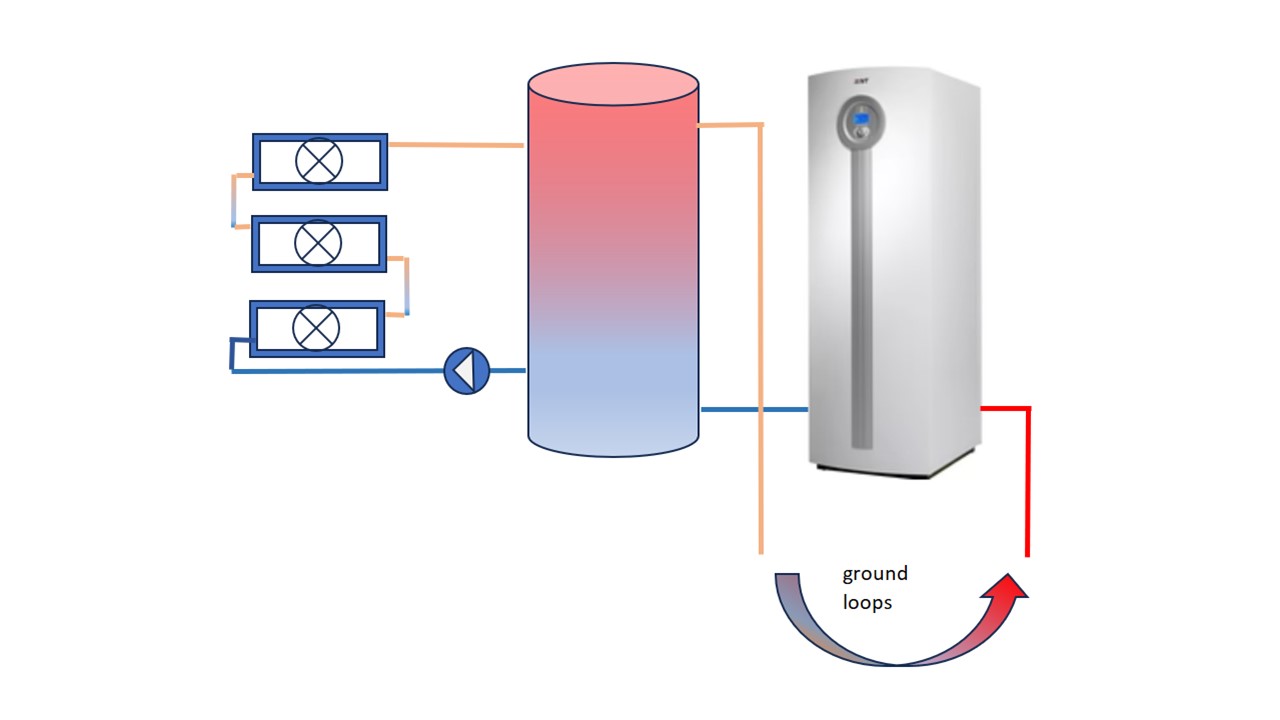
For the core of the system we start with a GSHP unit. As the name implies we need to feed it with some warmed water from a ground loop or slinky and more on that later.
Air source module
There is already water going in and out of the GSHP unit so warming it with air is simple.
There’s a pipe coming out of the GSHP unit and to the slinkys and we need to insert a buffer tank here. So far there is no change to the performance at all until we go on to warm that tank with air. Just connect a circuit incorporating an air handler unit, that is to say, a large heat exchanger with a fan on it. This is only connected to the buffer tank and is completely independent.
A few car radiators (surprisingly cheap) and a fan or two to make the equivalent of an air handler for about £200. 12v fans for cars are waterproof and easily available. It starts on a simple solar controller whenever it can contribute. Any time the air is warmer than the tank -click – the pump and the fans kick in. While the size of the buffer tank is not critical, bigger is better and 1,000 litres would not be unreasonable.
Warm air is a great resource so we decouple the air source module and let it run whenever there is a benefit, whether the heat pump is on or not. The tank will nearly always be available to charge when the heat pump is running and supplying an icy return flow on its way to the slinkys. That return flow will usually be around 0c or even less and the ambient air is usually above freezing so the air side will be making a usuful contribution most of the time.
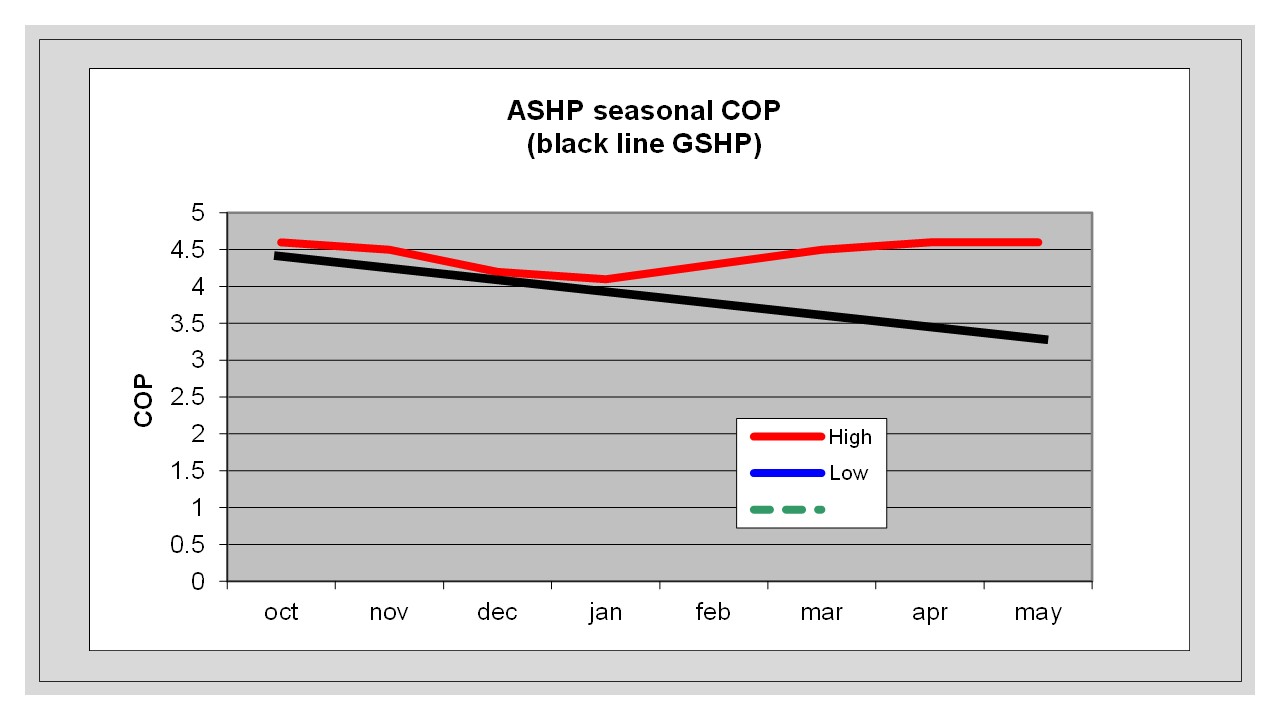
When the tank is warmed up the flow back into the slinkys is highly beneficial by raising the COP line slightly and delaying that end of season fall off in performance. The straight black line on the COP chart will bend upwards into better COP territory as shown in the new chart and it should even flatten out completely at around 4. Note how close that is to the daytime red line a bit higher up and how much better than the blue line we discarded in the first chart.
Slinky coils
Normally the ground starts the winter at around 12C then the GSHP and cold weather gradually take that down to around 0C. Permafrost around slinkys is not unusual. Normal ground loops are designed to perform at the worst end of this so they have to be huge. Not so with ours which can be smaller because:-
The ground starts the winter overcharged. We dump heat into it in the summer.
Frequent recharging takes place.
The cold return is usually pre-warmed by the air side before going back to the ground.
Towards the end of winter, as the air warms up, the Air Source contribution matches most of the load. The end of season performance stress on the slinky is avoided so the design is less critical and it can be considerably smaller.
I’ve done a job where the slinky was trucked down from Switzerland along with a man in a white coat and a bill for thousands; a bit over the top when polyethylene tube from the local builders merchant is just as good and costs under £300.
N.B. The pipes are filled with antifreeze and there are regulations about ground pollution so you can’t be too casual about pipe specification.
Pipes for the air side and the slinkys
It’s important to note that the power eventually delivered by the heat pump has to come from the air side or the slinky or both together. A quick look at my model for power and flow shows that for the air side the pipes will have to be 1″ at least to flow enough to raise 10kW on a Dt of 6 degrees. Same goes for the slinkys where on the same parameters the water would be in one pipe for around 2 minutes so it would almost certainly be better to have 2 slinkys in parallel to make that 4 minutes and 3 slinkys would be even better. A rule of thumb is that 10m of slinky trench makes 1kW so 100m for 10kW. Most of the time the air side and the slinky would run together so reaching 10kW would not be a problem even if the slinkys were cut down a little. However if the space is available I’d still go for the 10m =1 kW rule to be sure that there is no stress during prolonged cold weather.
Solar powerhouse.
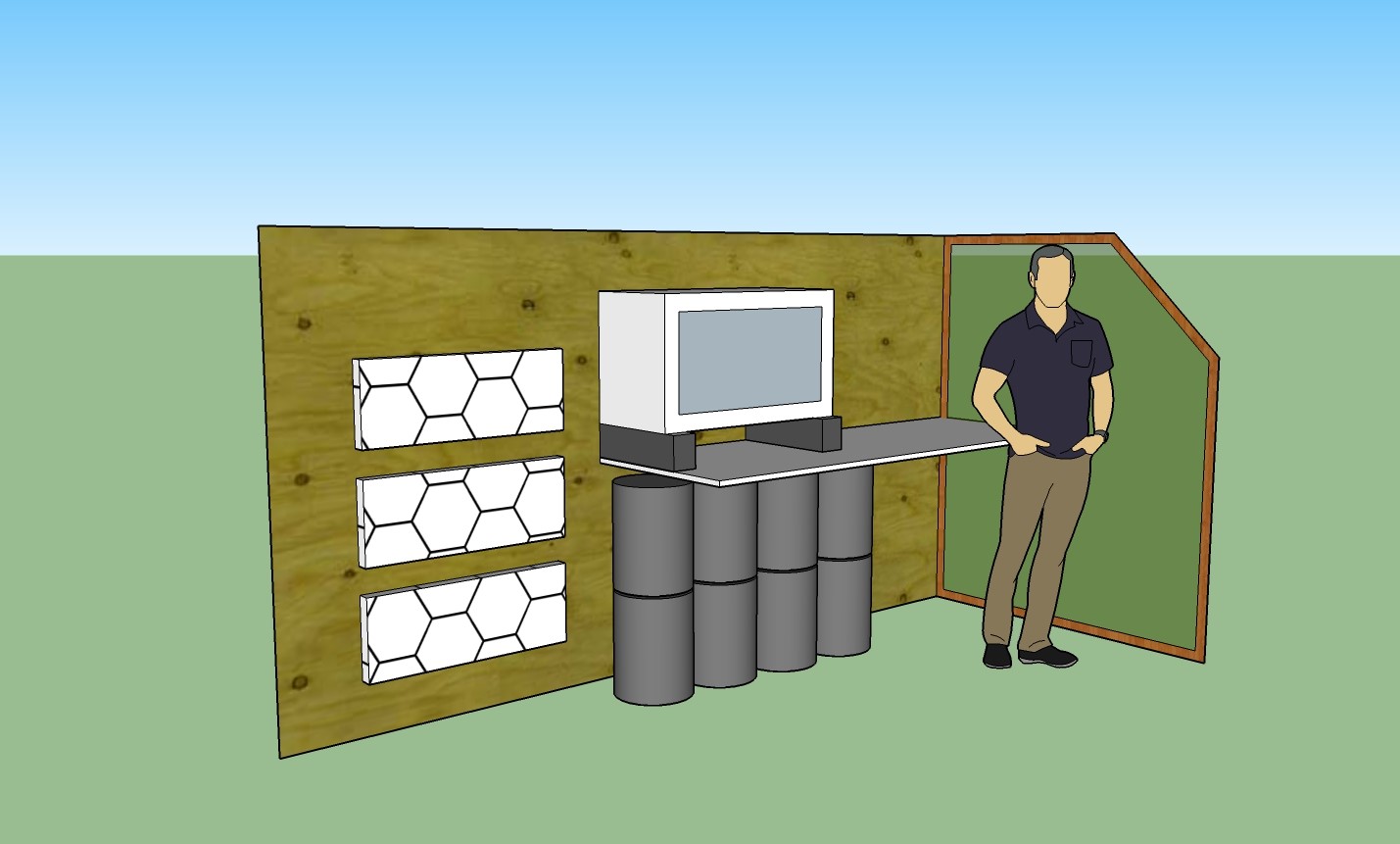
Just a thought. If all this kit were built into a small shed with sun facing glass sides it would be easy to fit the fans into the back wall and the heat pump onto a shelf for easy access. The solar input would raise the COP slightly and a few black water containers would store heat to ward off radiator frosting. To go even further, the air side could be boosted by big ground heated tubes which typically are good for a lift of 5 degrees. There would be wooden slatted duck boards on the floor to let the air up. So, with all this, not just best in the world but best of the best in the world. Picture below.
Summary
So that’s it. Better COPs than a GSHP or an ASHP, aircon, ground loop recharge, smaller ground loops and a better match to PV panels (more day time running). The smaller ground loop might just swing this for owners of regular sized gardens.
Ultimate Eco-heating system
If you are looking at heat pumps then I’ll assume you will have seen this heating system which particularly favours daytime running of Air Source Heat Pumps, a feature in keeping with the free power from PV panels.
This system has been revised and simplified. Revision 2
PV overclock and tilt
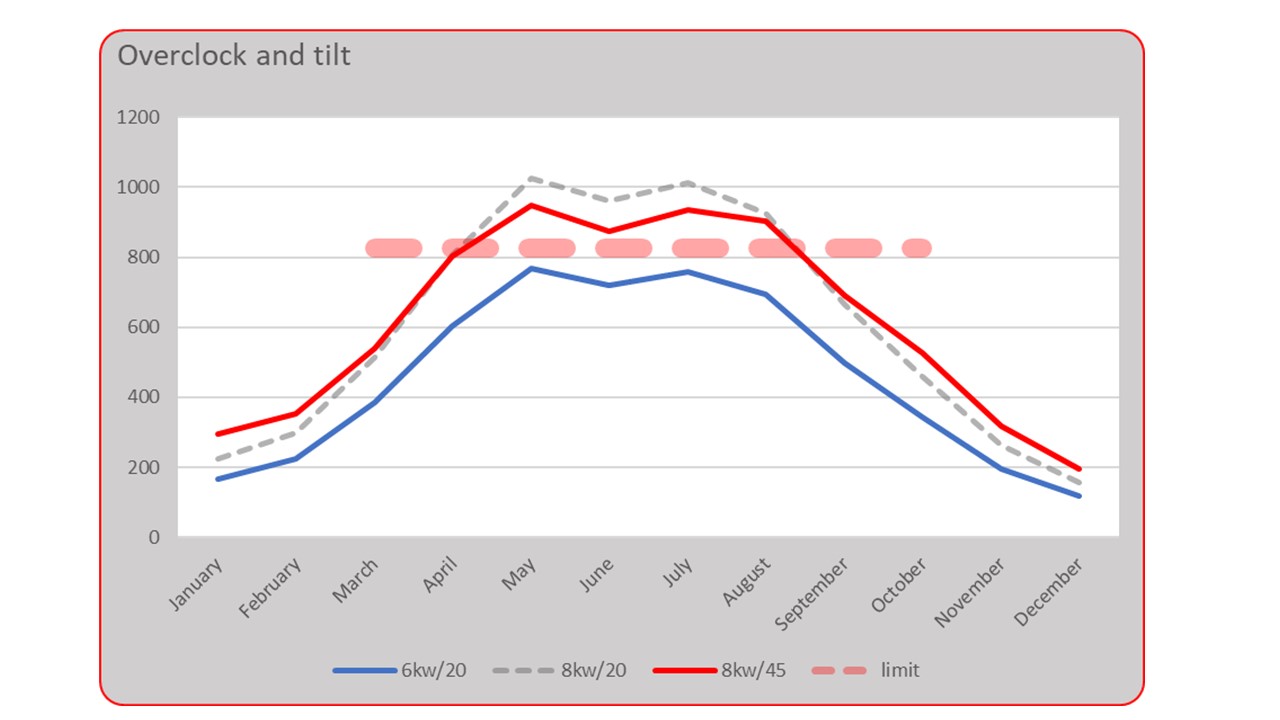
Using big PV to go off-grid – or nearly off-grid – makes sense especially when driving a heat pump. You’ll need every trick to make a limited energy supply go further so make sure you check out the 6kW overclock and tilt concept.


 Original Twist