There is a hard push under way to make us abandon fossil fuel boilers and adopt heat pumps instead. The trouble is they don’t seem to work for everybody and they are expensive too. So, in many cases that’s a lot of money for something we don’t even want. Don’t despair though, there’s a way through this maze and the outcome could be cheaper heating for less initial outlay. The trick, in a nutshell, is to have more than one heat pump; the one they pay you £7,500 to install and then a smaller one to back it up.
Learn to love heat pumps
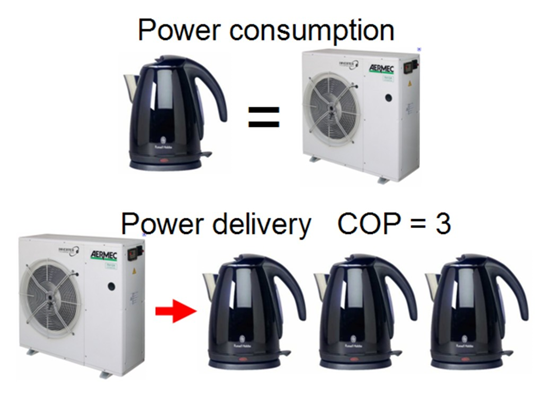
Typically consuming not much more power than an electric kettle the heat pump will deliver about 3 times as much energy to your heating, often more. The power is increasingly produced by renewables so the heat pump is an essential multiplier of green energy. That’s why we love them and that’s why we should have them.
Overcome the issues
Heat pumps work well at lower temperatures but that drastically reduces the effectiveness of your existing pipes and radiators. The pipes – usually 22mm copper – are the first bottleneck and probably only transmit around 12kW. So, without a total pipes overhaul the biggest heat pump you can have is 12kW (4kW drawn power). Half that, 6kW delivered is very common and suits well insulated modern houses and that might be the one for you too but only with extra back-up power.
Down the line the radiators will need an overhaul though; either some unsightly bigger ones or, preferably, fan-coil units with smart radiator valves on them to make heat distribution more selective and locally more effective. I prefer my own design for a DIY fan-coil unit (obvs).
With a smaller heat pump in the mix the chances are you can cover most of the cost with the £7,500 grant. A good start but now we need more power to back up a system living on the edge.
First things last
Before you start the big overhaul it’s best to install the back-up element, a mini-split heat pump – those aircon units often found in a hot foreign holiday rental. You probably only need one and they are so effective it should be a low power unit. The 1.71kW Mitsubishi SRK60ZSX-WF, for example, bangs out a healthy 6kW. Expect to spend under £2,000 for each one fully installed.
With the heat pump makeover done the running costs will still be the same as oil or gas but now the fun begins as we can move to the cost reduction phase.
First off, solar panels. Fitted with Enphase micro inverters you can fit odd numbers in odd places without any problems and they should give 20 years of trouble-free power. String inverters? Cheaper but when it fails in ten years everything fails at once; is the installer still around? Expect a long downtime, lots of grief and final expenditure higher than the Enphase route.
Because your heat pumps are low powered you will often find you can run one for free even when panel output is reduced. Include a solar diverter (like the Eddi) and the panels can send their surplus power to the immersion heater. This fixes the problem of poor hot water delivery associated with low temperature heat pumps and is the reason you might get away with not changing the tank in the first place. Keep your old tank, spend the money on panels. N.B the reason why your installer wants to change the tank is that the new one will have a much bigger coil to reduce recovery times – if you can afford it then go for it. Now the heating and electricity bills are usefully reduced and maybe servicing costs too. Do you service your fridge every year? No; same for heat pumps.
What about batteries? They used to be expensive and they wore out too quickly to justify the cost. But now they are cheaper (check out the Fogstar site) there is a better case for storing cheap off-peak electricity and running your (low powered) heat pump on it later. This can literally halve your energy bills – see graph below.
There’s a useful tactic to be considered when you are finally persuaded into owning an electric car.
Some EVs can offer 240v vehicle to load (V2L) with around 3kW available from a socket behind the back seat. They imagine you might plug in a toaster when you go camping. Never mind the toaster, you could plug in a mini-split and use cheap off-peak electricity to heat the house. If you are looking for a box of tricks to make this work check out the Victron Quattro-II which has an extra 240v input. The idea here is to go for a domestic battery first but be ready for the EV when it comes.
This all gets you connected to super cheap heating and air-conditioning too.
As you can see, cheap off-peak electricity, time shifted then multiplied with a heat pump gives astonishing results. Vehicle to Grid charging is another way although not yet mainstream but V2L gets us there now without installing the expensive V2G charger and you can choose from a bigger range of cars.So not a Nissan Leaf now, more likely a Kia or Hyundai.The result; half price for a lot of your heatingif not all of it.
The picture wouldn’t be complete without mentioning off-peak energy storage in water rather than batteries. Check out the idea in Grand Designs Heating System. Water lasts forever, batteries don’t.
Of course, all houses are different but hopefully there are some ideas here to help make a complex topic simpler. Small heat pump + mini-split + solar – the way to go – then batteries or tanks.
How much is a heat pump – £15,000? Actually, they start at £1.200
so let’s get going.
It’s easy to ruin a perfectly good house by doing a heat pump conversion. Thousands of people have already done so and yet the pressure is on to keep doing it. So, here’s how to do it logically and successfully. The measure of success here being better comfort with lower running costs and the satisfaction of lowering emissions too, but most of all, a system that actually works.
First of all, don’t rush in until you know how much power you have already and whether that is too much or too little. All installers have to err on the side of caution so your boiler will certainly be bigger than it needs to be.
Stage 1/:
Insulate, insulate, insulate, floors, walls, loft windows, all of that. Start here because, compared to your old boiler a heat pump is relatively weedy and anyway very different. It’s a low temperature high flow device and it will need all the help you can give it.
Stage2/:
How much power?
After insulating take a look at how much energy you are currently using and hoping to replace. There are a couple of ways of doing this and it is best to do them both. First check the nominal power of your boiler then see how often it cycles on and off on a cold day. This might involve half an hour standing by the boiler with a stop watch. You might have a 30kW boiler but the chances are it will be short cycling, especially if it runs on oil. When you have the time to running ratio you can see the average power your boiler is delivering and this will give an idea of your peak power requirement.
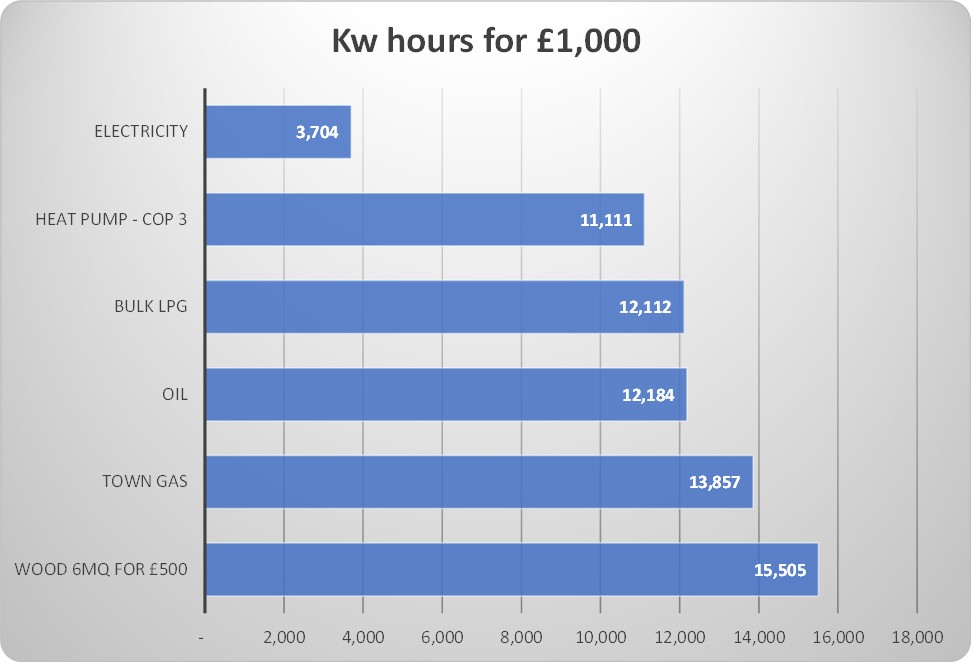
Secondly, check your total oil or gas bill and use this chart to calculate how many kilowatt hours of energy you have been buying. Whatever you replace your boiler with will have to make as many kW.hrs over the season.
There are about 200 days of winter so dividing the energy total by 200 will give you an idea of the average daily power requirement. This is only going to give a rough idea but that may be enough if you add a mini-split to the mix as a substantial top up for those arctic-blast days.
Unfortunately, we are not there yet because there are transmission issues to consider. The pipe that runs from your boiler to the radiators is likely to be 22mm copper which with typical heat pump temperatures will transmit between 10 to 15 kW and more likely towards the lower end of that. On a COP of 3 that means the maximum heat pump power will be around 5kW (delivering 15kW), any more cannot be used. That almost certainly leaves a large hole in the requirement and is the reason why so many installations are a disaster. The solution is pretty obvious though; just add that mini-split air to air heat pump or even two. They will plug the gap and leave your existing pipework untouched. A mini-split has no connection to your existing system and all the pipes and radiators etc. It’s a stand-alone heat pump and that’s why it is so cheap to install.
Stage 3/:
Transmission
It’s not just the limitations of the pipework to consider, now the heat has to come out. Assuming there is no underfloor heating in place that leaves replacing existing radiators with really huge ones (not an inviting prospect) or fan coil units. The latter can be inexpensive and effective – see DIY fan-coil units. Again, the mini-splits make up for transmission shortfalls.
Hot water
Quite often you will be quoted for a new hot water cylinder to go with the heat pump. The reason being that the coil needs to be bigger (3msq is good) to accommodate heat pump low temperatures. If you don’t have room for a new tank consider ignoring that suggestion and spend the money on solar panels and an energy diverter like the Eddi. Cheap night time electricity might be in your mix and that too can drive the immersion heater.
Looking back at that chart it appears that there are no savings to be made by running a heat pump. You can press on happily though because further tweaks will lead to the cheapest heating available. Heat pumps can run on renewable electricity too so they really will help you to save the planet.
If you have solar panels, they can make a free contribution and the low power mini-split(s) will often run for free on the first glimmer of sunlight.
In the long run you might have an electric car that allows the use of its battery to power the house. In one stroke that will easily halve your energy bill as you time-shift cheap night time electricity and amplify it with a heat pump.
For bigger houses with unusually high heating demands the answers are still the same although the transmission limitations can be bypassed with the aid of a heat bank with its multiple pumped outlets. That’s a longer discussion but have a look at The Grand Designs Heating System to see what the cutting edge system might look like. You might be a bit shocked.
So that’s it. Just sidestep the limitations and embrace the advantages. Easy really.
P.S. Some EVs can offer 240v vehicle to load with around 3kW available. They imagine you might plug in a toaster when you go camping. So you could plug in, for example, a Mitsubishi SRK60ZSX-WF Heat Pump System along with a changeover switch to pull in the mains when the car is not connected. This unit consumes 1.71kW (a lot less than a toaster) and delivers 6kW which is pretty punchy when it comes to making up any system shortfalls. Expect to pay £2,000 fully installed. This all gets you connected to super cheap heating without installing the expensive V2H charger and you can choose from a much bigger range of cars.
It’s no good just working out how much per kilowatt hour a heat pump costs to run compared to, say, a gas boiler. What’s more to the point is what is the total hit to your pocket will be after a reasonable length of time. Your system might have to generate around 15,000 kW.hrs or more each year. After about 6 years that will come to a neat 100,000 kW.hrs which is handy for making the maths easier. Say you spend £5,000 on a gas boiler then the capital cost per kW.hr it makes over that time is 5p. Each £1,000 becomes pence per kilowatt hour. Adding to that the actual running cost of the plant in question and we can get a good idea of the total long term cost. Similar maths for the energy component. So12p per kW.hr for gas is £12,000 for the 100,000 kW.hrs.
Putting those together. A £5,000 gas boiler with gas at 12p/kW.hr makes a total of £17,000 for 6 years.
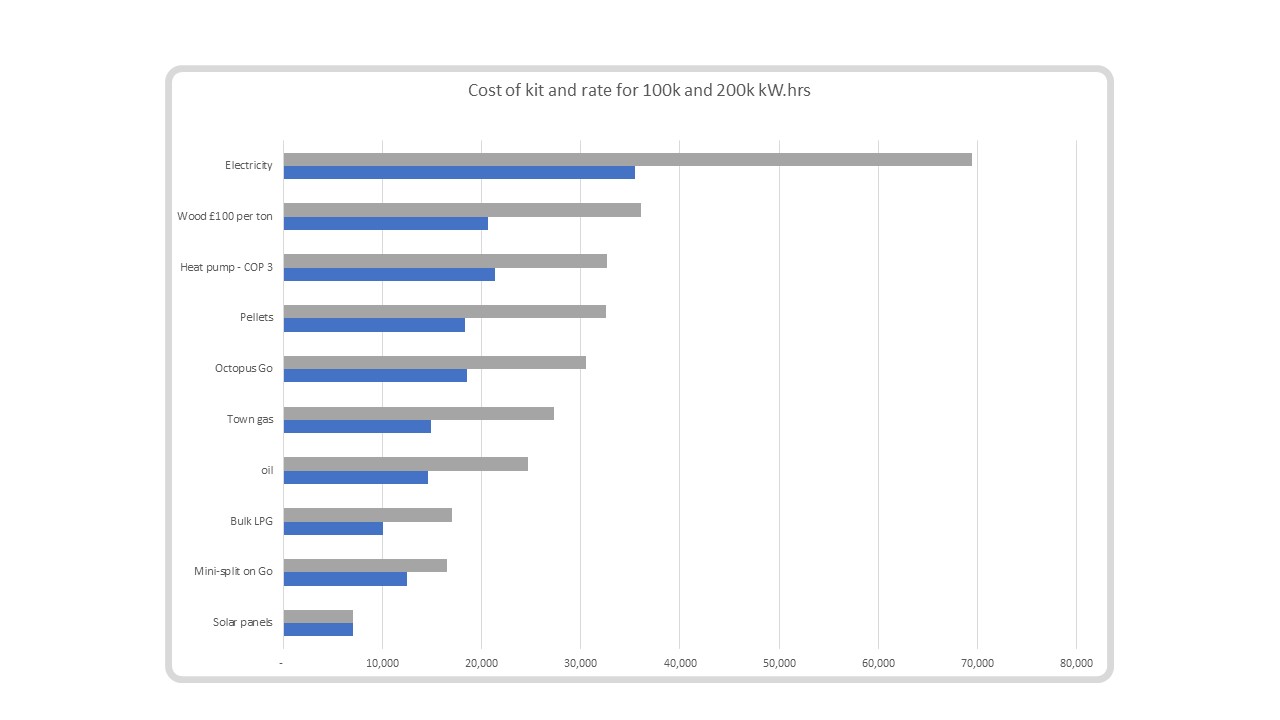
What about in the longer term when the cost of the kit is spread out? Below there’s a graph with the results. Double click on it to get a bigger view.
The blue bars are kit plus energy for 6 years and the grey bars go to 200,000 kW.hrs with the kit cost remaining the same Here the differences become even more marked.
These sums illustrate the danger of adding more kit to your mix. If you were to follow the government lead on hybrid heat pumps that would cost about £10,000 (after the grant) so you’d add about 10p/kW.hr to your existing set up but the 100,000 target doesn’t move. Add £10,000 to the natural gas bar on the chart and the total cost is worse than EVERYTHING on the chart except neat electricity.
Bearing in mind that the bottom scale shows your future heating bills and those figures are £thousands the differences are significant.
Electricity £1,500 for rads – Electric radiators are cheap enough to tempt one down this route but the sheer weight of expensive electricity has made this the worst choice by a long way. £70,000 for 10 years! Ads for 100% efficient electric radiators should be banned.
Stove and tank £5,200 – A stove connected to a heat bank is expensive but fares well compared to electricity. Even better if you can access cheap wood.
Heat pumps £10,000 – The heavy up front cost and use of the most expensive fuel makes heat pumps, sadly, the third worse choice. However, free power from solar panels makes a big difference. A smaller heat pump plus a separate mini-split is well worth considering.
Battery on Go £6,500 – An expensive battery grabbing cheap night time electricity from Octopus works out well but it’s always a limited supply.
Pellet boiler £4,000 – Who cares?
Gas boiler £2,500 – Getting better and reassuring seeing that this is what most people already have.
Oil boiler and tank £4,500- Expensive to buy and install. Expensive to service. We can do better.
Mini-split and battery £8,500 – Expensive battery meets cheap heat pump and the result is magic. Not the winner here because the battery will wear out eventually. Not shown on the graph but solar + mini-split is the way to go – this was only evident after the graph was there to see.
LPG gas boiler and tank £3,500 – Not too bad up front and cheap’ish to run. The winner by miles and leaves you much better off than with a heat pump.
Solar £7,000 for 20 panels – Not a fair comparison with this list as it would take 10 years to make the 100,000 kW.hrs but there are no running costs at all. Whatever you chose above, the panels will always be sort of better but you’d need them as well. Add a mini-split and that’s proper magic.
Conclusion – LPG gives plenty of power for not too much up front. Add lots of solar panels and a mini-split or two (without the battery) and you’ll be cushtie – relatively. Remember you will have electricity costs as well as all this heating and solar panels reduce this considerably and often run the mini-split free of charge. Free aircon in the summer is a bonus. A mini-split costs about £1,200 and it is a proper heat pump. So add £1,200 to the solar panel bar on the chart and you can see why this should be part of your strategy.
The choice for you? Take your quotes, add on the rate x 100,000 and draw it on the graph.
While I hope my figures are correct please check before making any decisions.
All this talk of nuclear fusion makes me laugh. Our area has been connected to a local nuclear fusion plant for ages and myself along with a few neighbours are already connected.
The benefits certainly compare well with other forms of energy. Unlike conventional sources there are no wires or pipes because the transmission is wireless. It’s hard to imagine how that works, but the energy is sort of beamed across the airwaves. It is necessary to have line of site from the reactor to the receiver so this may not be available for everyone. There was no cost to actually connect to the source reactor although the receiver was fairly expensive at around £5,000. Possibly the major benefit though is that there is no charge for the energy supplied as it is beamed, free of charge, directly to the receiver. In these times of hugely expensive energy, it seems impossible that this fusion power can be free but it’s true, there is no charge for the power and no sneaky daily charges either. Furthermore, the price is fixed at zero and it is guaranteed that there will be no price increases ever.
On the downside the transmission has been fairly erratic and a bit limited over the winter. This deficiency can be largely remedied by having a battery to tide us over the downtimes.
So far, reliability of the fusion reactor itself has been good and I’m told it is unlikely to fail for well past our own lifetimes. It is comforting to know that it has never been known to fail; unlike some other supplies.
So, you may well ask, if it’s free energy with free and quick connection why isn’t everybody doing it? Well, it beats me but I have noticed that a few savvy people round here have got the message and have fitted receivers to their rooftops.
You might not have heard about all this because the big energy suppliers want it to be kept secret. So, keep it to yourself. Mum’s the word.
When hydrocarbons like oil or gas are burnt they produce a fair bit of water in the form of steam and that steam contains energy that can be reclaimed if it can be cooled enough to condense. If your heating system returns water to the boiler at 55c or below then condensing happens in the boiler and that plume of steam outside disappears. The benefit to you, the boiler owner, is immense. The boiler that was sold to you as 97% efficient actually gets there instead of the mid eighties which is probably where it is now. On a gas bill of £3,000 a reduction of £300 – £450 makes this a topic worthy of some perusal. Plough on, it’s boring but not difficult.
There are different accepted design targets for the temperature drop across heat emitters (like radiators). A Dt of 20c or 11c. Both so widely apart to be pretty unhelpful. Maybe all of that is irrelevant as your system already exists and you can only move on by measuring what Dt you get.
So, say a radiator circuit might be set at 90c in and 70c out (Dt of 20) the desired return flow at 55c is far out of reach. Owners of oil boilers are a bit stuck here as the boilers don’t modulate which means they work on full power and are either on or off. Gas boilers, however, can have their output temperature turned down and this is the place to start but, unless you can tolerate a lot less heat in the house, it isn’t the full solution. The trouble is that the radiators don’t move as much heat at lower temperatures so they won’t achieve a Dt of 20 – maybe only 15 or less – so say you drop the input temperature down to 75c the return only drops to 60c. Getting close, but the heat to the house will be down to 12kW from 16kW for example, and we are still not condensing. Turning on more radiators will drop the return temperature and this where the juggling needs to begin. If you time the hot water heating to coincide with the heating that will help too. Looking at that standardised Dt of 11c and working back from a return of 55c the feed would have to be 66c which is quite low for radiators. The chances are your current set up is a bit above that.
Taping thermometer sensors to the feed and return pipes next to the boiler is essential for seeing what is going on.
DIY fan-coil unit
There is one tweak that could help reach down to those last few degrees and this will be particularly useful where oil boilers are concerned. Check out the DIY fan-coil unit featured here.
This works well at lower temperatures, such as the reduced return flow you are reaching for, so it will work just on the return flow pipe alone (via a diverter loop) anywhere towards the boiler end. It’s all about removing power to widen the Dt and it doesn’t make too much difference where this happens but removing heat from the return will leave the main circuit running hotter and with a higher Dt. So, when you have turned down the supply temperature as much as can be tolerated the return flow pipe can be tapped for energy and maybe you’ll reach the magic 55c.
Hardly anyone has a heat-bank based system but these have a return feed to the boiler drawn from the cooler bottom of the tank and that results in the boiler running in condensing mode most of the time and with much longer runs which is particularly good for oil boilers and their short cycling problems. If you are starting from scratch there are many other reasons why a heat-bank is the way to go. There’s a case study on one here. https://originaltwist.com/2016/01/21/eco-heating-news/
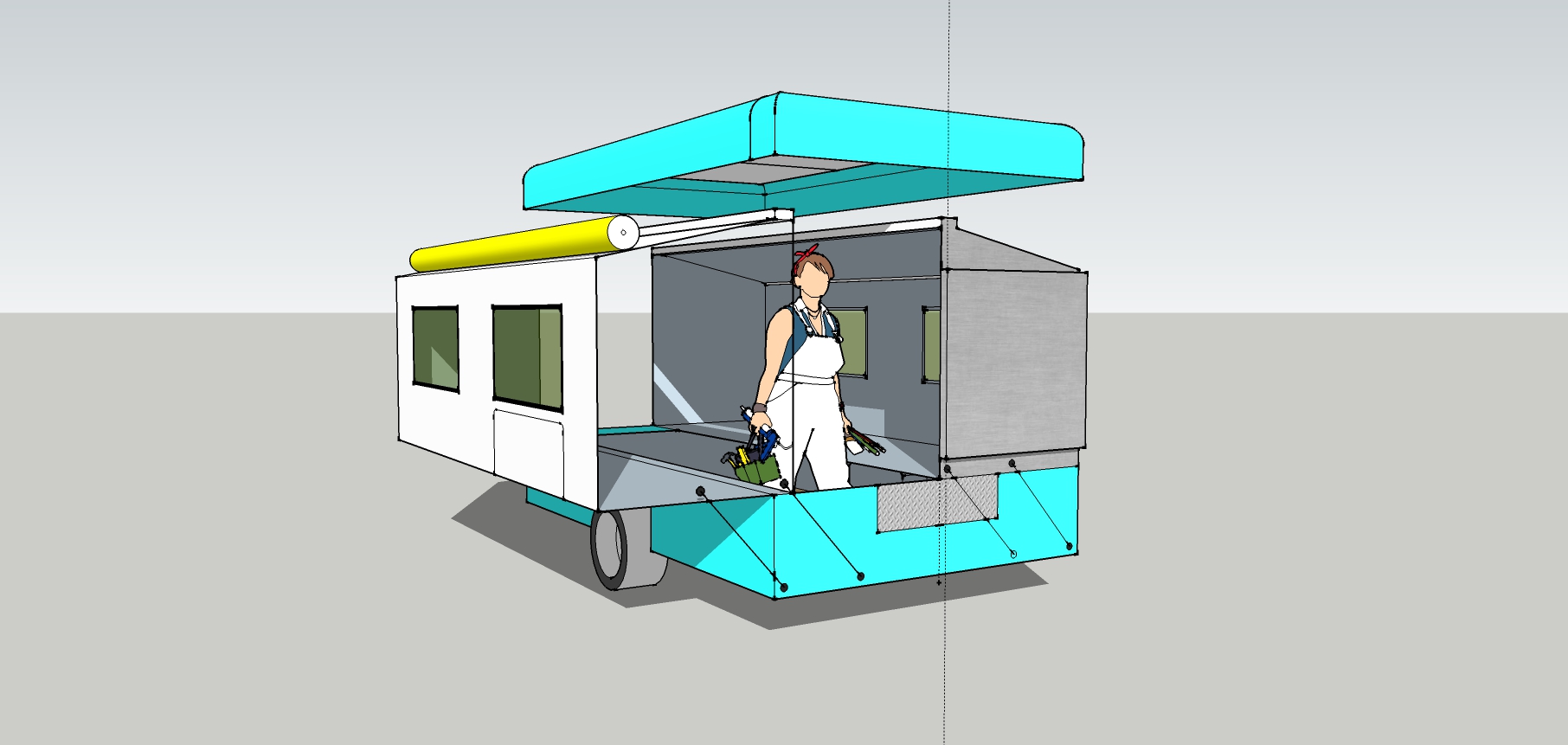
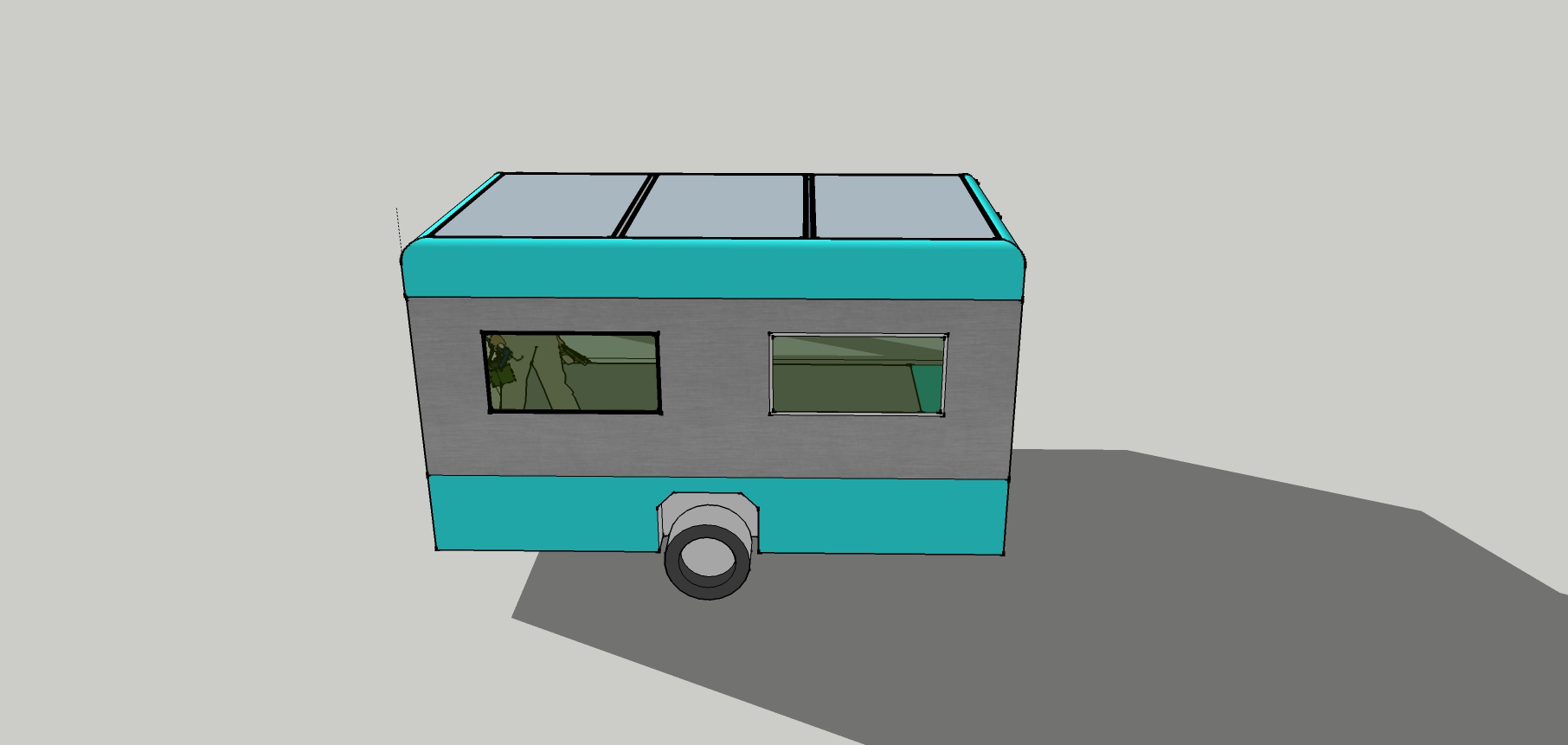
Wouldn’t it be great to have something that is smaller than a caravan for easy towing but bigger than a caravan when you arrive at your destination. lt would be packed tight with all your kit and then be opened up on site at the press of a button. A full off-grid energy system built in would be the cherry on top and a motorised satellite dish that gets the footie running straight away wouldn’t hurt either. And that brings us to the ……. drum roll …..
Original Twist Camping trailer.
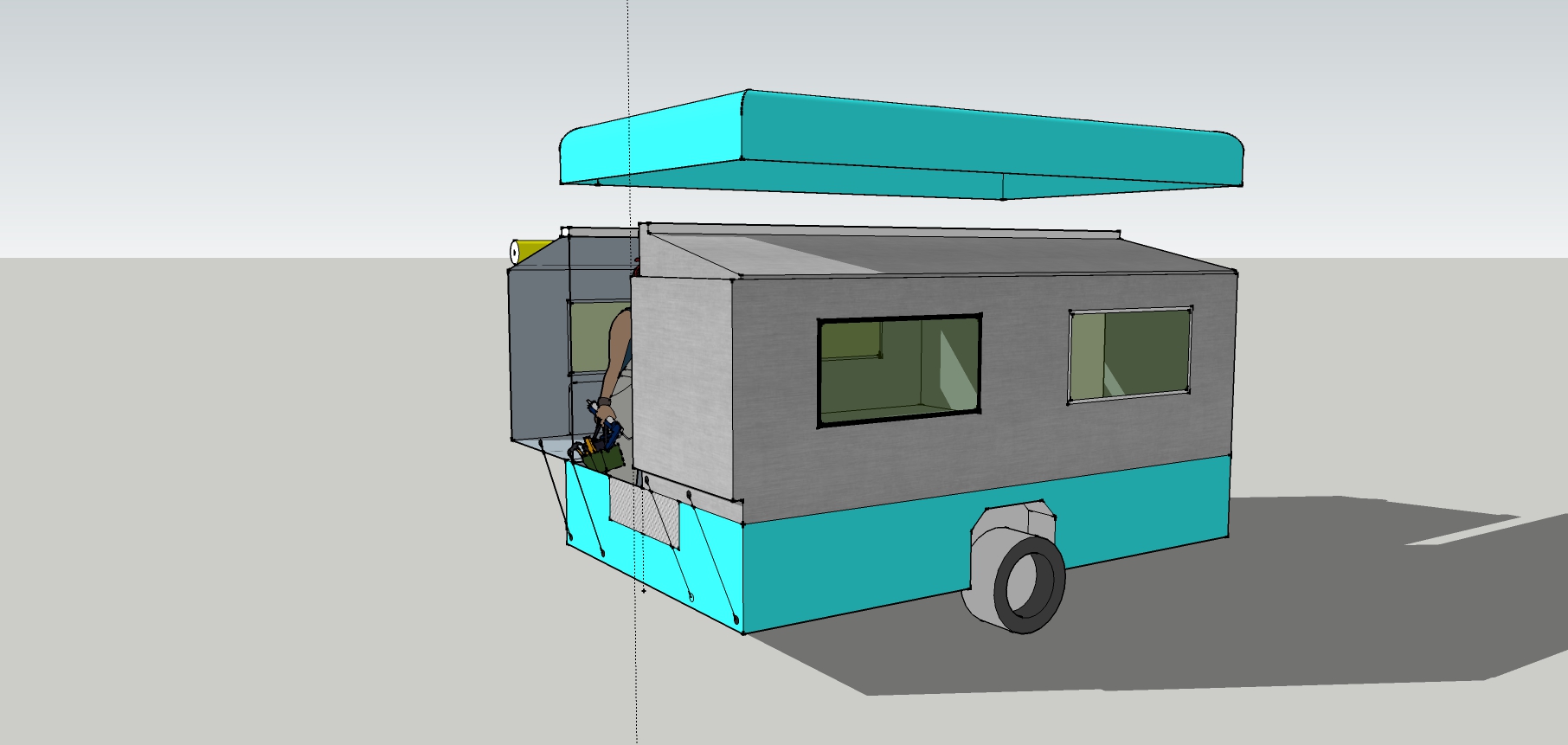
You know those tool boxes where the top parts push away to reveal the box underneath? Well this trailer is like a big one with wheels on. The door frames at each end support the roof and lift it just like a light four poster car lift. You arrive on site, the roof lifts up, the sides swing up and over then the roof closes down higher to lock and stabilise. You’ll see on the picture the links that let the side pods lift up and over to came down to rest on the sides They are steadied with torsion bars and chain and sprocket ties so powering it all is quite simple with one electric motor. The drawing shows one half closed and the other open; in practice both sides deploy together. The roof lift easily copes with the weight of the solar panels, dish, awning etc.
The side pods can contain beds with lights and TV built in and/or a kitchen unit. The choice is yours.
A shower room can be fitted over the draw bar as a separate cubicle that is entered privately from the main living quarters.
This design could be scaled up or down. Pictured here it starts as the size of an SUV, for easy storage and towing, but still sleeps up to 5 when you get there. A bigger version; longer by one solar panel and with 4 wheels, would be sensational when deployed; imagine rolling into the campsite and opening up straight away, the satellite dish locks on, footie on, beers out, all in about 2 minutes. A caravan that’s 4 metres wide before any canvas extensions go out! Stand by for a crowd of onlookers.
The generous PV array makes this very much off-grid but also raises an interesting question. If your electric tow car also had panels on the roof there could be significant range extension when all the panels are combined. In the new electric era tow cars will need all the help they can get. Note that the PV still works when you get home so it makes a useful uninterruptible power supply for your house – unless you park in your garage of course.
So there’s the idea. Does it exist? No, not yet, but let me know if you would like to build it and I’ll let you know how all the links work.
Features
Fits in a normal garage
Easy to tow – only as wide and as high as a car
Aerodynamic for economical towing
Automatic opening out and closing in a minute or two
Moulded in satellite dish recess on one roof, covered when stowed
Enough solar power to run air conditioning.
A solar/battery powerhouse
The drawing is done to fit existing 400W solar panels. Imagine a matching moulded roof on your tow car with another 3 panels fitted. A fantastic look and 2.8KW in total which is over 3 horsepower. Quite possibly this combination might be more economical to tow than a car on its own!
It’s not just about touring though. Plug it in when you get home and watch those electricity bills crumble. At next winter’s projected prices that’s well over £1,000 worth every year. While turning over energy ideas consider that your electric tow car has the equivalent of four Tesla powerwall batteries built in so your trailer and car is not only a monstrous power house when on the move but potentially a major part of your domestic energy strategy. Vehicle to grid chargers are the next big thing and more suitably equiped cars are already on the way. Interested? Have a look at a collection of heating concepts here
Heat pump energy delivery can be calculated using just 3 parameters. The flow of water passing through the machine and the inlet and output temperatures – that’s all. Heat pumps deliver energy at lower temperatures than gas or oil boilers so they need to flow more water to contain and transport that energy. That’s why the pipes coming out of a heat pump are fairly large. When that high flow is confronted by the slightly smaller pipes of a system designed for radiators it can get bogged down, even more so when the house has zoned heating areas and many parts are shut down. For these reasons the heat pump must be able to modulate the output flow – not all can.
The same 3 parameter calculation – flow and temperature drop – works for the heat output of radiators and for that matter, to heated floors. In typical 15mm OD pipes, leading directly off a radiator for example, flow will be around 7 litres/minute and, when supplied from a gas or oil boiler, at least 65C on the inlet, dropping to say 55C on the outlet (Dt of 10). The power extracted and delivered to the room in this case would be 4.9kW. So very hot radiators work well.
As flow is constrained by pipe size it is the design and size of the radiator that decides how much energy it can transmit and what the resulting Dt is. Heat transmission is restricted by any sludge on the inside and also the insulating boundary layer of air on the outside, just like the slower water flow near the banks of a river. The rate of loss of heat is proportional to the excess temperature of the surroundings, so clearly hotter radiators work best and also benefit from a stronger updraught which strips the heat off.
If we lower the temperature range to say 45 in, 35 out (typical heat pump) the calculation for power delivery would remain the same (Dt of 10 again) but the temperature drop is harder to achieve as the lower differential to the room cuts the updraught and also the heat transfer. The result can be a disastrous drop in performance – more than half. Your shiny new heat pump might have the nominal power output but the rads just can’t shift it to the rooms.
Assuming you are not able to dig up your floors for under-floor heating the solution is to blow air over the radiator surface to shift that boundary layer and replace it with cool air at room temperature, just like blowing on a hot cup of tea. That’s what fan-coil units do – they are fan assisted radiators and with their lower operating temperature they can make a heat pump system actually work. Alternatively bigger radiators would help, but as you probably already hate the smaller ones you have ,,,,,,,
Reverting back to our power calculation the other parameter is flow, so turning up the heating circulation pump speed is worth a try although pipe size imposes limits on this. Of course increasing pipe size is an often suggested solution and the right one if micro-bore pipes are in use. However my model suggests that the normal 15mm pipes will do as long as the delta T can be reached.
Quite often the main feed will be in 22mm pipe with 15mm take offs to the radiators. So just one pipe feeds all the radiators from your main heat source. This can easily flow about 14 litres/minute which with a 10 degrees Dt produces 9.8kW. The choice of power output of the heat pump is limited by the pipes it serves. Don’t buy a huge expensive heat pump because it won’t make any difference.
Of course if two or more pipes can be fed in parallel from the source then all these flow issues disappear.
Theoretically some heat pumps can deliver 60 degree temperatures but it is a struggle, particularly in very cold weather, and will result in a COP near to 2.5. Running costs will be worse than gas. Fitting fan-coils will lift the COP to about 3 and give much better performance all round. The order of play should be to get the heat pump installed then start fitting fan-coil units and turning down the set point as you go. Check out here for an inexpensive DIY fan-coil unit (pictured)
DIY fan-coil unit
At this point you might be dismayed to realise that your house needs more energy than your pipes and radiators can transmit. Don’t despair though. Have a think about installing a mini-split as well. These are independent, air to air heat pump units, quite cheap (under £600) and they can do air conditioning as well as make heat. They make excellent partners with PV panels which apart from running your heat pump in the winter will have masses of surplus power in the summer to run air conditioning.
2026 update. OK, the graph is now almost a decade out of date and house prices went up and not down. So why was I wrong and what next? We can get some insights by just shoving all those bars 10 clicks to the right and that immediately reveals the big mistakes. The big block of ‘buyers priced out’ grows up, earns more and moves into ‘the buyers‘ and simultaniously eclipses the ‘aged’ (supply) on their way out. The ‘working‘ bulge moved across to put its peak in the middle of its sector for a net increase in able property buyers. So that seems to be the current scenario which should prevail for a while at least. I got this so wrong before so maybe I should leave you draw your own coclusions for the future. A few thoughts to get you going though. First, give the bars another 10 year shove to the right so a total of 20 now. The ‘kids at home’ become even more ‘priced out of the market’ and their dip moves towards the ‘buyers’ section for a significant decline in future buyers. The boomers population peak (mid to late sixties now in 2026) will be retired and replaced by the following population bulge who form a significant cohort of house buyers.
What demands some deeper thinking is the attrition line where the far right of the graph inevitably has to dip towards the 100 mark. The boomers bulge is getting rather old and the attrition line must become steeper. It’s like the graph is made of ice cream with a heater causing a slump on the right hand side. Today the Boomers’ peak is already significantly lower than the following bulge – attrition starts early – although immigration has some bearing on this. The bottom line, I suppose, is that while more people are going to die than ever before (and the housing stock will proportionally increase) the dip between the two big bulges is moving on. It’s at 47 now and at a point where house ownership has already happened. The following bulge is large and wide and having once been ‘priced out of the market’ this group is springing back like a rubber band being finally released. All this points to a stable and growing market for a while. The continuing fall in the birthrate will change all this eventually but that’s another story for the next generation to worry about. Will AI make future buyers richer or poorer? Global debt, inflation, tax burden, student debt, ageing Western poulations all muddy the waters. Plenty of food for thought.
If everybody in the U.K. was made to stand in line according to age they would make a giant bar graph like this. Your place is there too; as you grow older each year your own line takes a sideways step to the right, and so does everyone else’s.
The steep ramp down to zero starts earlier than you would expect, from as young as the mid fifties. This is due to population growth (fewer people were born in the past so the corresponding lines are smaller) and also early death. You don’t have to wait for old age to join the 542,000 deaths each year; over 300,000 die from cancer, dementia, heart and stroke, all of which can strike prematurely.
The chart illustrates how demand from an ever increasing population made the meteoric rise in house prices inevitable. Look at the biggest and tallest block on the chart – the sixties baby boomers. The biggest population surge ever seen, grew up, got jobs and bought houses as fast as they could be built. Easy access to cheap money accompanied the latter days of the surge so it was inevitable that the run in prices would continue into territory that now looks uncomfortably overbought. That is just the nature of markets.
Once the rush started a new ‘truth’ emerged. With prices perpetually rising, for many borrowers there was no question of repaying their interest only loans; they could always sell at a profit, pay off the debt, buy a car and live happily ever after. This sort of thinking actually worked when prices kept rising; even the lenders got sucked in as their loans appeared to be safe. Old habits die hard it seems but what happens to those loans in a stagnant or falling market? Debt is a deferred payment which has to be paid by someone. Could it be that current buyers are not fully aware that they will have to pay back every penny? Now those mad days are over some recent house purchases may never be paid for, much to the chagrin of the lenders. An unfortunate knock-on from this mistaken optimism is that it inevitably depletes the inheritance tally of the next generation and their ability to buy a house.
Today the bulk of the boomers are middle aged, employed and at the height of their earning power, they mostly bought their houses cheaply and have seen their equity rise enough to borrow against it. There is a smart car on the driveway (brand new for one in ten households), holidays, restaurants, life is good. The bounty doesn’t stop there though, their parents are dying, a house is inherited to be sold or rented out. If only life could be so easy for everyone. The chart says no.
After the peak of the boomers the birth rate started to decline, 13 years in a row, and that signaled the end of their powerful influence on property prices and a lot more besides. The big arrow on the left of the chart shows the annual birth tally in gentle decline for the last 50 years. For now, births still exceed deaths so the population is still growing but births initially make more expense for the very group that is already struggling with high house prices.
The arrival of the baby boomers caused some seismic but positive effects and now, as they start to retire, we can expect to see some negativity as those effects are reversed. More people will retire for each of the next fourteen years until half the current block of baby boomers is drawing pensions with the other half still to go. From 2020 on, retirees start to overwhelm the young earners (backward slope in their area) coming up behind them.
The chart has an even bigger story to tell. Note the two big arrows on the chart and the abrupt change in direction just where the baby boomers peak occurs some 50 years ago. This is a momentous event not seen before for centuries; it signals the end of population growth and the start of a new ex-growth era. The effects of this will be profound, affecting pensions, business, stock valuations and more. As the change takes place the money – that washed plentifully over industries like travel, baby goods, retail, house builders and automotive – is drying up, with results that have recently been all too obvious. Sector by sector is succumbing to a lack of cash. The change is well under way with a lot more to come. House prices will be next. Ironically, as the wealthy baby boomers decrease their spending the resulting job loses are born by the next generation and job uncertainty holds back house buying decisions.
The Government will have to fund all the extra draws on the NHS, pensions, debt funding etc. by increasing taxes or borrowing more. But with the number of tax payers declining the Government will have to sell more bonds and this at a time when pension funds become net sellers of bonds (to pay out the pensions of course). With fewer buyers for bonds the only way to make them more attractive is to raise yields and this devalues existing bonds so even more have to be sold to pay the pensions. This is just one example of how ex-growth U.K. faces some intractable vicious circles. The point though is that this puts upward pressure on interest rates. The bank base rate is now 0.75% so there is very little scope for a fall so when change does come it is likely to be bad for property prices.
Excess personal debt is a major threat to property prices. On the surface daily life looks normal and secure but in reality it’s artificially and precariously propped by debt. We’re flying by pulling on our bootlaces. Whether through poverty or imagined wellbeing, personal debt continues to grow. Average household credit card debt is now £2,603 – pretty astonishing for the average. It seems unlikely that anyone needing this much debt can pay it back very quickly and it is predicted that the figure will increase substantially in the next 4 years. Average adult debt for everything including mortgages is £59,823. With record debt there is hardly a wall of money heading towards the property market.
Then there is government debt. As the retirees swell to well over 17 million that produces an annual pensions demand of around £170 billion not including the extra demand on the health service. The pensions industry and the Government need to be ready for this. The former already have their prudence being tested (or exposed) by the ex growth phenomenon but the problem for the Government is more acute. Pensions have always been met by the expanding set of workers following behind; a system that always worked when earners were growing in number. After centuries of habit forming complacency that era is now over. The new paradigm must involve extra taxes and borrowing. In contrast to the private pension system there is no Government pension pot, just borrowings of over £1,800,000,000,000 which is £56,000 per taxpayer and nearer £75,000 when future pension obligations are added (a promise to pay in the future is a debt). With talk of ‘fiscal headroom’ and post Brexit expenses looming these totals will certainly increase. There is talk about the end of posterity but that’s a word we can expect to see again.
The property boom has divided society into two halves. The people on the right half of the chart live in houses bought cheaply and they are very well off. All the people on the left don’t have a house and can only ever buy an expensive one; after rent, rates, general living expenses these are the people with credit card debts instead of savings.
Take the younger group shown in grey; they are starting out on their careers with little chance of buying a house of their own except via inheritance or parental gifts. The national house price to earnings ratio might be at a peaky 6 but that’s an average. Take a typical cookie cutter house in the south of England for £450,000 and the average wage of £26,364 and the ratio is 17; totally unsustainable, especially as hopeful buyers trapped in expensive rental properties are more likely to be in debt rather than building a savings pot. Let’s be clear about house price to earnings ratios; if the ratio is 17 then it would take ALL your earnings over 17 years to pay for it, and that’s before interest. Potential buyers for houses at the current prices are not in this grey group.
Obviously there are buyers out there, not very many though and declining by the year, but there non-the-less. In the home counties in particular properties are being bought by new millionaire Londoners cashing in before prices retreat further.
And buying still makes sense right? The agents saw high demand for these high priced houses which were sold quickly too – business was booming. Hold on, hold on; that’s the first danger sign slipping by – high turnover. Turnover so high that your local high street can support several estate agents (but no banks) – something weird there. When there are too many buyers or too many sellers there is an imbalance and transactions are relatively low. When there is a transition from one state to another there is a period when sellers exactly match the buyers; perfect conditions for a peak in transactions and peak agents. Logically, when transaction volume is high the market is turning. What looks like a buying frenzy is actually a subtle warning sign. The bubble is about to burst. Is that now? The house builders, are no longer making hay – maybe change is in the air?
A market correction has never amounted to much before and setbacks have always been ironed out over time. You can’t go wrong in bricks and mortar can you? Well things might be different this time. At this point we hear the call ‘there is a massive property shortage so prices can’t possibly fall’. Actually there is a shortage of ‘affordable’ property, but there is no shortage at all of ridiculously expensive properties, the market is flooded with them. You might note how half of them have price reductions; they are not exactly being snapped up.
It would be no surprise if Brexit goes down in history as the trigger that turned the property market and burst some other bubbles too. The transition will certainly be disruptive in the short term. There are thousands of areas where there will be a threat to jobs and in turn a threat to property prices.
Watch the pound carefully while Brexit unravels. Any need to defend a weak currency could raise interest rates and that will make holding or buying property even more expensive. Actually it makes everything more expensive; a country with a huge debt burden can only expect huge interest burdens when rates rise.
It can’t be sensible to be invested in an overvalued asset class while all this is going on. Buy-to-let investors (already taxed and stamped) are reasonably liquid and might well see the sense in locking in profits right now. Any obvious downturn in the market will set them selling and after that most buyers will step back to watch the fall.
So, to summarise; property prices are unsustainably high, the money that bought them was easy and cheap but is now evaporating. The ex-growth G.B. effect has kicked in disturbingly early with still more jobs at risk. The market may be turning now, or very soon, and when it does the fall will be sudden and without respite. Bubbles don’t burst quietly.
Follow up March 2020: Well there we are; the pin to burst the bubble has arrived and all sorts of unexpected consequences are popping up. One yet to be seen is the effect on the lenders as their clients lose their jobs and maybe even their lives. In short they have lent on overpriced collateral to clients who can’t pay them back. A black hole in the accounts will decrease the funds to be lent. If turning off the money tap doesn’t trouble the property market I’d be very surprised.
Cheap PV panels have radically changed a few of our preconceptions about heating. The heating system layout has become much simpler (and less expensive) as under-floor heating and wet solar panels are deleted and heat pump connections are simplified.
heat pump – heating and cooling
The heat pump connections are easier thanks to the Original Twist Hybrid Heat Pump which indirectly supplies chilled water without breaking the rules for the RHI incentives. Note that the system copes with 2 set points from the heat pump; hot water is routed to the hot tank while the heating is kept going with stored energy from the cooler tank. For the lower set point, heat is sent directly to the cooler heating side without disrupting the stratification in the hotter tank. The system can heat either tank while simultaneously supplying chilled air – how cool is that? An extra immersion heater helps use all that extra PV energy and for absolute perfection I’d have an external one – e.g. the Willis (no short cycling and easier to service and delivers heat to the top of the tank).
The cool tank has a large coil to preheat the DHW going to the hot tank heat exchanger and now there is a large choice of suitable tanks thanks to the heat pump drive. 3sqm of coil surface is common.
You can see the original system here along with a long list of all the benefits which still make this the best system on the planet.
You might have sussed that with 2 tanks here and another from the heat pump system your tech room is going to be large and, dare I say, impressive. I imagine all the tanks raised slightly on a low wall with wooden slats across the top. This allows most of the pipes to be hidden. The tanks are often raised when a wood burning stove is connected and gravity circulation is required.
What’s the point? Well it’s all about integration of multiple input sources, like a wood burning stove or a gas boiler along with a heat pump. Many experts say you can’t integrate all these things but they are wrong.
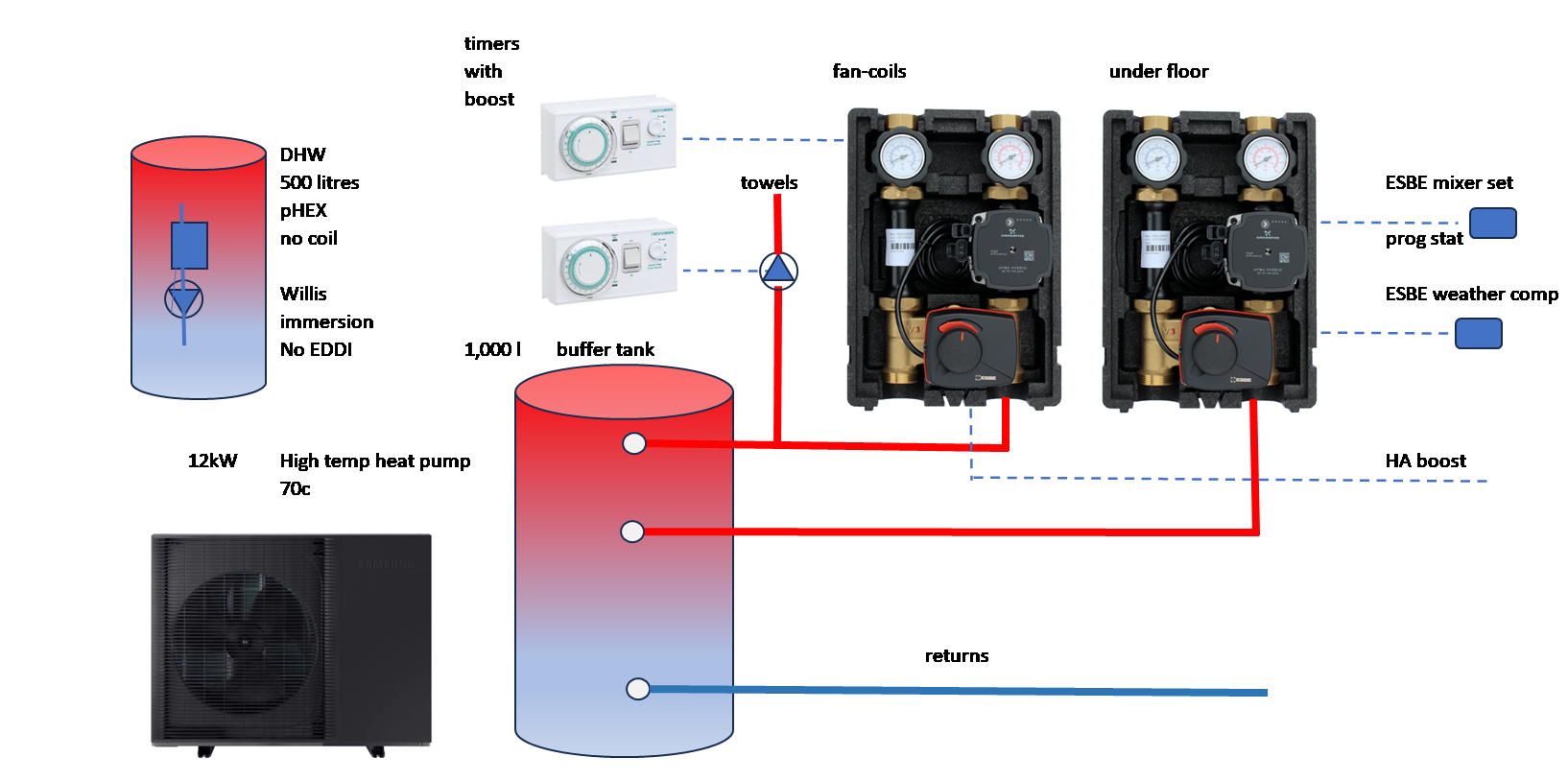
There is a commonly recurring problem with heat pumps and that is that existing pipework is too small to deliver much more than 6-10kW. The solution, of course, is to stick with the low powered heat pump and add a mini-split air to air heat pump.They are cheap, independent of any existing systems and they do aircon. This immediately ducks all the attendant problems with transmission and low power and makes the whole set up even simpler.
With a mini-split on board you might go really simple and have just one heat bank, a wet connected stove, a gas boiler (get one while you can) and no other heat pumps. All very simple and enough money saved to buy some PV panels.
Heat pumps of all sorts (ground source or air source) are going to save the World. The debate over ground or air rages on but is largely irrelevant when a hybrid design could cherry pick the best bits from both. Both suck heat out their surroundings and pump it to a higher level. You get 3 or 4 times more energy out than is put in, a seemingly impossible engineering miracle which still, for many, defies belief. The in-out energy ratio is the coefficient of performance or COP.
First lets join the debate about ASHP vs GSHP by comparing the COPs of both across the season.
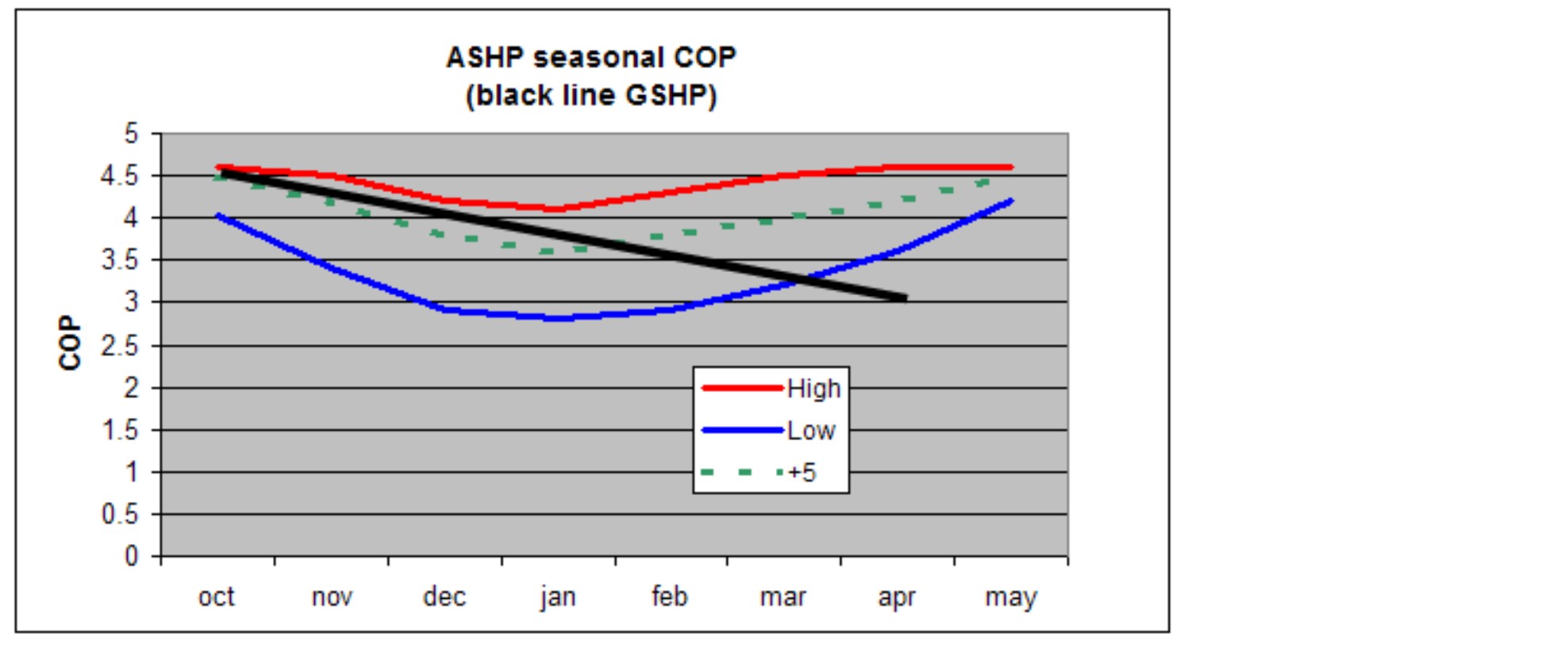
The ASHP operates in a wide temperature range between the red line (day time running) and the blue line (night time running). Cold night time temperatures look pretty disastrous but warmer day time running produces consistently high COPs. On the black line the GSHP does without the wild swings and gently declines in performance as it sucks the heat out of the ever cooling ground.
Day COP vs. Night COP
While the GSHP (black line) gradually loses performance over the winter the ASHP can always do better on warmer days (red line) making the two systems closely matched during the daytime, up until Christmas anyway. Soon after that the daytime COP on the air source starts to improve while the ground source continues to deteriorate. The only redeeming feature of the ground source is that it is miles better than the air source blue line on dark and cold days or, as some might call it, winter
Even though the GSHP rules the night an ASHP system geared towards more daytime running would be a match for the much more expensive GSHP which, let’s face it, doesn’t always need to run at night at all.
However, some new electricity deals for electric car charging (7.5p/kW.hr at night) make a GSHP, with more night time running, quite compelling. It might be thermally less efficient but the running cost is only 25% that of daytime rates. So while this system favours daytime running it also supports the concept of running cheaply at night and storing the energy in big tanks. See Off-peak energy storage for cheaper heating
If only there was a system that could cherry pick the best COP line on the chart for any given moment. It would need to extract heat from the air on most days – red line – and extract heat from the ground at night – black line. The air side would not run at night so the blue line can be ignored and the system would cherry pick between the red and black lines. The average COP over the season would be around 4 which is better than either system on its own, so best in the world then. Luckily designing such a system is easy really and not particularly expensive either.
Original Twist Hybrid heat pump.
GSHP unit
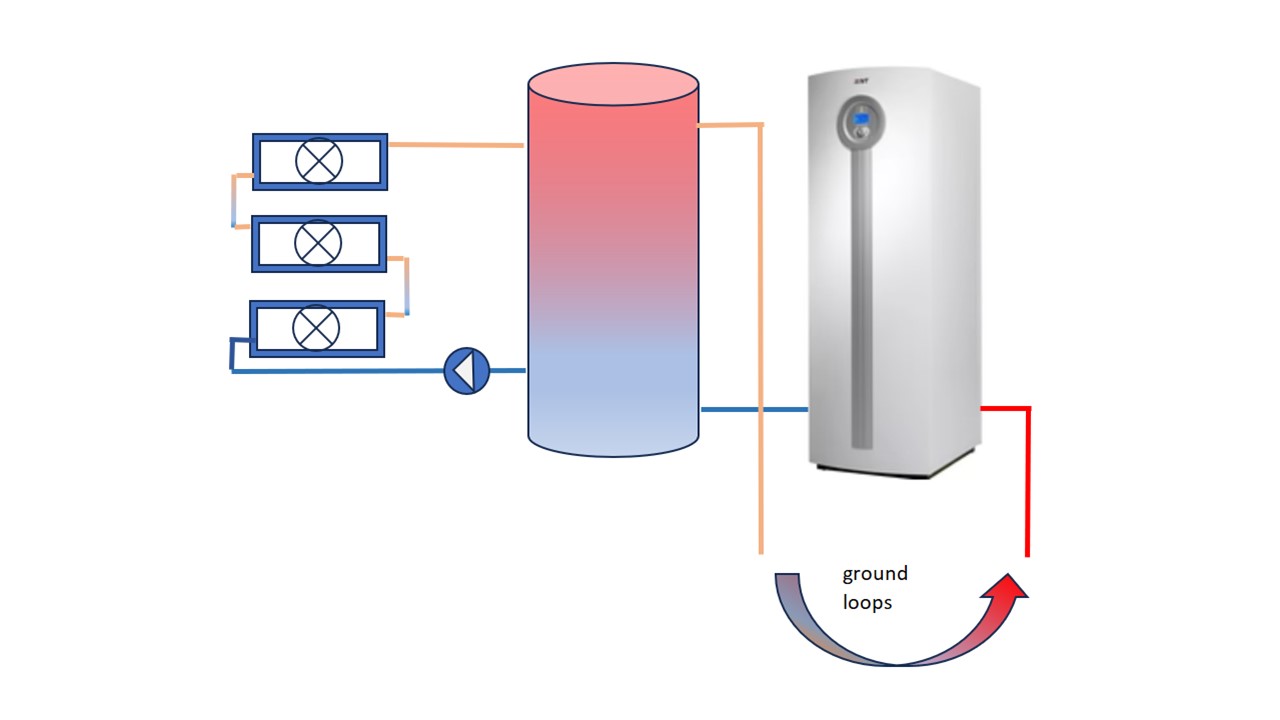
For the core of the system we start with a GSHP unit. As the name implies we need to feed it with some warmed water from a ground loop or slinky and more on that later.
Air source module
There is already water going in and out of the GSHP unit so warming it with air is simple.
There’s a pipe coming out of the GSHP unit and to the slinkys and we need to insert a buffer tank here. So far there is no change to the performance at all until we go on to warm that tank with air. Just connect a circuit incorporating an air handler unit, that is to say, a large heat exchanger with a fan on it. This is only connected to the buffer tank and is completely independent.
A few car radiators (surprisingly cheap) and a fan or two to make the equivalent of an air handler for about £200. 12v fans for cars are waterproof and easily available. It starts on a simple solar controller whenever it can contribute. Any time the air is warmer than the tank -click – the pump and the fans kick in. While the size of the buffer tank is not critical, bigger is better and 1,000 litres would not be unreasonable.
Warm air is a great resource so we decouple the air source module and let it run whenever there is a benefit, whether the heat pump is on or not. The tank will nearly always be available to charge when the heat pump is running and supplying an icy return flow on its way to the slinkys. That return flow will usually be around 0c or even less and the ambient air is usually above freezing so the air side will be making a usuful contribution most of the time.
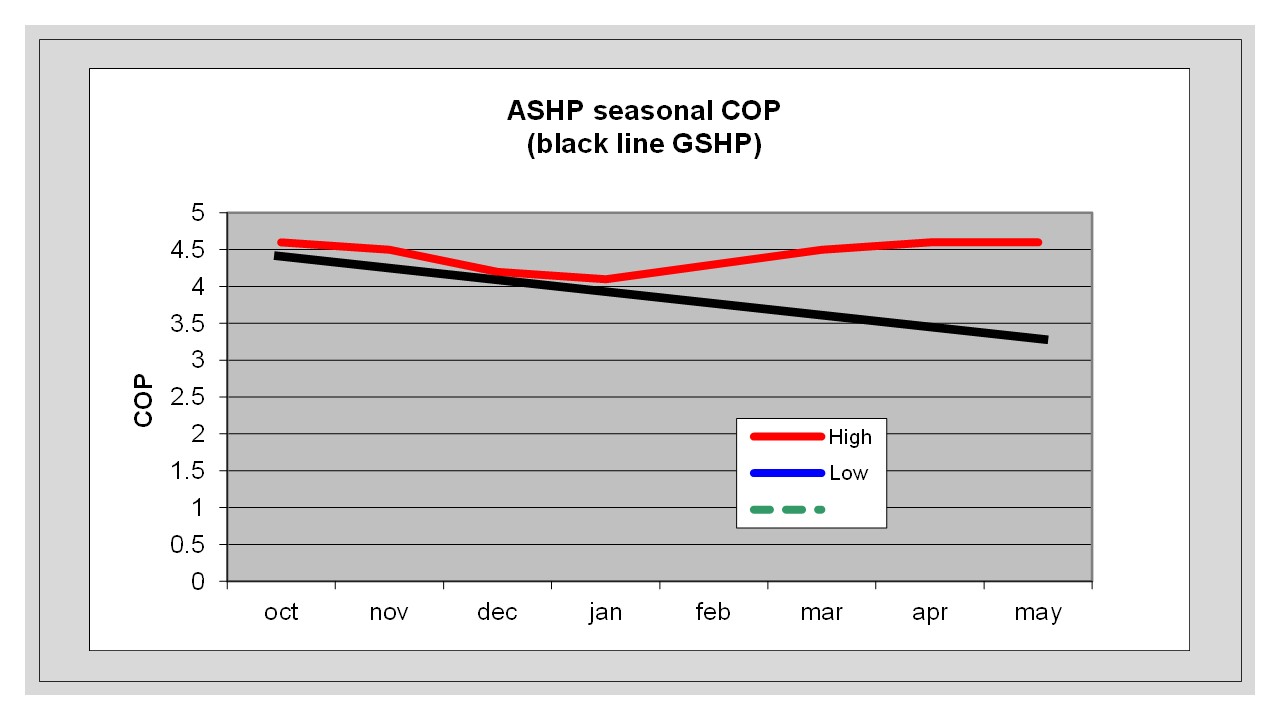
When the tank is warmed up the flow back into the slinkys is highly beneficial by raising the COP line slightly and delaying that end of season fall off in performance. The straight black line on the COP chart will bend upwards into better COP territory as shown in the new chart and it should even flatten out completely at around 4. Note how close that is to the daytime red line a bit higher up and how much better than the blue line we discarded in the first chart.
Slinky coils
Normally the ground starts the winter at around 12C then the GSHP and cold weather gradually take that down to around 0C. Permafrost around slinkys is not unusual. Normal ground loops are designed to perform at the worst end of this so they have to be huge. Not so with ours which can be smaller because:-
The ground starts the winter overcharged. We dump heat into it in the summer.
Frequent recharging takes place.
The cold return is usually pre-warmed by the air side before going back to the ground.
Towards the end of winter, as the air warms up, the Air Source contribution matches most of the load. The end of season performance stress on the slinky is avoided so the design is less critical and it can be considerably smaller.
I’ve done a job where the slinky was trucked down from Switzerland along with a man in a white coat and a bill for thousands; a bit over the top when polyethylene tube from the local builders merchant is just as good and costs under £300.
N.B. The pipes are filled with antifreeze and there are regulations about ground pollution so you can’t be too casual about pipe specification.
Pipes for the air side and the slinkys
It’s important to note that the power eventually delivered by the heat pump has to come from the air side or the slinky or both together. A quick look at my model for power and flow shows that for the air side the pipes will have to be 1″ at least to flow enough to raise 10kW on a Dt of 6 degrees. Same goes for the slinkys where on the same parameters the water would be in one pipe for around 2 minutes so it would almost certainly be better to have 2 slinkys in parallel to make that 4 minutes and 3 slinkys would be even better. A rule of thumb is that 10m of slinky trench makes 1kW so 100m for 10kW. Most of the time the air side and the slinky would run together so reaching 10kW would not be a problem even if the slinkys were cut down a little. However if the space is available I’d still go for the 10m =1 kW rule to be sure that there is no stress during prolonged cold weather.
Solar powerhouse.
Just a thought. If all this kit were built into a small shed with sun facing glass sides it would be easy to fit the fans into the back wall and the heat pump onto a shelf for easy access. The solar input would raise the COP slightly and a few black water containers would store heat to ward off radiator frosting. To go even further, the air side could be boosted by big ground heated tubes which typically are good for a lift of 5 degrees. There would be wooden slatted duck boards on the floor to let the air up. So, with all this, not just best in the world but best of the best in the world. Picture below.
Summary
So that’s it. Better COPs than a GSHP or an ASHP, aircon, ground loop recharge, smaller ground loops and a better match to PV panels (more day time running). The smaller ground loop might just swing this for owners of regular sized gardens.
Ultimate Eco-heating system
If you are looking at heat pumps then I’ll assume you will have seen this heating system which particularly favours daytime running of Air Source Heat Pumps, a feature in keeping with the free power from PV panels.
This system has been revised and simplified. Revision 2
PV overclock and tilt
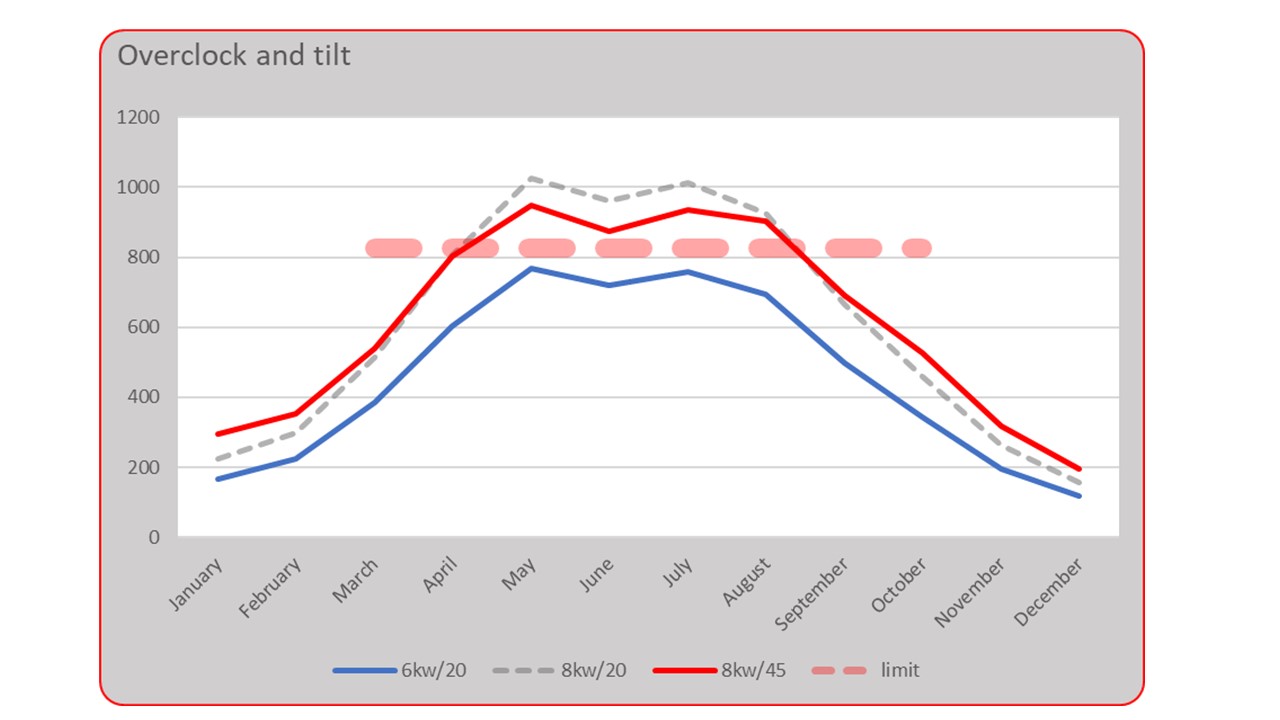
Using big PV to go off-grid – or nearly off-grid – makes sense especially when driving a heat pump. You’ll need every trick to make a limited energy supply go further so make sure you check out the 6kW overclock and tilt concept.




 Original Twist