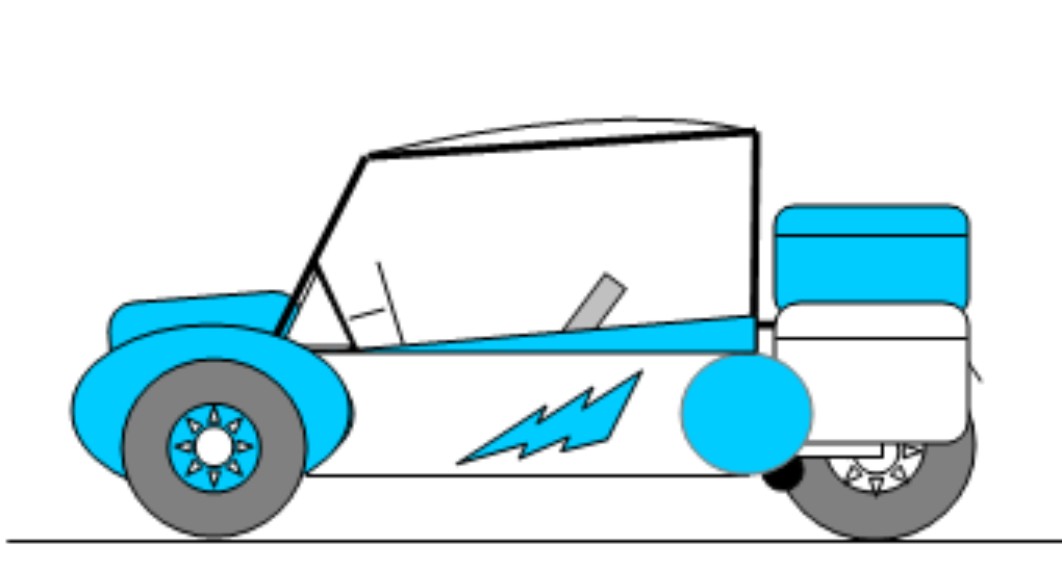
Original Twist hybrid electric 3-wheeler

Original Twist 3-Wheeler

Original Twist 3-Wheeler

OK – so the next automotive era has arrived and all car makers now offer some variation of an electric car. However, despite thousands of people with free home-brewed solar electricity just itching to go electric there is nothing economically viable on offer. Here then is an attempt to define what would be a workable, even desirable, alternative.  A lot hangs on the price.
Anyone paying the London congestion charge could be paying an additional £2,000 a year.  If one spent £10,000 on a vehicle that was exempt it would immediately give a return of 20% on capital so that suggests what the lowest price might be and even double that would still be economically feasible.
Let’s set a price target of £10,000 – £15,000 and define what sort of attributes most users would want:
Safety – very strong with above average crash sustainability. Not like a Sinclair C5 then.
Seating – for 2 adults and a rear parcel-shelf seat for occasional use, children and baggage.
Range – a normal daily commute of a 25 mile round trip entirely on battery power.
Range – a small combustion engine to give unlimited extended mileage.
Parallel hybrid – both power sources used at once if extra power is needed.
Plug in hybrid – batteries charged at home or by range extender engine.
Performance – equal to or faster than normal traffic.
Luggage – similar capacity as any other small car and much better than a microcar.

The key to economical motoring is lightness so from the start let’s begin with a 3-wheeler with two wheels in front and one behind. At a stroke this dispenses with some heavy things like a differential, axle, and one back wheel with suspension, brakes and associated bodywork.
With some heavy batteries mounted low down between the front wheels there will be no stability issues.
The power train couldn’t be simpler. The rear wheel spindle is mounted in an ‘H’ shaped swing arm, just like a motorcycle, with a chain drive to a sprocket that spins on the same inboard spindle that the swing arm pivots on. This sprocket spins alongside 2 others whose chains run up to the main power shaft where dog clutches engage either one to give high and low ratio drives. The transverse power shaft has a push on drive coupling on each end to connect an electric motor on one end and a small single cylinder petrol engine on the other – it’s that simple.
The permanent magnet Lynch electric motor produces maximum torque from a standstill so there is no need for a clutch. It also doubles as the starter motor for the engine, a regenerative braking charger and can run backwards to provide reverse gear. Dispensing with a starter motor, alternator, gearbox, prop shaft, clutch and reverse gear puts more in the ‘saved weight’ account. Electric power is a useful 20bhp with 40bhp available in 5 second bursts. By comparison the original 850 Mini had 33bhp but weighed 70% more than our target of 7cwt.
The electric motor and the 10kW.hr battery pack is sufficient for general short trips of up to 25 miles and perfect for city traffic creeping while adding in the petrol engine produces lively performance up to 60 mph for bigger trips on the open road.
The slightly modified Honda 200cc GX petrol engine only weighs 35lbs and produces 9bhp; adequate for performance boosting, charging, range extending and even as a limp home device. It can be replaced for well under £500 (clones are £200) and after 5 minutes of unclipping could be left behind for servicing.
Maximum combined power is 49bhp to give a power to weight ratio of 150bhp/ton; it will be nippy.
Of course the design could have substituted extra batteries and an extra electric motor for the petrol powered assistance but the logic is that some petrol power enables the driver to set out on any journey with confidence.
With an Indian made Agni electric motor (very similar to the Lynch pancake motor) this car would make great third world transport with India to start with. Tata this is your new super-cheap world car!
A £100 programmable logic controller is used to control gear selection via the clutches and the potentiometer throttle pedal. Regenerative braking is controlled but limited if the rear wheel tries to lock up. The same idea also provides optional launch control and safer driving by restricting wheelspin.

3 power modes are selected by a dash mounted knob;
Electric
Engine +
Range.
The ‘Range’ mode uses ‘engine +’ to drive as normal but whenever the car stops, the engine revs up and starts charging the battery ready for the next burst of power. At the first touch of the throttle the engine disengages and the electric motor stops the power shaft to select first gear.

At the front end of the car a simple subframe makes a battery box with incorporated suspension mounts. A lightweight rack and pinion and unassisted brakes take care of steering and stopping; all very simple but maybe the biggest weight and cost savings will come from the novel bodywork or indeed from the lack of it.
Central to the strength of the car is the passenger cell made from 2 CNC machined aluminium sheet and plywood bulkheads all connected with 3 fat aluminium torque tubes and further panels in the same aluminium and wood sandwich. The complex bulkheads enable the suspension loads to be fed into the extremely rigid passenger cell as well as mounting dozens of other components. Design like this not only saves weight, cost and assembly time but the bare aluminium looks so good that there is no need to paint it.
A smaller stressed panel incorporates the dashboard where a matt carbon fibre like laminate sets off the Stack instrument panel and the selector knobs for power and varying the regenerative braking.
Behind the passenger cell there is no bodywork as such; a horizontal tubular hoop supports motorcycle panniers on each side of the back wheel and a top box over the top.
At the front a one piece moulding covers the battery box with a pair of wings over the wheels and partially down the side panels.
The narrow central roof panel is supported by two longitudinal roll cage bars which also provide hinge points for the gull wing window/doors. Similar to a Mini Moke (and the Mercedes SLS) there are no doors as such, just side pontoons.
To cut out the cost of regulations, crash tests etc the car will be sold as a kit car so customers will be expected to fit the engine and the wheels, perhaps with 10 minutes of help at the point of sale.
Can the price target be met? By raiding the parts bins for existing components and keeping it all minimal and simple the answer is yes. The result would be a characterful and useful eco-runabout with almost negligible running costs and at half the price of a Morgan 3-wheeler (with sales of over 1,000).
The Renault Twizy costs just £8,000 but battery hire costs £55 a month and it is hardly a useful all-rounder, and anyway similar mass production would make our car much cheaper.
This is just a sketch to hint at the full design. If you want to make one just let me know.

Tech notes: front suspension – wishbones but none sourced yet. MX5? Usual Cortina geometry from kit car uprights.
Rear swing arm – nice specials available for drag bikes at reasonable prices, just need a wide mounting to take side loads. .. easily made anyway.
Wheels etc .. 155×13” tyres at front … cheap and plentiful. 165×14” at rear.
Electric clutches … magnetic or dog clutches .. either would work … drag race air shifters?
A lock-up centrifugal clutch needed for the engine to provide limp home mode.
Roll cage; usual wide front and rear hoops connected by a close pair of tubes running from top of screen to rear and then down the rear bulkhead to pick up the engine/transmission plates. The rear frame extension is a loop of same width as the roof bars and provides a rear grab handle as well as support for top box etc.
The aluminium engine/transmission plates also provide swing-arm mounts, rear frame bracing and pickup lugs for the rear coil shock absorber units – a nice CNC machining exercise.
For a low car like this, gas-strut balanced self raising seats would be a nice touch to make getting in and out easier and the side pontoon height could then be higher for better strength and protection.
Rear corners of the passenger cell are fitted with sprung skateboard wheels to counteract any inadvertent tipping without damaging the bodywork. The Morgan F4 used to scrape the exhaust to the same effect (only tipping after C of G was raised with back seat passengers).

More on this topic in LIST OF POSTS

260mph in a 3 wheeler!

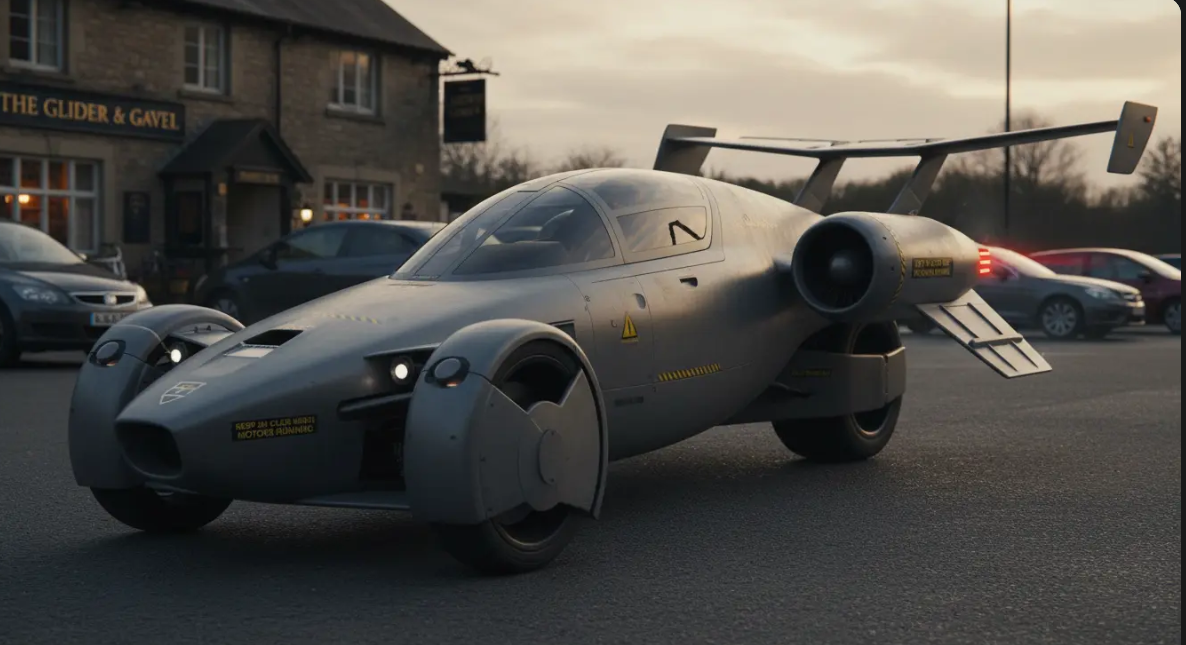
It’s in the pub car park, still hot and ticking slightly as it cools. It has a pair of wheels visible under some cowls outside at the front of what looks like a glider fuselage and a single, fat rear tyre can just be seen at the back. So it must be a vehicle of sorts, but the rear tail wing and the pair of jet engine cowls blending into the rear bodywork make it look like a combination of a glider and a Lockheed A-10 Thunderbolt (alias the Tankbuster or the Warthog). Unlike most cars this looks very military with matt grey paintwork and stenciled labels such as ‘Keep 2m clear when motors running’, ‘no handhold’. I just had to have a word with the owner.

Q: This looks more like a glider fuselage with two wheel pods on the front. Is it some sort of jet car?
A: It’s a very slippery and light 3-wheeler and yes the detachable canopy is from a glider.

Q: Does it have a jet engine then?
A: No it has a front mounted 600hp turbocharged 2.5 litre Subaru Impreza engine driving all three wheels through an automatic gearbox. The things like jet pods at the back are air intakes for the entrained exhaust powered water cooling. The brake lights are incorporated which gives the illusion of exhaust flare and sometimes the exhaust does proper flares too.

Q: Wow that must be pretty quick. I guess you could keep up with a Bugatti Veyron then?
A: It’s a close thing and really a battle for traction. Acceleration is about the same up to 120 mph with all 3 tyres trying to smoke but up to 160mph the computer controlled rear wing gives exactly enough traction to get the edge. After that we can flatten the wing and carry on to 260mph with the Veyron in our mirrors. We don’t need to compare ourselves this way though – it’s easier just to say that this is a match for the supercars but the quickest 3 wheeler ever. Although, having said that, we are working on the next version where the rear pods will partially fold in to give less drag and with that we are hoping for a few more mph.

Q: What about braking?
A: Backing off from 260mph gives 600bhp worth of drag. Slamming up the wing gives drag and downforce so we can pull 3G on the brakes – only a good idea with a full harness on though and it’s hard to hold your head up. In some ways the brakes are too good, especially at lower speeds, as there is always a danger of collecting all the cars behind you whenever you stop.

Q: Why isn’t the rear wing on straight?
A: The wing is computer controlled for downforce as well as lateral force, hence the sideways tilt. We literally fly round corners. It sounds silly but we park the wing sloping to stop people putting their drinks on it at the pub. The car always has a crowd round it and it was fun when the start up routine tipped all the drinks off the back but we thought glass on the road was a bad idea.

Q: So what made you build it then?
A: I heard about some Australian guys who had built a successful drag Subaru WRX and it struck me that the drive to the rear could just power one rear wheel and that would enable a streamlined plane-like body to be used. They were getting 600hp and the thought of that in something light and aerodynamic was too much to resist.

Q: So it’s a road car?
A: Yes it is used daily on the road and is easy to drive slowly. What really freaks people out is when we play a loud jet engine soundtrack on the stereo and the best bit about that is playing the sound of a turbine spooling down after parking the car. The main problem though is talking to people about it all the time.

Q: Oh – that’s me too I guess. Well thanks for the chat; will we be seeing any more of these on the road?
A: We hope someone will take up the design and produce the car albeit with a bit less power. The Thunderbolt was a spectacularly beautiful plane and its character should live on in a car.

More on this topic in LIST OF POSTS

Glass top PC in a desk

The Original Twist PC in a desk


PC components are so gorgeous you just have to put them in a glass box, so here is a layout for a DIY glass topped PC. What if a glass desk was used as the top of the PC? Even better; either way here is a computer and desk idea for your viewing pleasure.

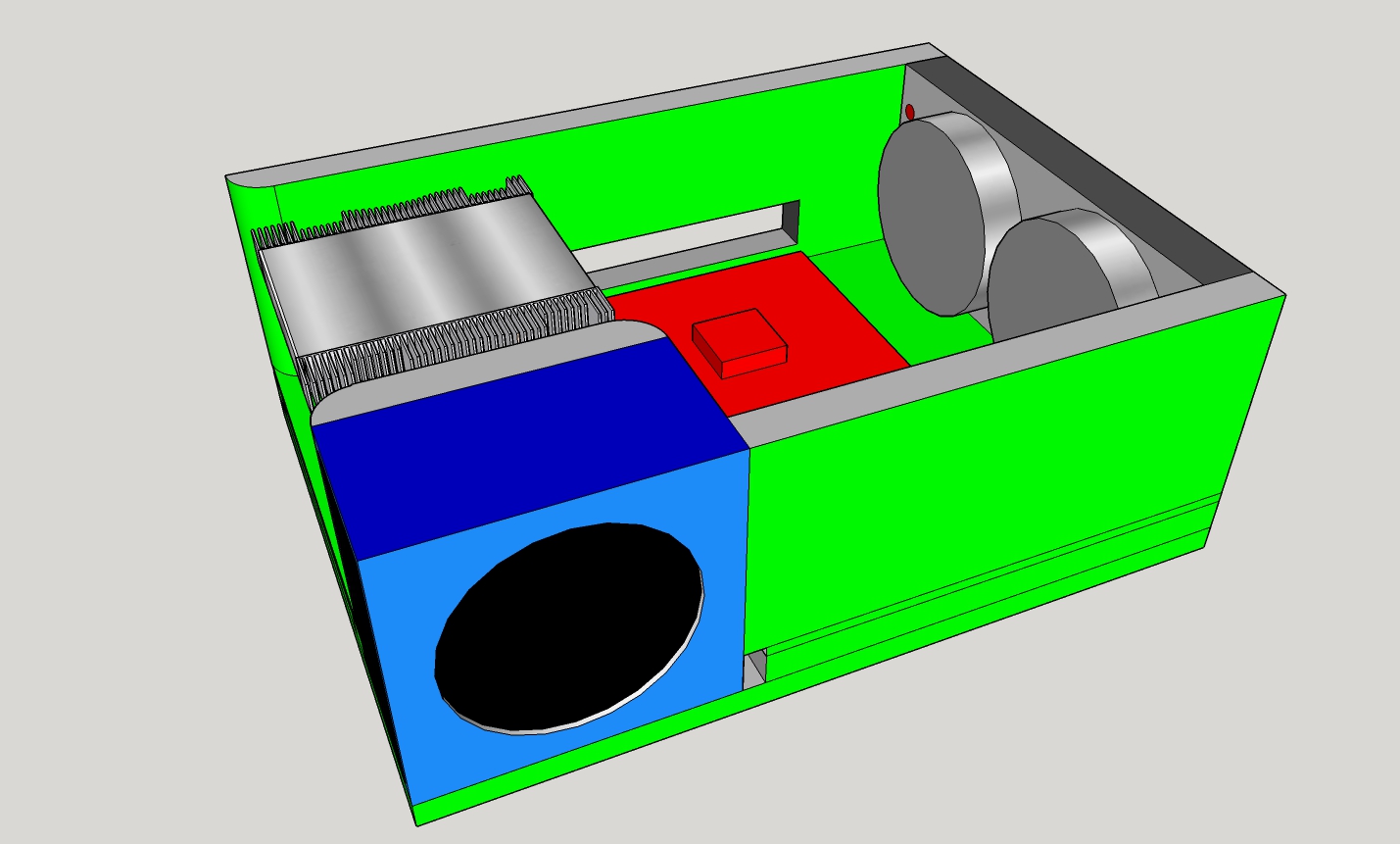
The MDF case is a perfect fit for the Corsair H100i cooler which fixes the width. The power supply fixes the height . The sketch here show how it goes together. A false floor hides most of the wires. The motherboard is raised slightly to give better airflow around it and the M.2 memory on the underside. The two fans on the cooler draw air across the box with the smaller inlet giving a fast airflow across the motherboard and the HDD.

The finished case will be bolted up under the desk using threaded pucks glued to the glass.
To flesh it out more we’ll go through the components that would make a great PC (July 2018) and then we’ll add up the prices using the uk.pcpartpicker.com web site. N.B. A gamer’s version will need a graphics card mounted externally – another box then and more bling.

Corsair H100i V.2 CPU cooler.
The whole design rests on this pre-assembled water cooler which will cool the CPU while its fans draw air across all the other components. It comprises of a pump block on the main processor chip with a pair of pipes connecting a large radiator with 2 fans on it. The air flow is choked across the narrowed section of the case containing the motherboard and the hard disk drive. The fans, controlled on the Corsair Link, will run almost silently unless heavy CPU loads are imposed when the full 77cfm flow will come into force.  Dimensions 276x125x30

Gigabyte – Z370N WIFI Mini ITX LGA1151 Motherboard     170x 170

Intel – Core i5-8400 2.8GHz 6-Core Processor

Without going into mega expensive chips this is great value for money. The H100i is well up to cooling this latest generation Intel CPU even when overclocked and the cooling limits are actually related to heat flow across the chip rather than the water cooler itself.

G.Skill – Ripjaws V Series 8GB (2 x 4GB) DDR4-3200 Memory

8Gb should be enough for most users.

Samsung – 970 Evo 250GB M.2-2280 Solid State Drive

This 250Gb solid state memory will ensure super fast boot up times and application loading. M.2 is neat too.

Western Digital – Caviar Blue 1TB 3.5″ 7200RPM Internal Hard Drive

This component looks great with passive coolers and sound damping rubber suspension. A couple of Akasa aluminium finned side mounts will look and perform well without significantly impeding airflow.

Corsair – 650W 80+ Gold Certified Fully-Modular ATX Power Supply – RMi 650i

650 Watts is greatly in excess of requirements but the bonus is that on light loads the inbuilt fan won’t even run at all. Like the H100i cooler the parameters can be viewed and controlled by Corsair Link on the PC. Quality is matched by the 7 year guarantee. The unit is modular so only the cables needed are used and being black and flat they will fit under the false floor and pretty much disappear in the case.
Note that the PSU is mounted on its side outside the case in a corner cut out; an arrangement that isolates the cooling from anything else going on in the case. The 150mm side of the unit determines the height of the PC case.  Dimensions 150x86x160

How much?
The PC parts, Office, Windows 10, and monitor come to almost exactly £1,000 which is remarkably reasonable for such a high specification.

Before you start – how about perspex for the sides? All those lovely bits would float in full view while you sit at your desk.

Please note: The cooling of components may be very much on the excessive side but even so this is all untried and should be treated as a suggestion and starting point for someone who is computer savvy.

Check out the silent PC in LIST OF POSTS

Bug-R-Off bug catcher gun

Bug-R-OffBug-R-Off Bug catcher
Spiders, scorpions, wasps, creepy leggy things; Bug-R-Off gets them all.

The Original Twist bug catcher enables any bug in the house to be captured with a single press of a trigger. It works like a one shot Hoover with a spring loaded piston causing an air blast to move the bug from a wall to inside the bug viewer.
The bug catcher is a short clear plastic tube with a funnel shaped trap at the front to enclose the bug and a cylinder off the side where the bug ends up after firing. The side cylinder is also clear plastic and incorporates a magnifying glass for better bug inspection.
The firing sequence. The piston has to be pulled to the front with a pull rod until it locks on the trigger stop. The pull rod is then pushed back into the gun and only then does an interlock allow the trigger to be pressed. When the trigger is pressed a spring pulls the piston back into the body of the gun and the vacuum causes air to enter the funnel trap and blast the bug into the gun too. Perforations at the back of the gun regulate the back pressure air and a twist collar can set the power from ‘Kill’ to ‘Kind’. There is a small hole at the very back of the gun which allows air to escape from the damper chamber which is simply where the back end of the piston ends up coming to a soft stop.
Just as the piston comes to a stop it uncovers the entrance to the bug viewer; the bug slams into the angled face of the piston and is deflected into the bug viewer along with some of the moving air. The entrance port to the bug viewer has some bendy hairs which give way to the bug and air but spring back to prevent the bug climbing out. After that the bug can be inspected and ejected by removing the bug viewer canister.

You saw it on Original Twist first. If you wish to use this design please get in touch using the contact form.