Solar batteries – not quite worth it

Battery prices continue to fall so their time will come and with enhanced export rates from ‘Axle’ it’s becoming tempting. If you are installing solar now, you’ll have to choose between micro-inverters, a direct to AC inverter or a battery based inverter/charger. For what it’s worth I’d go for Enphase micro-inverters and leave batteries for later.

Why not batteries now? I suspect these sums will seal the debate.

Let’s work around a hypothetical 10kWh battery costing £3,000. We’re assuming no losses so everything will be worse than shown by this basic maths.

Solar storage

Base line, use the free battery provided by the grid; export for 12p and buy back for 25.5p Here the free battery is charging a holding cost 13.5p per kWh. Think of it as a rental charge for an infinitely large battery that holds your inputs for as long as you like. Zero capital cost to you though so £3,000 in pocket; stick that in premium bonds for 10 years instead? Whatever you do, your battery project has to compare as an improvement over the virtual battery that is ready to use whenever you like.

Solar + Battery; input free, profit £25.5p so 12p better than the free grid battery solution. For 10kWh that’s £1.20 saving per day, so payback takes just under 7 years of surplus energy every perfect sunny day. So, in reality, about 15 years then. Is that fair? What about storing free energy and getting 25.5p worth later for a 3 year payback. Nice idea but that assumes 10kWh every day of the year, even the 200 days of winter. You’d also be directly consuming some of your solar production (practically all of it in winter) so you can more than double this estimate. 7 years? Possible but unlikely. And, sorry to rub this in, there’s still the grid battery available to you so these optimistic sums are based on a fragile platform.

Other interesting ideas

Off-peak storage sold to grid –   7.5p in 12p out – profit of 4.5p. For 10kwh that’s 45p/day. To pay back£3,000 would take 18 years but then more really because the batteries would die before that.

Off-peak storage used next day –   7.5p in 25.5p worth out – a saving over the grid of 18p. For 10kwh that’s £1.80/day. To pay back £3,000 would take 5 years. After that, the next 5 years drops £3,000 into your pocket but then the batteries need changing so it’s gone again. Close! But not overly compelling.

A bit of solar and a bit of off-peak

There’s a seasonal split here for sure. In Summer there is little demand for electricity and in practice, even with no battery at all, bills are pretty much matched by exports. In winter there is significantly reduced solar so the story is all about off-peak storage and we’ve covered that above.

Unfortunately, we have failed yet again to make a compelling case for battery storage. If that leaves you with £3,000 burning a hole in your pocket just consider that the payback time on solar panels is hovering around 3 years so make sure you have enough of them. Your money will do much more for you here.

Here’s a rough example for PV evaluation. Scale up to suit.

£1,400 buys 4 panels with microinverters. (Includes £500 for fitting)

Total 2000Wp

This makes 1,600 kWhrs a year

That’s worth £400

Payback is 3.5 years.

So, there you go. That £3,000 would buy you a nice solar rig and not a battery in sight.

Best heat pump on the market? – run it off-peak

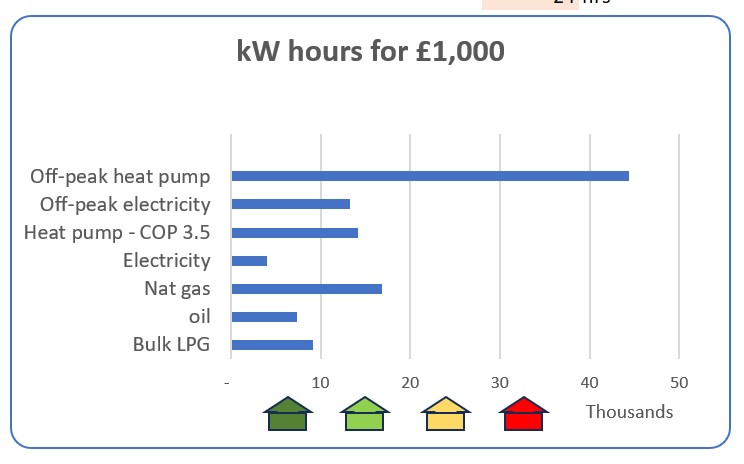
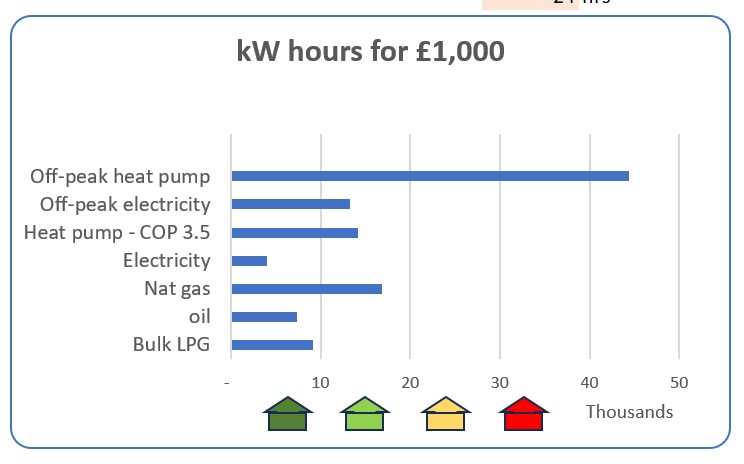
So many people are saying their new heat pump is costing a fortune to run. Well, they run on the most expensive energy available so what did they expect? This chart shows that heat pumps are no cheaper to run than gas boilers, so should you walk away from the idea right now?

Back to the chart though and WOW, look at that. A heat pump running on off-peak electricity will heat most houses for well under £1,000 over the 200 days of winter. So, no, don’t walk away; a heat pump run intelligently can be the best solution by miles.

But where is your house on all this? You can get there by extrapolating from your existing bill. So, say you spend £1,330 on gas (adding another third to that Nat gas bar) you are using about 24,000kW hours which puts you in the yellow house. Looking up to the ‘off-peak heat pump’ line, the same amount of energy would have cost about £500. The conclusion is that for any fuel and any house, a heat pump could halve your bills, but only if run on the cheapest electrcity.

How is that even possible? Well, it’s just simple maths. A typical small heat pump (12kW) consuming 3kW at 7.5p/kWh for 7 hours a night costs a mere £1.52. With a COP of 4 multiplier this makes 16,263kWh over 200 days for a mere £305. That would suit the small and well insulated green house. All this happens at night but we want heat during the day so now let’s talk about storage.The cheap energy has to be stored in water tanks (2,000 litres in this case) and there must be underfloor heating to use every last bit of energy in the tank. To get those cheap night rates you might need to have an electric car too. Any house better than the green house, Passivhaus maybe, will almost run for free. Going back to the yellow house, we’ll need 3,000 litres of water storage and a 17kW heat pump consuming 4.5kW at a total cost of £500. A fundamental point here; the heat pump is running fewer hours and needs to be unusually powerful to supply the energy total so it might need to be bigger than your supplier calculates.

The red house gets more interesting. 4,000 litres of water and maybe two heat pumps for an annual bill of about £600. For a deeper dive into all this have a look at the ‘Absolute ultimate heat pump system for large houses’. This explains how the system is put together along with some interesting enhancements.

War rattles heating bills

Plugging in the new April price caps and prevailing war driven spikes this is roughly how many kW hours £1,000 buys you. Gas and electricity will be fixed until July but oil and LPG will certainly remain volatile. Oil, for example, has shot up to £1.31 a litre (good chart on Boilerjuice) so if you are living in a big old leaky house, like the red one below, your heating bill will be over £4,000. Extrapolating from the bar of your particular fuel will give a good bills prediction with the orange house giving targets for most people using around 25,000 kW hours a year. As usual, at the extremes, a direct electric resistance heater is the worst thing to turn on (even half as good as oil) while the best strategy is to harvest cheap rate energy with a heat pump and store it in a tank for later use. While that heat pump trumps everything it is notable that off-peak electricity is currently better than oil or LPG; maybe night storage heaters are due for a comeback.

Trying to find a filling station that had any diesel left at all was a bit of a wake-up call; an electric car, with attendant cheap night rates, could lower heating and fuel costs while giving some protection from energy crises. Bi-directional chargers? Still ‘on the way’ but could be just months now so choose your car with care.

If these prices persist into next winter the Government will no longer be able to support the price cap so expect some unpleasant changes.

If this sudden price shock is prompting you to take some action you might take a look at Absolute ultimate heat pump system’ where there may be one or two useful ideas for your heating strategy.

Meanwhile, solar panel prices continue to fall and make even more sense. They pair especially well with a mini-split heat pump which is not only cheap to install (£2,000 ish) but gives a welcome addition of air conditioning during these hot summers.

Cheaper batteries are worth considering although payback times still look long. While export rates are falling the idea of giving access to your battery when the grid is stressed is looking tempting. Check out ‘Axle’ who will pay you £1 for every kW hour they take. For that money they can hammer your battery as much as they like. N.B. Check out their compatible inverter/chargers before you install your PV.