£2m house? This might help.
If you fancy the Grand Designs Heating System but need a bit more power for a bigger house then you are in luck; bigger is even better. Rather than scaling up the ground source heat pump we can add one of the latest high temperature air source heat pumps to the mix.
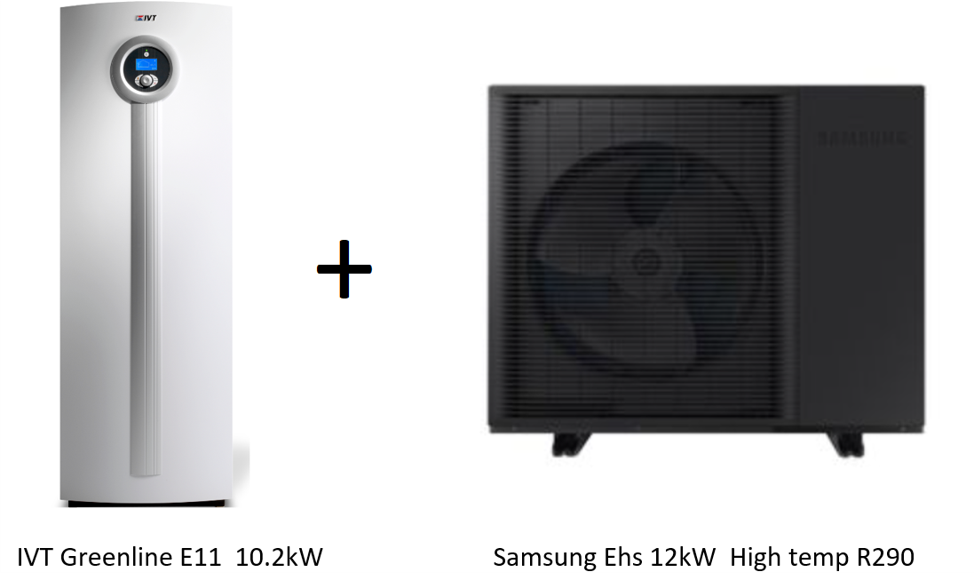
That way we get the best of both worlds with the GSHP taking care of the cheap rate nightshift and the ASHP maximising efficiency with warmer daytime air. Both heat pumps can run together when needed and this layered approach will satisfy the heating seasonal demands of a wider range of houses. Heating with this system is unusually flexible. With energy stored in oversized buffer tanks, the heat delivery is governed by the rate at which it is pumped to the various emitters and not directly determined by heat pump power; it is even possible to exceed the power of the heat pumps for short periods.
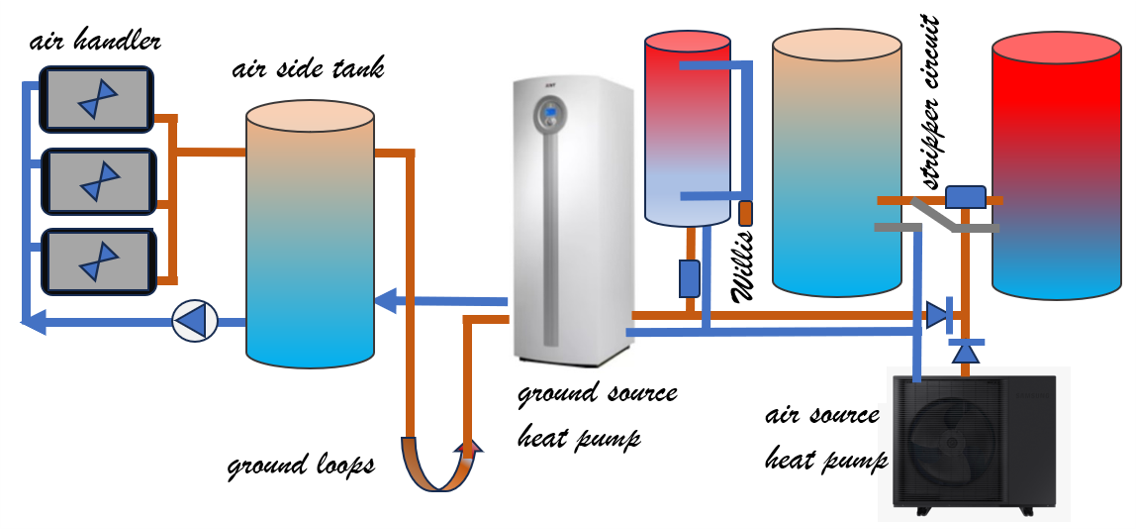
Above is the heat pump pipework. All the input to the tanks is via coils except the air side tank (on the left) which is direct. We’ll go through this, bit by bit, and you’ll see all the clever stuff emerge.
Running largely at night and avoiding all the cold air and defrosting malarky that would plague an ASHP a ground source pump is the starting point. GSHPs produce slightly better seasonal COPs than ASHPs but we can raise that even more by putting extra energy back into the ground.
Concept number one:
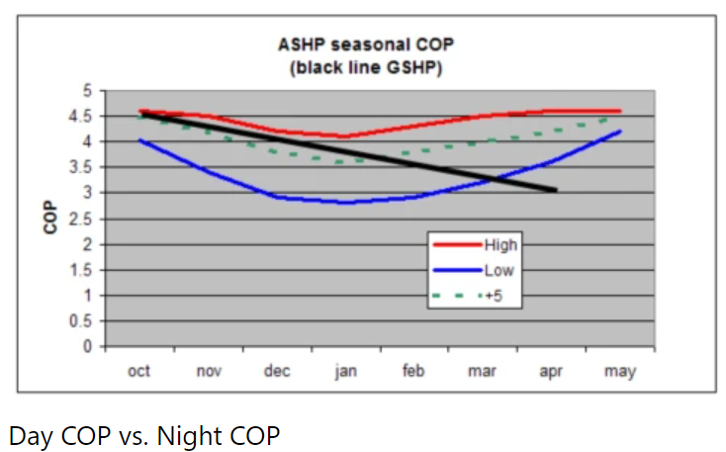
This chart compares the COP of a GSHP with the COP variation of an ASHP over the winter months. The wide swings in air temperature vary the COP of an ASHP hugely (the area between the red and blue lines) and show how day time running might be a lot better than night time. The black line for the GSHP is steady but declines as the ground is cooled by the season as well as the demand from the heat pump. Note the huge difference between the blue line and the black line which shows why ground source heat pumps are generally better.
Our system seeks to ignore that horrible blue line (i.e. don’t run the ASHP at night) and to operate around the red line and the black line. Those lines diverge after January where the ground gets colder and day time temperatures start to recover and it then makes sense to focus on daytime running of the ASHP. Here comes the big concept. We can also grab some of the day time warmth to benefit the GSHP and flatten and lift the black line to a COP of around 4. We do this with a tank and some air-to-water heat exchangers, shown on the left of the diagram above.
Here’s how it works. The outlet flow from the GSHP is typically around zero degrees, or colder, so the ambient air is nearly always warmer, especially during the daytime. The heat in the air is captured with three car type radiators and fans and circulated into the large buffer tank. This water goes to the ground loops whenever the heat pump and its circulation pump runs. There will be times when the tank is actually hot enough to feed energy back into the ground. Imagine a nice sunny day when the tank has been independently spooling up to 12c or so and the heat pump starts up and dumps 1,000 litres straight into the ground loops. This won’t happen often but the ground will rarely be fed temperatures below zero. Generally the ground loops will start off warmer and in warmer earth. The overall result is that we take a system that is intrinsically very good and make it much better. A higher COP gives much lower bills. A COP lift from 3 to 4 produces 33% more heat for your money; it’s that significant. That’s a good starting point but we can improve a lot more on that.
Concept number two:
Off-peak electricity can be had at night (for the car charging brigade) and when that is multiplied up by a heat pump the result is astonishingly cheap energy. A 10kW heat pump running 7 hours nightly for the whole 200 days of winter delivers 14,000kW.hrs for a mere £260. Crazy but true! The maths says it all; 7.5p for 1 kW.hr boosted by the COP makes 4kW.hr – divide 7.5 by 4 and you get 1.88p per kW.hr. How good is that? Well, gas is four times more expensive and direct electricity is twelve times more expensive, so yes, it’s good alright.
But it has to be stored ready for the next day, hence some tanks. Two 1,000 litre tanks for 2,000 litres of heating storage.
Although the ASHP is more suited for the day shift (nearer the red line on that COP chart) it makes sense to run it at night too when electricity is cheap. For example, near dawn while the GSHP tops up the domestic hot water cylinder the ASHP can be supplying much hotter water to the hot cylinder (red one on the right of the picture) for morning use on towel rails and fan-coils. The system can also be heating the concrete floor slabs at the same time so that’s more power used and stored.
Concept number three:
The stripper circuit
I developed this idea to preserve the precious heat in the hotter tank of a two tank system. It works a treat and will lift the performance of this system considerably. Here a three-port valve diverts water to the hot tank coil – if that incoming water is hotter – and the returning water then goes through the colder tank coil where the remaining heat is stripped out. If the incoming water is cooler than the hot tank then it is switched, by a simple Dt controller, directly to the cooler tank coil. So, if the supply from either heat pump was on a low set point, say to run the floors, then the hotter water tank, with its precious high grade heat, would be left undisturbed. That hotter tank could also be heated further by a wood burning stove or a gas boiler (directly, no coils) – and that’s where they go if needed. They say that you can’t combine low temperature heat pumps with additional high temperature sources but they are wrong. This does the job perfectly. A wood burner might be high on your wish list especially if you have access to cheap wood. A gas boiler is also a desirable addition to the stack of power sources, providing masses of high grade heat and adding to the overall system reliability.
Day time electricity is much more expensive but solar panels can help to run the ASHP fairly cheaply (or free) and that high, warm day, COP makes a big difference. Don’t forget, the stored energy might be enough to get through most days without any additional heat at all. That’s the benefit of having two lower powered heat pumps – you are more likely to be able to run one free on the solar panels. Of course, on really cold days both pumps can run together and along with any stored energy there will always be enough power.
Transmission

Lets now add a few more pipes to the two big tanks on the diagram. With masses of cheap heat parked in them, sending it to towel rails, fan coils in bedrooms, under-floor downstairs and in bathrooms is all easier than usual. All independent of the heat pumps and fully timed and zoned. If the diagram looks simplistic it’s because it really is that simple.
ESBE mixer unit
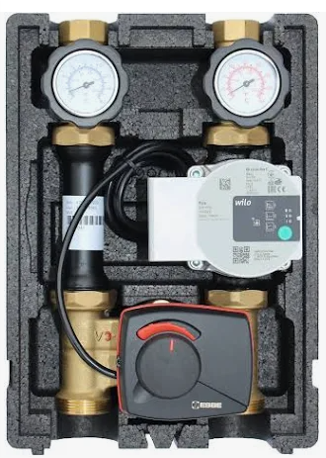
This blends down the big tanks to suit the under-floor pipes and it does weather compensation too. Normal UFH mixers are fixed at one temperature but ESBE mixers vary according to the outside temperature and adjust the power of the heating as necessary.
The towel rails and fan-coil units are separately fed by pump(s) and timers and there is no problem with zoning them as much as is required. If any radiators are used the hotter ASHP will cope with these too but they are best avoided.
Naysayers will now be saying that buffer tanks are inefficient or that heat pumps should run 24/7 or that zoning does not sit well with heat pumps. They are right on all counts but that misses the point; our system is so efficient and cheap to run it easily trumps any minor gains elsewhere.
The tanks – all from OSO
The tech room will look rather impressive with three 1,000 litre tanks. One will be for the air side of the hybrid heat pump and the other two for heat storage. A fourth tank is for domestic hot water. (300 litres with a 3msq coil for heat pump compatibility).
EDDI solar diverter
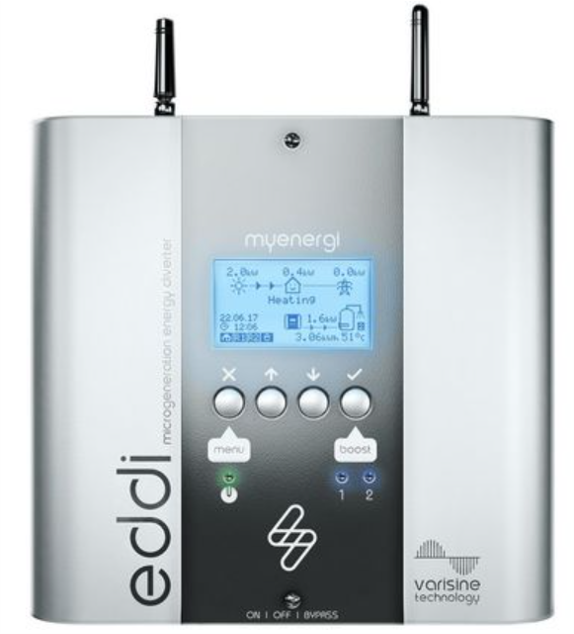
The GSHP can produce hot water cheaper than a direct immersion heater but the EDDI picks off solar excesses in short bursts during the day and runs the tank up to much higher temperatures. The heat pump will be all the better for not firing up all the time, the legionella will get regularly fried and a higher temperature effectively makes the tank size bigger; so wins all round.
Willis remote immersion heater
I like these because the circulation past the immersion element keeps the thermostat from shutting down under its own heat and also tank loading is straight into the top to maintain perfect stratification. Tank fitted immersion heaters can short cycle frequently and are harder to service too.
Air conditioning
Mmmm, how to mix heating the hot water cylinder with cooling the house? Easy actually; the GSHP and the Eddi do the hot water and the ASHP does the cooling of the floors etc. Both at once if you like. While this is technically possible I’d favour separate fan coil units which not only do cooling but add to the energy stack.
Solar panels + Enphase IQ8 micro-inverters
Each panel has its own micro-inverter for long term reliability, performance and also power if the grid fails – you know, in a Zombie Apocalypse scenario. At least 18 panels (about 7kWp) would often keep either heat pump running during the day. Each heat pump draws just over 2kW so the panels should have that covered.
Electric car
It’s hard to get cheap off-peak electricity combined with a decent export rate so the car makes a good soak for any excess. You no longer buy petrol so that’s just as good as any export payments. N.B. There are no domestic batteries in our system – the money is better spent elsewhere. When the technology matures the car will be the battery anyway.
Solar tech room
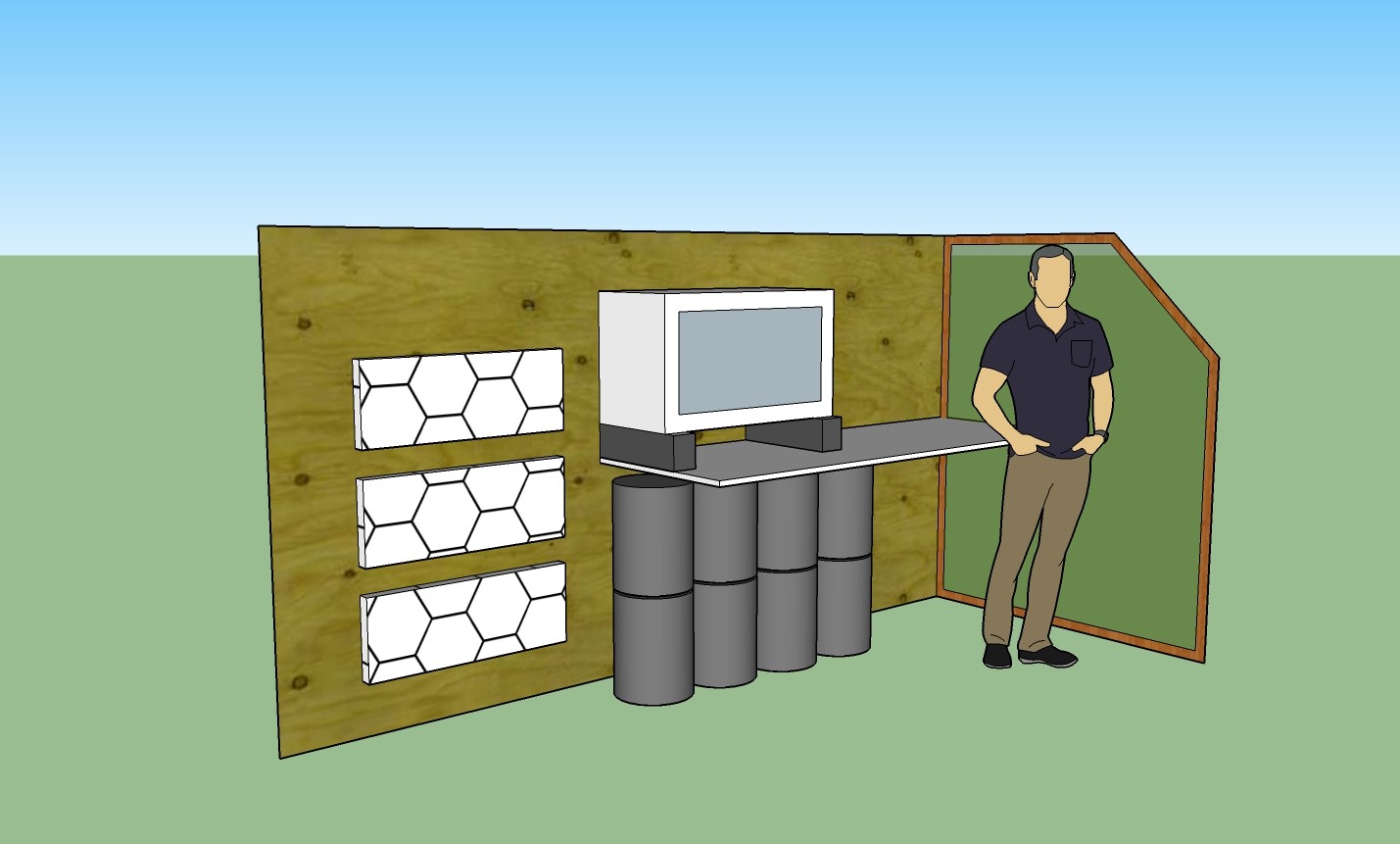
This is just a fancy tweak – you don’t need this as part of the system; be cool if you did though.
All those car radiators and the ASHP would be neat and more efficient in a dedicated shed with glass sides for some solar heat. If possible, on a flat roof would be good. Apart from being neat and tidy the solar side helps to avoid the ASHP defrosting cycles with that bank of solar warmed water barrels. There is a COP lift too.
Summary
You’d need a huge house to justify all this but if you are in that fortunate position this maximises cheaper energy along with the versatility to cope with any demands. Some heat pump installations can be disappointing but this so simple and powerful there is no fear of that here, indeed you might have the best system ever devised.
Could this super cheap heating scale up for a really huge house? Absolutely, with reasonable capital costs and, with multiple power sources, better reliability too. Both heat pumps could go up to the next common size – 17kW each and then, if that’s still not enough, you could double up with two of each for a total of 68kW. More? Well, don’t forget that the hot tank is designed to receive direct heat from a gas boiler and/or a wood burning stove so if you need 100kW or more that’s no problem at all.
Compared with , say, a wood chip burning furnace this system is not only cheaper but easy to run reliably with lots of redundancy built in. Best of all though the extreme efficiency will get those bills down to levels you’d hardly believe.
 Original Twist