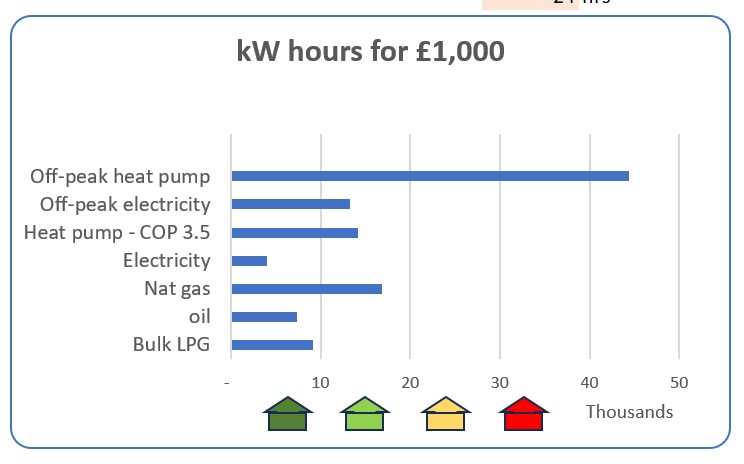
Plugging in the new April price caps and prevailing war driven spikes this is roughly how many kW hours £1,000 buys you. Gas and electricity will be fixed until July but oil and LPG will certainly remain volatile. Oil, for example, has shot up to £1.31 a litre (good chart on Boilerjuice) so if you are living in a big old leaky house, like the red one below, your heating bill will be over £4,000. Extrapolating from the bar of your particular fuel will give a good bills prediction with the orange house giving targets for most people using around 25,000 kW hours a year. As usual, at the extremes, a direct electric resistance heater is the worst thing to turn on (even half as good as oil) while the best strategy is to harvest cheap rate energy with a heat pump and store it in a tank for later use. While that heat pump trumps everything it is notable that off-peak electricity is currently better than oil or LPG; maybe night storage heaters are due for a comeback.
Trying to find a filling station that had any diesel left at all was a bit of a wake-up call; an electric car, with attendant cheap night rates, could lower heating and fuel costs while giving some protection from energy crises. Bi-directional chargers? Still ‘on the way’ but could be just months now so choose your car with care.
If these prices persist into next winter the Government will no longer be able to support the price cap so expect some unpleasant changes.
If this sudden price shock is prompting you to take some action you might take a look at ‘Absolute ultimate heat pump system’ where there may be one or two useful ideas for your heating strategy.
Meanwhile, solar panel prices continue to fall and make even more sense. They pair especially well with a mini-split heat pump which is not only cheap to install (£2,000 ish) but gives a welcome addition of air conditioning during these hot summers.
Cheaper batteries are worth considering although payback times still look long. While export rates are falling the idea of giving access to your battery when the grid is stressed is looking tempting. Check out ‘Axle’ who will pay you £1 for every kW hour they take. For that money they can hammer your battery as much as they like. N.B. Check out their compatible inverter/chargers before you install your PV.
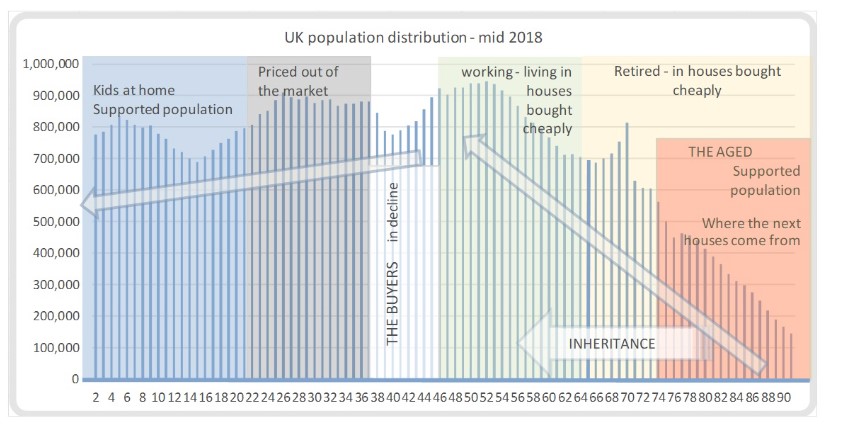
The shape of the UK population in 2018 told a familiar story. The large post-war “baby boomer” cohort — visible as a pronounced bulge in the age distribution — had dominated economic life for decades. This generation benefited from stable employment, affordable housing, rising property values, and strong economic growth. Many accumulated substantial housing equity and later inherited increasingly valuable family homes. Comfortable retirements, foreign holidays, and rising living standards were hallmarks of that era.
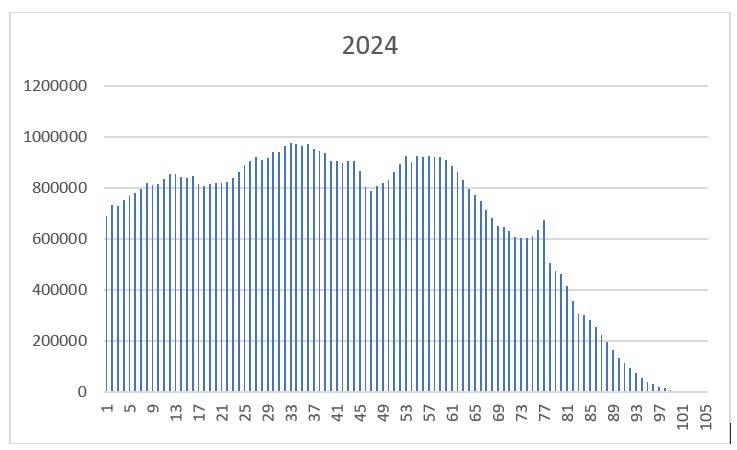
Six years later, the 2024 population profile reveals a different picture.
Chart 1: UK Population by Age, 2018
Caption: The 2018 age distribution shows the prominent post-war baby boomer bulge (right-hand side). At this point, much of this cohort was approaching retirement, holding substantial housing wealth and representing a dominant economic force.
In 2018, the boomer generation was still economically influential. Many remained in work, while others were entering retirement with significant accumulated assets. Their size amplified their impact on housing markets, healthcare demand, pensions, and consumer spending.
A Declining Birth Rate and an Ageing Nation
The most striking feature of the 2024 chart is the continued fall in birth rates — a trend extending back roughly 60 years. The supply of younger workers is no longer expanding fast enough to support a growing retired population. The UK appears to be shifting from demographic expansion to structural ageing.
Chart 2: UK Population by Age, 2024
Caption: By 2024, the baby boomer peak has begun to shrink due to natural attrition, while birth rates remain historically low. The reduction in births highlights a reduced inflow of future workers.
The reduction in the boomer peak reflects ageing and mortality, with the COVID-19 period likely contributing. Meanwhile, the lower birth rate narrows the base of the pyramid, reinforcing long-term workforce constraints.
The 65-year threshold illustrates that the flow into retirement will continue for at least another decade. A comparatively smaller working-age population must generate sufficient tax revenue to fund pensions and healthcare. For now, the boomer generation’s children remain numerous enough to shoulder much of that responsibility.
Projecting Forward: 2030
To understand what happens next, we can shift the 2024 age profile forward by six years.
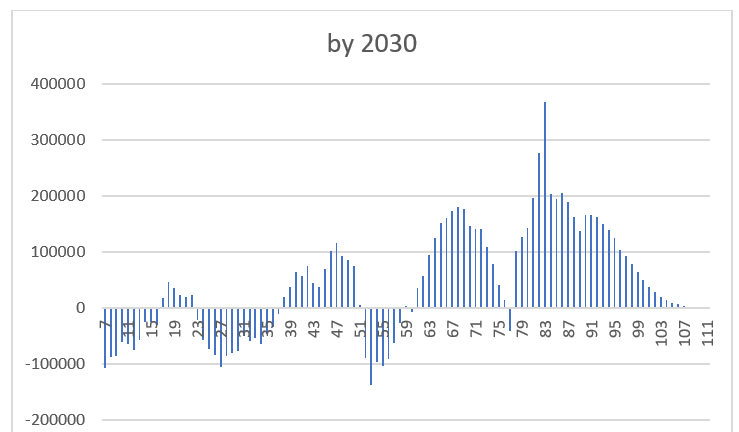
Chart 3: Projected Change in Age Groups, 2024–2030
Caption: Difference chart showing the change in population numbers between 2024 and 2030 (assuming simple age progression). The largest increases occur in older age groups, intensifying pension and healthcare pressures.
Even without adjusting for mortality, the projected increase in older age groups is clear. Given average life expectancy of around 83 years, attrition will reduce the oldest segments, but not before a sustained period of elevated demand on healthcare and pension systems.
The following block represents the steady swell of retirees exiting the workforce.
Extending the Projection: 2034
Looking ten years ahead from the 2024 baseline makes the ageing shift even more pronounced.
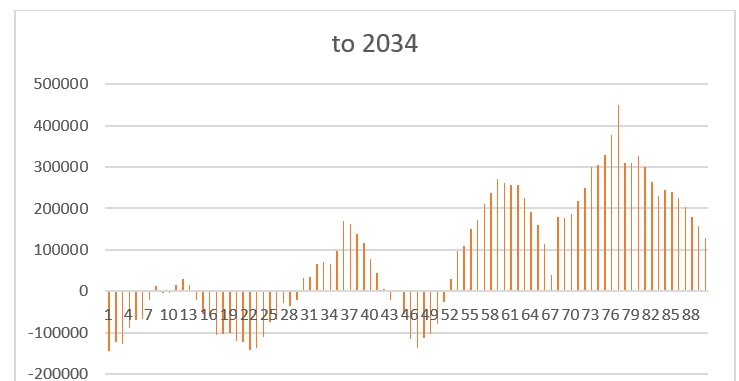
Chart 4: Projected Change in Age Groups, 2024–2034
Caption: Ten-year projection highlighting a substantial expansion in older age cohorts. Figures are measured in hundreds of thousands, underscoring the fiscal significance of demographic ageing.
The scale of the ageing population becomes economically material. Pension liabilities, healthcare costs, and age-related public spending will remain elevated throughout this period.
All pension liabilities are a form of debt – a promise to pay at a future date – and this chart only shows the changes coming. The main blocks from which these figures are derived are still present and significant and yet they do not count as a component of the national debt.
Wealth Transfer and the Housing Question
One frequently raised concern is whether a wave of property sales will destabilise housing markets as older homeowners pass away. This appears unlikely to produce a sudden glut. Much housing will transfer through inheritance rather than open-market sale. Properties are likely to cascade down the generational ladder.
Over the next decade or two, the UK may experience one of the largest intergenerational wealth transfers in its history. For the boomer generation’s children — currently in their prime working years — this could provide relative financial stability during demographic adjustment.
The Longer-Term Challenge
The deeper structural issue emerges further ahead.
When the boomer generation’s children retire — roughly 25 to 30 years from now — they will be followed by a significantly smaller cohort. If birth rates remain subdued, the tax base may struggle to sustain pensions, healthcare, and public services at current levels.
This challenge is not unique to the UK. Across Europe, demographic pressures are intensifying. Countries such as France face similar trajectories, while Germany and Italy confront even sharper ageing profiles.
A Generation That Shaped the Economy
The defining story is the rise and fall of the baby boomer bulge. At peak working age, it drove growth and prosperity. As it aged, economic momentum slowed, pension obligations expanded, and healthcare demands rose.
For the next decade, relative stability is plausible as wealth transfers offset some pressures. Beyond that horizon, demographic arithmetic becomes harder to ignore.
The UK’s long-term prosperity will depend on how effectively it responds — through productivity gains, workforce participation, immigration policy, technological innovation, and pension reform.
Demography is not destiny. But it sets powerful constraints — and the charts suggest the most significant adjustments are still to come.
In the UK you can drive a light quadricycle on a motorcycle licence. There’s not much to these vehicles so this begs the question – could you actually just make one? I’m thinking pretty much on the kitchen table and using just regular hand tools.
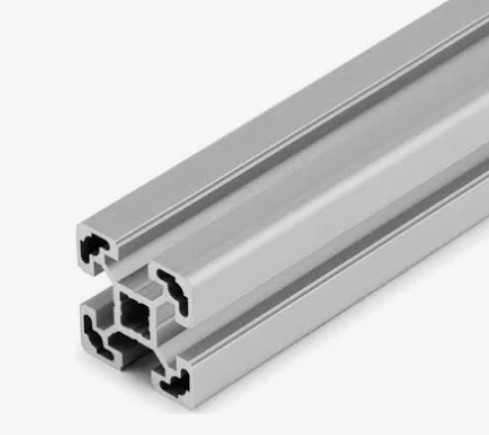
Here the body has a frame made with these aluminium extrusions.
The ‘T’ slots enable panels of polycarbonate and plywood to be easily bolted on or slotted in. With a side profile of 1.2m x 1.2m at this stage it is still easily lifted off the kitchen table and with a plastic chair inside you can already sit in it. What makes it go?
There are loads of ads for electric hub motors for scooters and a pair of these at the back would be perfect. Failing that, a pair of decapitated scooters bolted to the floor would provide power and batteries all in one go. Just make sure you don’t exceed 6kW if you want to keep to a simpler light quadricycle. At the front you could use go-kart parts to provide brakes and steering although the front wheels you chopped off your scooters might do. Even better might be a ready made cyclekart front axle – see link below.
Lights? Just bike stuff, even torches. Speedo? Phone. Wipers? Nah, just prop open the screen. Suspension? Possibly not needed at such low speeds but tennis balls make cheap springs. Luggage? Box at the back doubles as a seat.
So, lots of ideas that might provide inspiration for a fun project and ultimately make the school run interesting and economical.
You might find it hard to tear yourself away from the cyclekart web site. If you are inspired in this direction have a look at the OriginalTwist 3-wheeler here which might tie in nicely. A cyclekart Morgan F4; now there’s an idea. My first car was an F4; great fun.
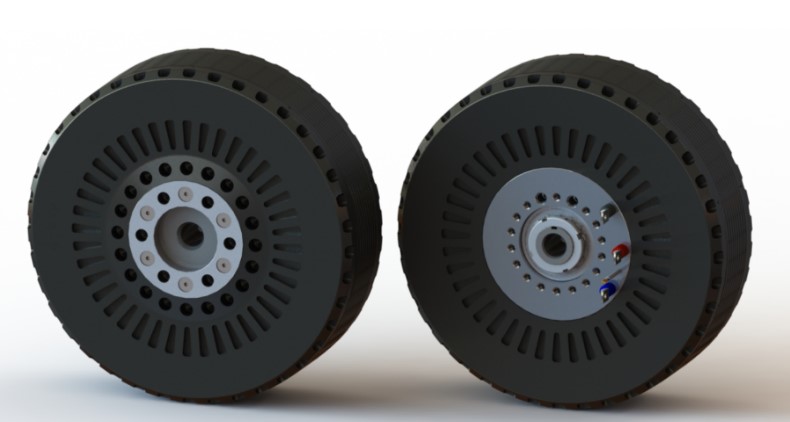
If you’re building an EV or converting an existing car, why settle for ordinary when you can create something extraordinary? Enter the Emrax 348 electric motor—one of the most impressive motors available today. Whether you’re using one, a pair, or going all out with four, the numbers are jaw-dropping:
Emrax 348 Quick Specs:
Dimensions: 348mm diameter × 110mm depth (about the size of a wheelbarrow wheel).
Torque: 1,000 Nm—nearly as much as a Bugatti Chiron (1,600 Nm), so a pair of Emrax motors surpass it. Of course, the Chiron has a gearbox, but still.
Power: 500 hp per motor (1,000 hp for a pair). Although output is halved after 2 minutes, that’s more than enough if you’re hitting 100 mph in under 7 seconds.
Max Revs: 4,000 RPM—this limits top speed and influences gear ratios, making it a balancing act between acceleration and top speed.
Design Objective:
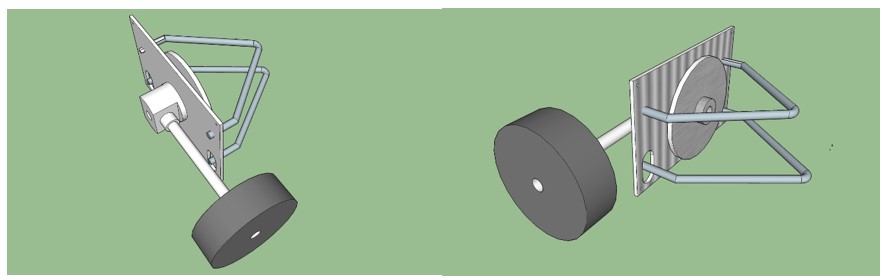
Create a modular unit that combines suspension, steering, braking, and drive—all in one elegant package. The idea is to keep it compact and cost-effective, but versatile enough to be used on any corner of the car.
The core of the module is a CNC-machined aluminium plate (approx. 60×40 cm). Mounted to it are:
Unequal-length wishbones shorter upper arms – longer bottom arms bolted at the rear through slots.
A universal hub carrier (e.g. Brypar Motorsport) for flexibility in steering geometry and the strength of Porsche-grade hubs and bearings.
Brake discs mounted close to the plate with callipers fixed directly to it, minimising unsprung weight.
Electric motor + bevel gear drive: Instead of mounting the reduction gear and motor inline (which causes width and cooling problems), we use a bevel gear connected to a short, angled prop shaft. The drive motor is then mounted elsewhere, anywhere along an arc—say, on the rear bulkhead behind the back seats —improving cooling, packaging, and polar moment of inertia. The gear ratio can be changed very quickly just by exchanging the whole bevel gear housing.
The suspension uses a pushrod-actuated rocker linked to a spring/damper mounted along the top of the plate—neatly tucked away and easy to tune.
Performance Examples:
Two-Wheel Drive:
Cap your top speed at 150 mph and the gearing and torque gives around 1.4 tons of thrust at the wheels. If your car weighs more than that—and most EVs do—you won’t hit the 1g needed for a 2.5-second 0–60 mph time although circa 3 seconds would be a reasonable expectation. So while a 1,000hp car will be pretty spectacular, to graduate from supercar to hypercar territory, you’ll need four-wheel drive.
Four-Wheel Drive:
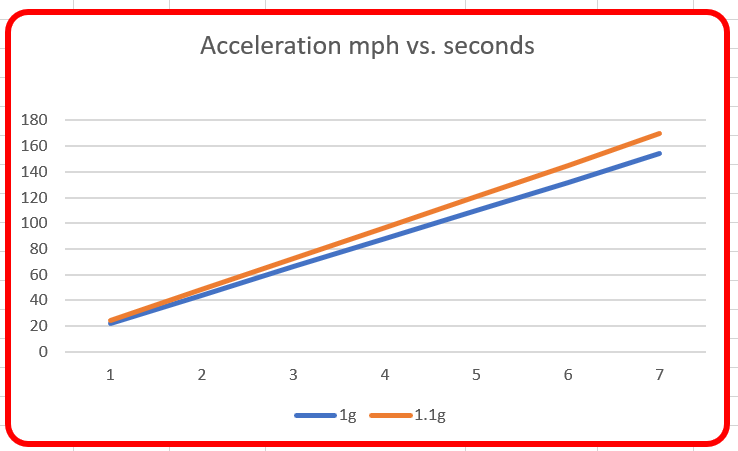
Use all four corners, and with a tyre speed rating limit of 186 mph, you’ll get 2.2 tons of thrust (or 2.67 tons if limiting top speed to 155 mph). With a 2.2 ton car that translates to 0–60 in 2.5 seconds—now we’re talking hypercar credentials. Tyres are usually grippy enough to allow acceleration of at least 1g. The chart below shows how long that takes to reach various speeds. Unfortunately, the faster you go, the more wind resistance bends those lines; even so, 0-100 in 4 seconds looks like a realistic target.
Braking Considerations:
Even with regenerative braking, powerful cars still need strong friction brakes. Freed from the constraints of wheel diameter, the brake disc can be as large as needed—and even have a second calliper. That means you don’t need massive wheels just to fit oversized brakes. Big discs and double calipers make no difference to unsprung weight – perfect.
Final Thoughts:
These integrated modules are perfect for developing a powertrain test mule. Any sturdy hatchback will do. With most of the engineering already solved, you can jump straight into drivetrain testing without reinventing the wheel.
And because they’re stealthy, we’re entering the golden age of Q-cars. That humble Citroën Berlingo sketched above? It could quietly hide 2,000 hp. Why the Berlingo? There’s loads of room in the nose for front motors, even more in the back, and already wide wheels with arches ready to take bigger tyres. Inside, you’ve got ample space for batteries, telemetry, and more. Why sit on the floor of a cramped supercar when a roomy Berlingo is just as quick?
In case you were wondering, the McMurtry Speirling fan car does 0-60 in 1.4 seconds – but you can’t get a sofa in the back.
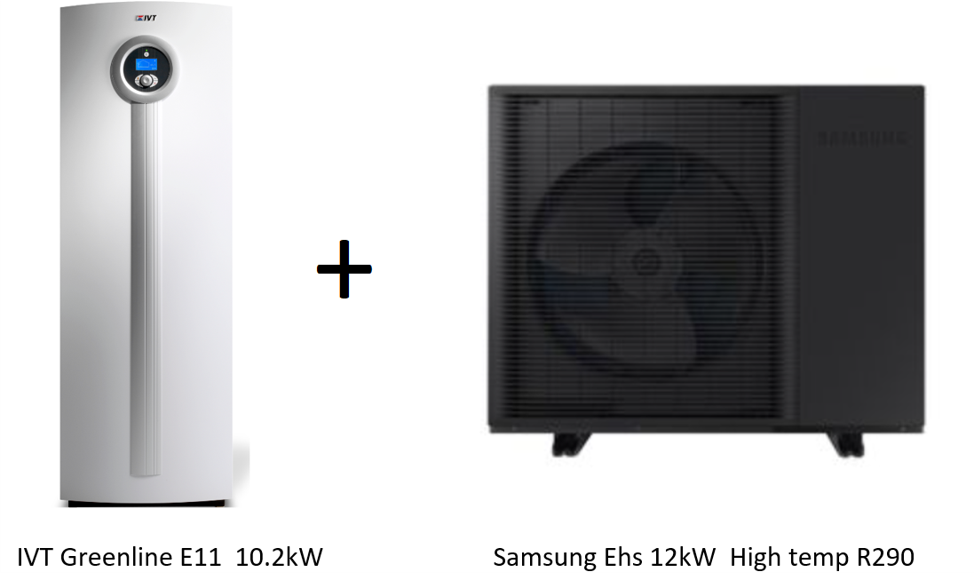
If you fancy the Grand Designs Heating System but need a bit more power for a bigger house then you are in luck; bigger is even better. Rather than scaling up the ground source heat pump we can add one of the latest high temperature air source heat pumps to the mix.
That way we get the best of both worlds with the GSHP taking care of the cheap rate nightshift and the ASHP maximising efficiency with warmer daytime air. Both heat pumps can run together when needed and this layered approach will satisfy the heating seasonal demands of a wider range of houses. Heating with this system is unusually flexible. With energy stored in oversized buffer tanks, the heat delivery is governed by the rate at which it is pumped to the various emitters and not directly determined by heat pump power; it is even possible to exceed the power of the heat pumps for short periods.
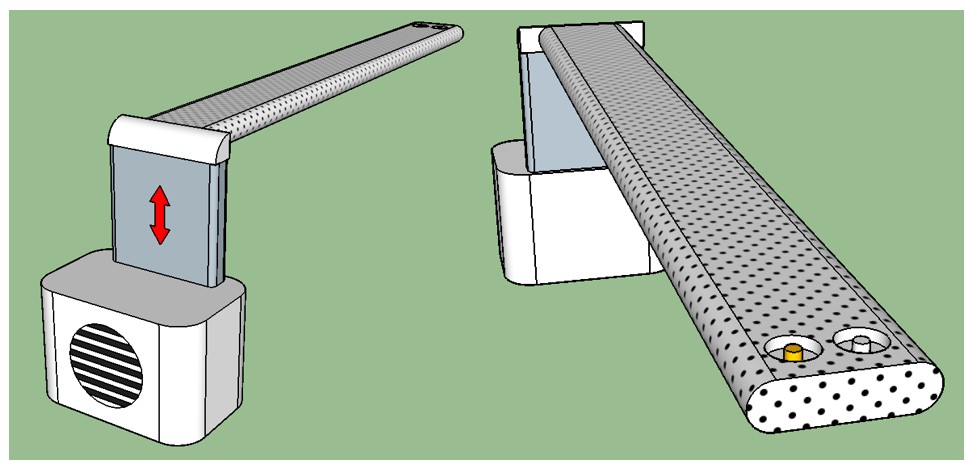
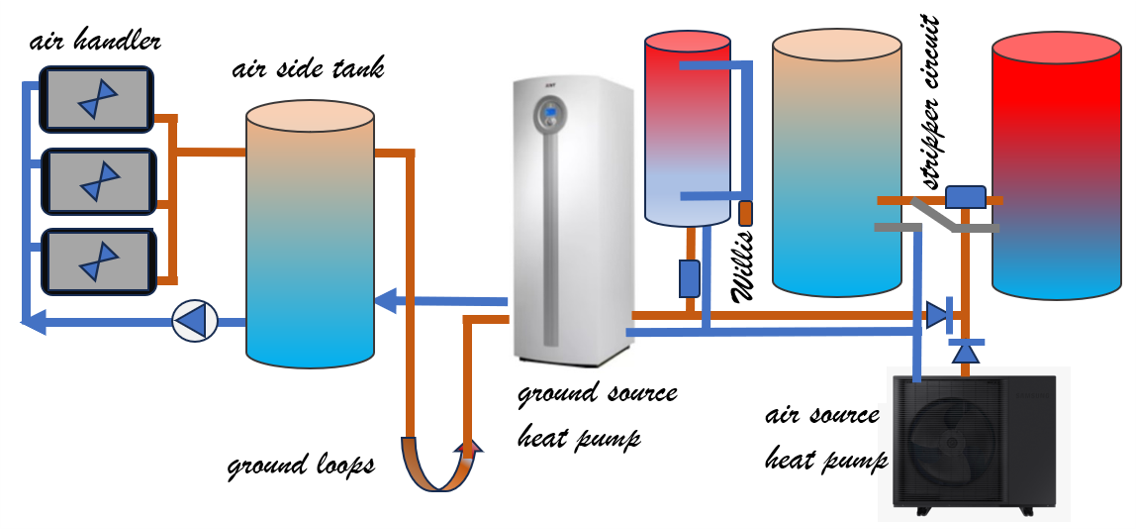
Above is the heat pump pipework. All the input to the tanks is via coils except the air side tank (on the left) which is direct. We’ll go through this, bit by bit, and you’ll see all the clever stuff emerge.
Running largely at night and avoiding all the cold air and defrosting malarky that would plague an ASHP a ground source pump is the starting point. GSHPs produce slightly better seasonal COPs than ASHPs but we can raise that even more by putting extra energy back into the ground.
Concept number one:
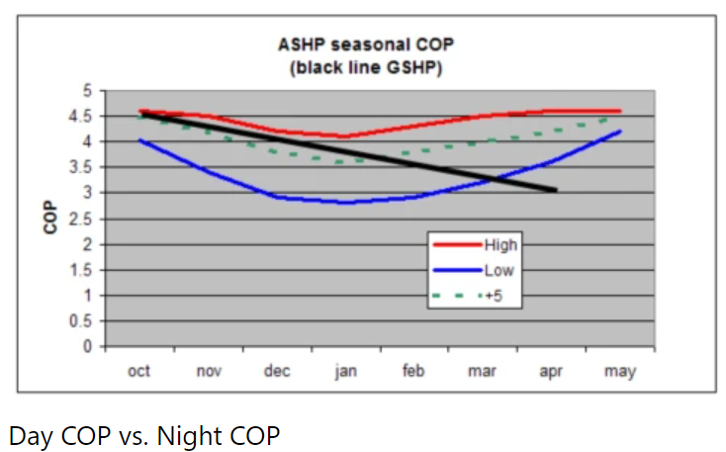
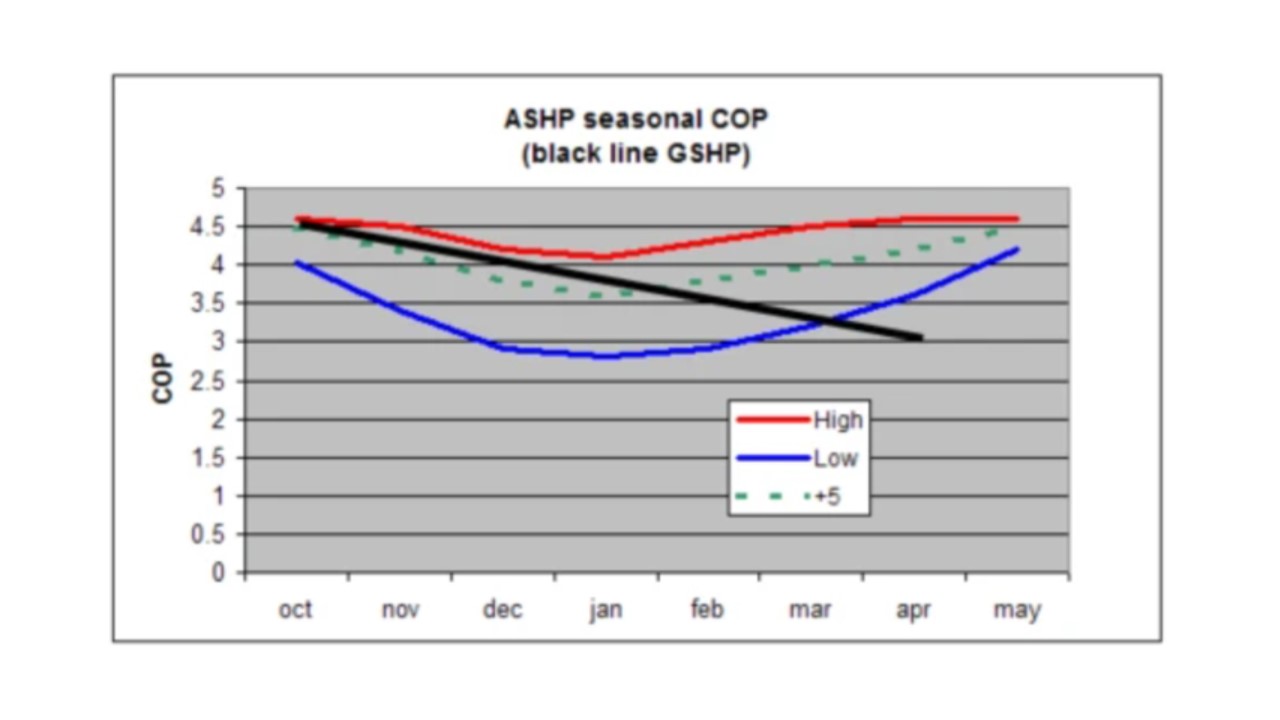
This chart compares the COP of a GSHP with the COP variation of an ASHP over the winter months. The wide swings in air temperature vary the COP of an ASHP hugely (the area between the red and blue lines) and show how day time running might be a lot better than night time. The black line for the GSHP is steady but declines as the ground is cooled by the season as well as the demand from the heat pump. Note the huge difference between the blue line and the black line which shows why ground source heat pumps are generally better.
Our system seeks to ignore that horrible blue line (i.e. don’t run the ASHP at night) and to operate around the red line and the black line. Those lines diverge after January where the ground gets colder and day time temperatures start to recover and it then makes sense to focus on daytime running of the ASHP. Here comes the big concept. We can also grab some of the day time warmth to benefit the GSHP and flatten and lift the black line to a COP of around 4. We do this with a tank and some air-to-water heat exchangers, shown on the left of the diagram above.
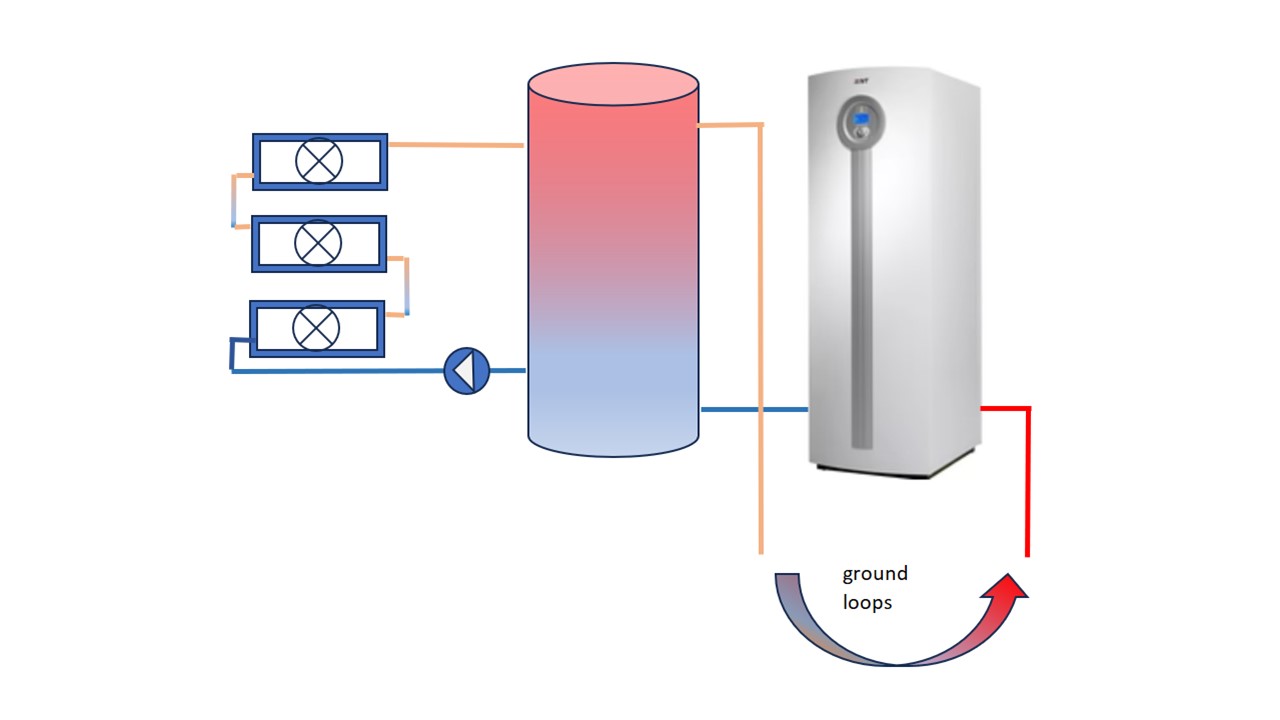
Here’s how it works. The outlet flow from the GSHP is typically around zero degrees, or colder, so the ambient air is nearly always warmer, especially during the daytime. The heat in the air is captured with three car type radiators and fans and circulated into the large buffer tank. This water goes to the ground loops whenever the heat pump and its circulation pump runs. There will be times when the tank is actually hot enough to feed energy back into the ground. Imagine a nice sunny day when the tank has been independently spooling up to 12c or so and the heat pump starts up and dumps 1,000 litres straight into the ground loops. This won’t happen often but the ground will rarely be fed temperatures below zero. Generally the ground loops will start off warmer and in warmer earth. The overall result is that we take a system that is intrinsically very good and make it much better. A higher COP gives much lower bills. A COP lift from 3 to 4 produces 33% more heat for your money; it’s that significant. That’s a good starting point but we can improve a lot more on that.
Concept number two:
Off-peak electricity can be had at night (for the car charging brigade) and when that is multiplied up by a heat pump the result is astonishingly cheap energy. A 10kW heat pump running 7 hours nightly for the whole 200 days of winter delivers 14,000kW.hrs for a mere £260. Crazy but true! The maths says it all; 7.5p for 1 kW.hr boosted by the COP makes 4kW.hr – divide 7.5 by 4 and you get 1.88p per kW.hr. How good is that? Well, gas is four times more expensive and direct electricity is twelve times more expensive, so yes, it’s good alright.
But it has to be stored ready for the next day, hence some tanks. Two 1,000 litre tanks for 2,000 litres of heating storage.
Although the ASHP is more suited for the day shift (nearer the red line on that COP chart) it makes sense to run it at night too when electricity is cheap. For example, near dawn while the GSHP tops up the domestic hot water cylinder the ASHP can be supplying much hotter water to the hot cylinder (red one on the right of the picture) for morning use on towel rails and fan-coils. The system can also be heating the concrete floor slabs at the same time so that’s more power used and stored.
Concept number three:
The stripper circuit
I developed this idea to preserve the precious heat in the hotter tank of a two tank system. It works a treat and will lift the performance of this system considerably. Here a three-port valve diverts water to the hot tank coil – if that incoming water is hotter – and the returning water then goes through the colder tank coil where the remaining heat is stripped out. If the incoming water is cooler than the hot tank then it is switched, by a simple Dt controller, directly to the cooler tank coil. So, if the supply from either heat pump was on a low set point, say to run the floors, then the hotter water tank, with its precious high grade heat, would be left undisturbed. That hotter tank could also be heated further by a wood burning stove or a gas boiler (directly, no coils) – and that’s where they go if needed. They say that you can’t combine low temperature heat pumps with additional high temperature sources but they are wrong. This does the job perfectly. A wood burner might be high on your wish list especially if you have access to cheap wood. A gas boiler is also a desirable addition to the stack of power sources, providing masses of high grade heat and adding to the overall system reliability.
Day time electricity is much more expensive but solar panels can help to run the ASHP fairly cheaply (or free) and that high, warm day, COP makes a big difference. Don’t forget, the stored energy might be enough to get through most days without any additional heat at all. That’s the benefit of having two lower powered heat pumps – you are more likely to be able to run one free on the solar panels. Of course, on really cold days both pumps can run together and along with any stored energy there will always be enough power.
Transmission
Lets now add a few more pipes to the two big tanks on the diagram. With masses of cheap heat parked in them, sending it to towel rails, fan coils in bedrooms, under-floor downstairs and in bathrooms is all easier than usual. All independent of the heat pumps and fully timed and zoned. If the diagram looks simplistic it’s because it really is that simple.
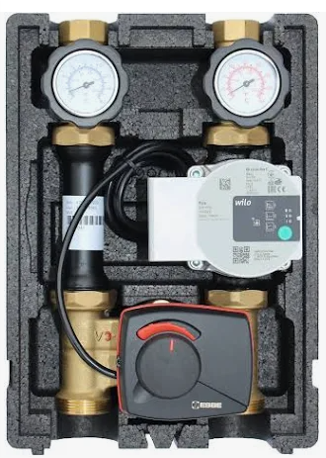
ESBE mixer unit
This blends down the big tanks to suit the under-floor pipes and it does weather compensation too. Normal UFH mixers are fixed at one temperature but ESBE mixers vary according to the outside temperature and adjust the power of the heating as necessary.
The towel rails and fan-coil units are separately fed by pump(s) and timers and there is no problem with zoning them as much as is required. If any radiators are used the hotter ASHP will cope with these too but they are best avoided.
Naysayers will now be saying that buffer tanks are inefficient or that heat pumps should run 24/7 or that zoning does not sit well with heat pumps. They are right on all counts but that misses the point; our system is so efficient and cheap to run it easily trumps any minor gains elsewhere.
The tanks – all from OSO
The tech room will look rather impressive with three 1,000 litre tanks. One will be for the air side of the hybrid heat pump and the other two for heat storage. A fourth tank is for domestic hot water. (300 litres with a 3msq coil for heat pump compatibility).
EDDI solar diverter
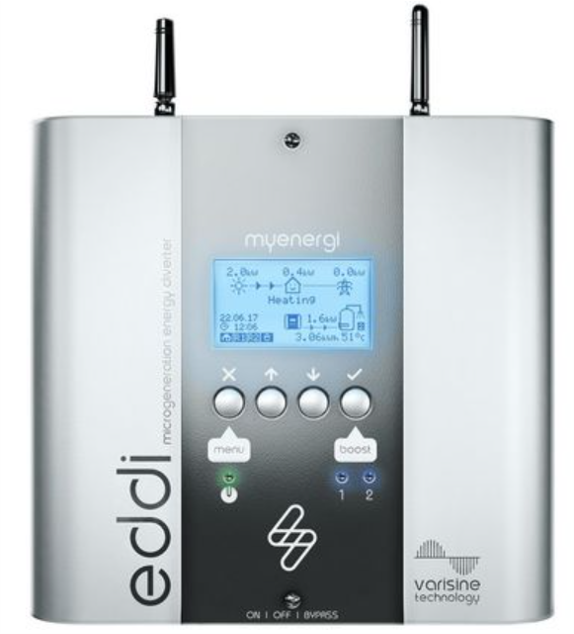
The GSHP can produce hot water cheaper than a direct immersion heater but the EDDI picks off solar excesses in short bursts during the day and runs the tank up to much higher temperatures. The heat pump will be all the better for not firing up all the time, the legionella will get regularly fried and a higher temperature effectively makes the tank size bigger; so wins all round.
Willis remote immersion heater
I like these because the circulation past the immersion element keeps the thermostat from shutting down under its own heat and also tank loading is straight into the top to maintain perfect stratification. Tank fitted immersion heaters can short cycle frequently and are harder to service too.
Air conditioning
Mmmm, how to mix heating the hot water cylinder with cooling the house? Easy actually; the GSHP and the Eddi do the hot water and the ASHP does the cooling of the floors etc. Both at once if you like. While this is technically possible I’d favour separate fan coil units which not only do cooling but add to the energy stack.
Solar panels + Enphase IQ8 micro-inverters
Each panel has its own micro-inverter for long term reliability, performance and also power if the grid fails – you know, in a Zombie Apocalypse scenario. At least 18 panels (about 7kWp) would often keep either heat pump running during the day. Each heat pump draws just over 2kW so the panels should have that covered.
Electric car
It’s hard to get cheap off-peak electricity combined with a decent export rate so the car makes a good soak for any excess. You no longer buy petrol so that’s just as good as any export payments. N.B. There are no domestic batteries in our system – the money is better spent elsewhere. When the technology matures the car will be the battery anyway.
Solar tech room
This is just a fancy tweak – you don’t need this as part of the system; be cool if you did though.
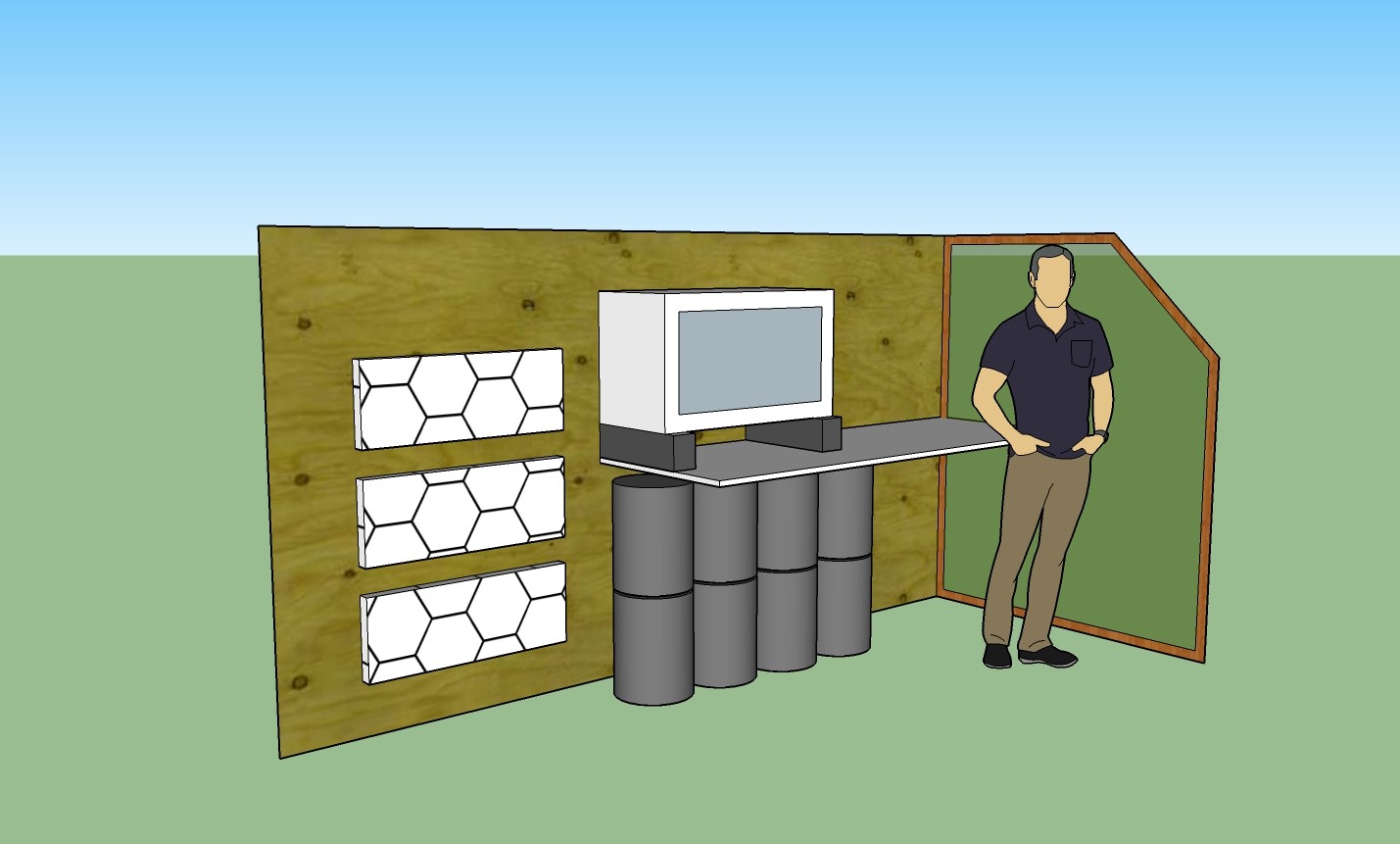
All those car radiators and the ASHP would be neat and more efficient in a dedicated shed with glass sides for some solar heat. If possible, on a flat roof would be good. Apart from being neat and tidy the solar side helps to avoid the ASHP defrosting cycles with that bank of solar warmed water barrels. There is a COP lift too.
Summary
You’d need a huge house to justify all this but if you are in that fortunate position this maximises cheaper energy along with the versatility to cope with any demands. Some heat pump installations can be disappointing but this so simple and powerful there is no fear of that here, indeed you might have the best system ever devised.
Could this super cheap heating scale up for a really huge house? Absolutely, with reasonable capital costs and, with multiple power sources, better reliability too. Both heat pumps could go up to the next common size – 17kW each and then, if that’s still not enough, you could double up with two of each for a total of 68kW. More? Well, don’t forget that the hot tank is designed to receive direct heat from a gas boiler and/or a wood burning stove so if you need 100kW or more that’s no problem at all.
Compared with , say, a wood chip burning furnace this system is not only cheaper but easy to run reliably with lots of redundancy built in. Best of all though the extreme efficiency will get those bills down to levels you’d hardly believe.
There are a couple of significant heating ideas already featured on this site. One, the hybrid combined air/ground source heat pump, where a ground source pump has a connected tank warmed by the ambient air. And the other where big water tanks store cheap off-peak energy.
The first concept produces astonishing coefficients of performance and the second produces astonishingly low bills.
For the Grand Designs Heating System, we’ll combine these concepts and serve them up as a benchmark for what is possible. Here we go.
Running largely at night and avoiding all the cold air and defrosting malarky that would plague an ASHP. a ground source pump is the starting point. GSHPs produce slightly better seasonable COPs than ASHPs but we can raise the COP even more by putting extra energy back into the ground.
This chart compares the COP of a GSHP (black line) with the COP variation of an ASHP over the winter months. We can ignore that horrible blue line and focus on the divergence of the red line (warm air days) with the declining black line for the GSHP. Our mission is to grab some of the day time warmth and add it to the mix and thus flatten the black line to a COP of around 4. We do this with a tank and some air to water heat exchangers.
The outlet flow from the heat pump is typically around 0c or colder so the ambient air is nearly always warmer, especially during the daytime. The heat in the air is captured with three car type radiators and fans and stored in a large buffer tank. This water goes to the ground loops whenever the heat pump and its circulation pump runs. The design power of the radiator/fan combination is roughly equal to the heat pump to try to keep the ground temperature from depleting. There will be times when the tank is actually warm enough to feed energy back into the ground. Imagine a nice sunny day when the tank has been independently spooling up to 12c or so and the heat pump starts up and dumps 1,000 litres through the ground loops. This won’t happen often but the ground loops will rarely be fed temperatures below zero as is typical with most installations. The overall result is that we take a system that is intrinsically very good and make it much better. A higher COP gives much lower bills. That’s a good starting point but we can improve a lot more on that.
Concept number two:
Off-peak electricity can be had at night, for the car charging brigade, and when that is multiplied up by a heat pump the result is astonishingly cheap energy. A 10kW heat pump running for 7 hours nightly over the whole 200 days of winter delivers 14,000kW.hrs for about £260. Crazy but true! The maths says it all; 7.5p for1 kW.hr on a COP of 4 makes 4kW.hrs – divide 7.5 by 4 and you get 1.88p per kW hour. Compare that with electricity which costs around 24p/kW.hr. The difference is astonishing but that cheap energy has to be stored ready for the next day, hence some tanks. Two 1,000 litre tanks combine to make 2,000 litres for the heating storage. N.B To remove that energy from the tanks we need to get the tank temperature back down to 30c or less and that will require, at least some, underfloor heating.
The stored energy might be enough to get through most days without any additional heat at all. If there is a shortfall any day time running will be much more expensive but the solar panels can help to run the GSHP fairly cheaply (or free) and that high COP makes a big difference.
Naysayers will now be saying that buffer tanks are inefficient or that heat pumps should run 24/7 or that zoning does not sit well with heat pumps. They are right on all counts but efficiency is not the point; we are using one third priced electricity which easily trumps any minor gains elsewhere.
The tanks – all from OSO
The tech room will look rather impressive with three 1,000 litre tanks and another smaller one. One will be for the air side of the hybrid heat pump and the other two for heat storage. The smaller tank is for domestic hot water. (300 litres with a 3msq coil for heat pump compatibility).
EDDI solar diverter
You could argue that the GSHP can produce hot water cheaper than a direct electric heater – the immersion – but the EDDI picks off solar excesses in short bursts during the day and runs the tank up to much higher temperatures. The heat pump will be all the better for not firing up all the time, the legionella will get regularly fried, and the tank size is effectively bigger; wins all round.
Willis remote immersion heater
I like these because the circulation past the immersion element keeps the thermostat from shutting down under its own heat. Tank fitted immersion heaters can short cycle frequently and are harder to service too.
Transmission
Towel rails, fan coils in bedrooms, under-floor downstairs and in bathrooms. All independent of the heat pump and fully timed and zoned. The big tanks make this possible and simple too.
ESBE blender unit
This blends down the big tanks to suit the under-floor pipes and it does weather compensation too. The towel rails and fan-coil units are directly fed by pump(s) and timers.
Mini-split
On warm days an air-to-air heat pump will be more efficient than the GSHP and it will be useful for topping up especially if it’s lower powered and often running free off solar. The blown warm air makes a useful laundry drier and the cooling feature sorts out the need for air conditioning. Cold air pours across the floors making a single source surprisingly effective.
Solar panels + Enphase IQ8 micro-inverters
Each panel will have its own micro inverter for long term reliability, performance and also power if the grid fails – you know, in a Zombie Apocalypse scenario. At least 18 panels (about 7kWp) would often keep either heat pump running during the day. The GSHP draws just over 2kW and the mini-split just under 2kW so the panels should have that covered.
Electric car
It’s hard to get cheap off-peak electricity combined with a decent export rate so the car makes a good soak for any excess. You no longer buy petrol so that’s just as good as any export payments. N.B. There are no domestic batteries in our system – the money is better spent elsewhere. When the technology matures the car will be the battery anyway.
Solar tech room
All those radiators and the mini split would be neat and more efficient in a dedicated solar shed. If possible, on the roof would be good. Apart from being neat and tidy the solar side helps the air powered mini-split to avoid defrosting cycles.
Conclusion
If you want your Grand Designs house to stand out and be the best of the best, this could be the way to go. What do you think Kevin?
BTW If you own a castle or something and this looks a bit light on, then check out the meaty version on
There is a hard push under way to make us abandon fossil fuel boilers and adopt heat pumps instead. The trouble is they don’t seem to work for everybody and they are expensive too. So, in many cases that’s a lot of money for something we don’t even want. Don’t despair though, there’s a way through this maze and the outcome could be cheaper heating for less initial outlay. The trick, in a nutshell, is to have more than one heat pump; the one they pay you £7,500 to install and then a smaller one to back it up.
Learn to love heat pumps
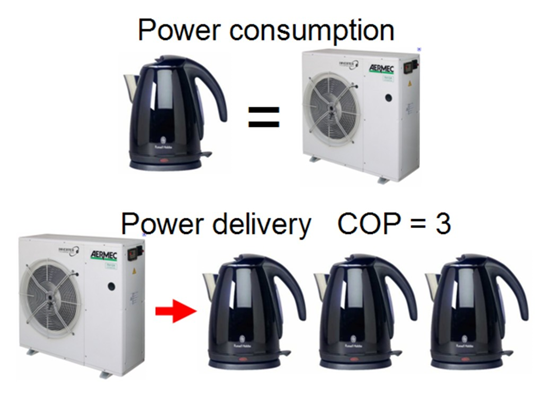
Typically consuming not much more power than an electric kettle the heat pump will deliver about 3 times as much energy to your heating, often more. The power is increasingly produced by renewables so the heat pump is an essential multiplier of green energy. That’s why we love them and that’s why we should have them.
Overcome the issues
Heat pumps work well at lower temperatures but that drastically reduces the effectiveness of your existing pipes and radiators. The pipes – usually 22mm copper – are the first bottleneck and probably only transmit around 12kW. So, without a total pipes overhaul the biggest heat pump you can have is 12kW (4kW drawn power). Half that, 6kW delivered is very common and suits well insulated modern houses and that might be the one for you too but only with extra back-up power.
Down the line the radiators will need an overhaul though; either some unsightly bigger ones or, preferably, fan-coil units with smart radiator valves on them to make heat distribution more selective and locally more effective. I prefer my own design for a DIY fan-coil unit (obvs).
With a smaller heat pump in the mix the chances are you can cover most of the cost with the £7,500 grant. A good start but now we need more power to back up a system living on the edge.
First things last
Before you start the big overhaul it’s best to install the back-up element, a mini-split heat pump – those aircon units often found in a hot foreign holiday rental. You probably only need one and they are so effective it should be a low power unit. The 1.71kW Mitsubishi SRK60ZSX-WF, for example, bangs out a healthy 6kW. Expect to spend under £2,000 for each one fully installed.
With the heat pump makeover done the running costs will still be the same as oil or gas but now the fun begins as we can move to the cost reduction phase.
First off, solar panels. Fitted with Enphase micro inverters you can fit odd numbers in odd places without any problems and they should give 20 years of trouble-free power. String inverters? Cheaper but when it fails in ten years everything fails at once; is the installer still around? Expect a long downtime, lots of grief and final expenditure higher than the Enphase route.
Because your heat pumps are low powered you will often find you can run one for free even when panel output is reduced. Include a solar diverter (like the Eddi) and the panels can send their surplus power to the immersion heater. This fixes the problem of poor hot water delivery associated with low temperature heat pumps and is the reason you might get away with not changing the tank in the first place. Keep your old tank, spend the money on panels. N.B the reason why your installer wants to change the tank is that the new one will have a much bigger coil to reduce recovery times – if you can afford it then go for it. Now the heating and electricity bills are usefully reduced and maybe servicing costs too. Do you service your fridge every year? No; same for heat pumps.
What about batteries? They used to be expensive and they wore out too quickly to justify the cost. But now they are cheaper (check out the Fogstar site) there is a better case for storing cheap off-peak electricity and running your (low powered) heat pump on it later. This can literally halve your energy bills – see graph below.
There’s a useful tactic to be considered when you are finally persuaded into owning an electric car.
Some EVs can offer 240v vehicle to load (V2L) with around 3kW available from a socket behind the back seat. They imagine you might plug in a toaster when you go camping. Never mind the toaster, you could plug in a mini-split and use cheap off-peak electricity to heat the house. If you are looking for a box of tricks to make this work check out the Victron Quattro-II which has an extra 240v input. The idea here is to go for a domestic battery first but be ready for the EV when it comes.
This all gets you connected to super cheap heating and air-conditioning too.
As you can see, cheap off-peak electricity, time shifted then multiplied with a heat pump gives astonishing results. Vehicle to Grid charging is another way although not yet mainstream but V2L gets us there now without installing the expensive V2G charger and you can choose from a bigger range of cars.So not a Nissan Leaf now, more likely a Kia or Hyundai.The result; half price for a lot of your heatingif not all of it.
The picture wouldn’t be complete without mentioning off-peak energy storage in water rather than batteries. Check out the idea in Grand Designs Heating System. Water lasts forever, batteries don’t.
Of course, all houses are different but hopefully there are some ideas here to help make a complex topic simpler. Small heat pump + mini-split + solar – the way to go – then batteries or tanks.
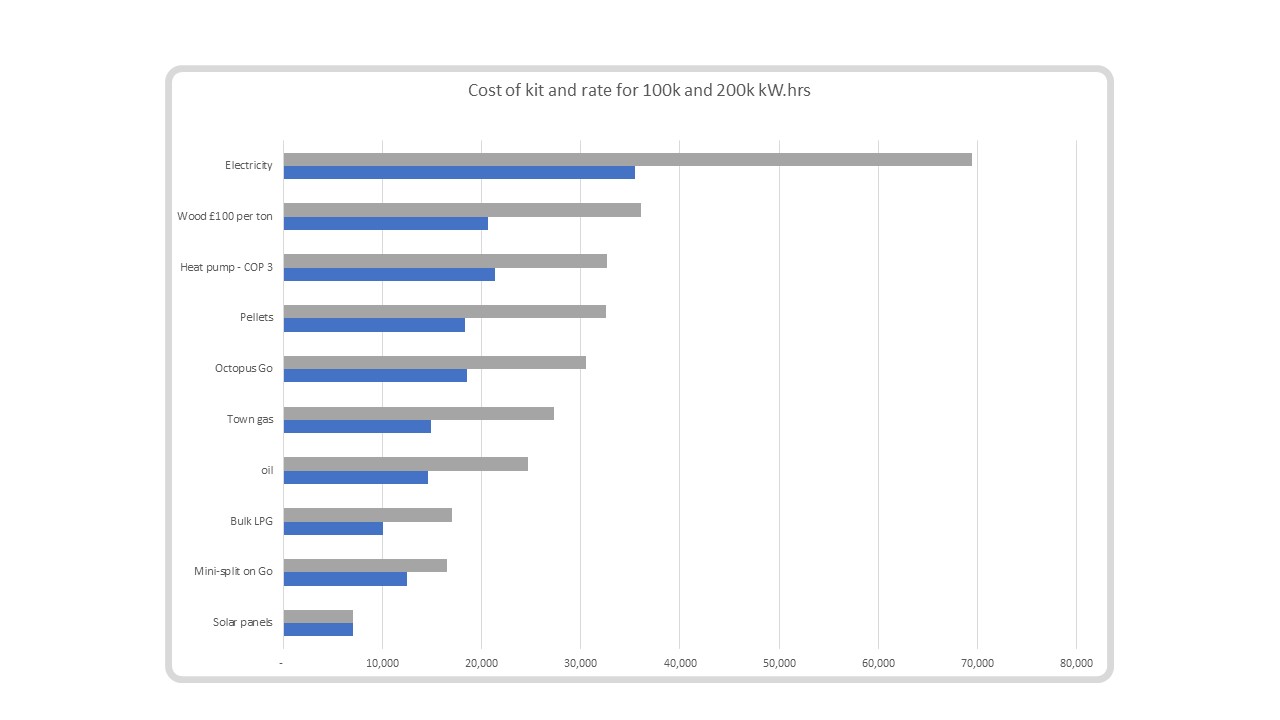
It’s no good just working out how much per kilowatt hour a heat pump costs to run compared to, say, a gas boiler. What’s more to the point is what is the total hit to your pocket will be after a reasonable length of time. Your system might have to generate around 15,000 kW.hrs or more each year. After about 6 years that will come to a neat 100,000 kW.hrs which is handy for making the maths easier. Say you spend £5,000 on a gas boiler then the capital cost per kW.hr it makes over that time is 5p. Each £1,000 becomes pence per kilowatt hour. Adding to that the actual running cost of the plant in question and we can get a good idea of the total long term cost. Similar maths for the energy component. So12p per kW.hr for gas is £12,000 for the 100,000 kW.hrs.
Putting those together. A £5,000 gas boiler with gas at 12p/kW.hr makes a total of £17,000 for 6 years.
What about in the longer term when the cost of the kit is spread out? Below there’s a graph with the results. Double click on it to get a bigger view.
The blue bars are kit plus energy for 6 years and the grey bars go to 200,000 kW.hrs with the kit cost remaining the same Here the differences become even more marked.
These sums illustrate the danger of adding more kit to your mix. If you were to follow the government lead on hybrid heat pumps that would cost about £10,000 (after the grant) so you’d add about 10p/kW.hr to your existing set up but the 100,000 target doesn’t move. Add £10,000 to the natural gas bar on the chart and the total cost is worse than EVERYTHING on the chart except neat electricity.
Bearing in mind that the bottom scale shows your future heating bills and those figures are £thousands the differences are significant.
Electricity £1,500 for rads – Electric radiators are cheap enough to tempt one down this route but the sheer weight of expensive electricity has made this the worst choice by a long way. £70,000 for 10 years! Ads for 100% efficient electric radiators should be banned.
Stove and tank £5,200 – A stove connected to a heat bank is expensive but fares well compared to electricity. Even better if you can access cheap wood.
Heat pumps £10,000 – The heavy up front cost and use of the most expensive fuel makes heat pumps, sadly, the third worse choice. However, free power from solar panels makes a big difference. A smaller heat pump plus a separate mini-split is well worth considering.
Battery on Go £6,500 – An expensive battery grabbing cheap night time electricity from Octopus works out well but it’s always a limited supply.
Pellet boiler £4,000 – Who cares?
Gas boiler £2,500 – Getting better and reassuring seeing that this is what most people already have.
Oil boiler and tank £4,500- Expensive to buy and install. Expensive to service. We can do better.
Mini-split and battery £8,500 – Expensive battery meets cheap heat pump and the result is magic. Not the winner here because the battery will wear out eventually. Not shown on the graph but solar + mini-split is the way to go – this was only evident after the graph was there to see.
LPG gas boiler and tank £3,500 – Not too bad up front and cheap’ish to run. The winner by miles and leaves you much better off than with a heat pump.
Solar £7,000 for 20 panels – Not a fair comparison with this list as it would take 10 years to make the 100,000 kW.hrs but there are no running costs at all. Whatever you chose above, the panels will always be sort of better but you’d need them as well. Add a mini-split and that’s proper magic.
Conclusion – LPG gives plenty of power for not too much up front. Add lots of solar panels and a mini-split or two (without the battery) and you’ll be cushtie – relatively. Remember you will have electricity costs as well as all this heating and solar panels reduce this considerably and often run the mini-split free of charge. Free aircon in the summer is a bonus. A mini-split costs about £1,200 and it is a proper heat pump. So add £1,200 to the solar panel bar on the chart and you can see why this should be part of your strategy.
The choice for you? Take your quotes, add on the rate x 100,000 and draw it on the graph.
While I hope my figures are correct please check before making any decisions.
All this talk of nuclear fusion makes me laugh. Our area has been connected to a local nuclear fusion plant for ages and myself along with a few neighbours are already connected.
The benefits certainly compare well with other forms of energy. Unlike conventional sources there are no wires or pipes because the transmission is wireless. It’s hard to imagine how that works, but the energy is sort of beamed across the airwaves. It is necessary to have line of site from the reactor to the receiver so this may not be available for everyone. There was no cost to actually connect to the source reactor although the receiver was fairly expensive at around £5,000. Possibly the major benefit though is that there is no charge for the energy supplied as it is beamed, free of charge, directly to the receiver. In these times of hugely expensive energy, it seems impossible that this fusion power can be free but it’s true, there is no charge for the power and no sneaky daily charges either. Furthermore, the price is fixed at zero and it is guaranteed that there will be no price increases ever.
On the downside the transmission has been fairly erratic and a bit limited over the winter. This deficiency can be largely remedied by having a battery to tide us over the downtimes.
So far, reliability of the fusion reactor itself has been good and I’m told it is unlikely to fail for well past our own lifetimes. It is comforting to know that it has never been known to fail; unlike some other supplies.
So, you may well ask, if it’s free energy with free and quick connection why isn’t everybody doing it? Well, it beats me but I have noticed that a few savvy people round here have got the message and have fitted receivers to their rooftops.
You might not have heard about all this because the big energy suppliers want it to be kept secret. So, keep it to yourself. Mum’s the word.







 Original Twist