Integrated Concrete Beam System

Integrated Concrete Beams

Building with Durisol, Quadlock or any other ICF blocks? Here’s the easy way to do a poured concrete floor.

Concrete first floors are good; low noise transmission, high thermal mass and suitable for under-floor heating. The trouble is the shuttering required is elaborate and expensive both in materials and time and once the floor is poured there is usually more work involved in boarding, plastering and painting. Concrete block and beam systems look easier but you do need to be very organised and get delivery of exactly the right beams and after paying for heavy lifting gear they won’t look like a cheap fix. Again there will be final finishing to do. Plastering and painting ceilings – no thanks.

The Original Twist Integrated Concrete Beam system is so suitable for the self builder that it is hard to consider anything else. It couldn’t be simpler. You make up some hollow beams out of easily sourced planks, put them up in a row, fill the gaps with wooden floorboards and pour. That’s it.

Concrete floor system

Step 1/.

Make up the wooden beams as shown in this cross section. The blue and yellow bits are your choice of regular timber from your local supplier.  The slots sawn out of the yellow sections are for wiring channels and it makes sense to insert the wires while the beam is being assembled. The threaded studding stops the beam spreading when the concrete pours in and is part of the construction with the outside acorn nuts making a decorative feature. Use a spindle moulder or router to round off the edges and then apply your choice of finish after distressing with chain, hammer, belt sander etc. You will see that the yellow sections stick up by the thickness of your floor planks and make a perfectly curved transition between the concrete floor and the integral ‘I’ beams. The rebar at the bottom of the ‘I’ section needs to be held in position prior to the pour and this can be done easily and cheaply with pairs of cup hooks screwed into the bottom plank. Use cable ties across each pair to hold the rebars in. Finally, paint the inside of the beam to isolate it from the wet concrete. The beams are then ready to be placed in position, typically on a one metre pitch (Durisol blocks are half a metre wide) and each propped with one or two Acrow props. If you are using ICFs like Durisol for your walls you should cut out large slots on the inside face to take the beam ends. You might want to pour the walls up to the level of the beam bases now.

Step 2/.

The floor planks can be cut and finished at ground level before fitting between adjacent beams. Now is the time to fit any pockets for spot lamps and take the wiring back towards the slots pre-cut in the main beams. The floor planks need to be strong enough to resist the weight of the concrete without sagging; they don’t need to be jointed together as a layer of building paper over the top will stop any leaks. Unlike concrete blocks they are light and easy to pass up to your helper.

Step 3/.

With steel mesh over the beams and planks the floor is ready to pour.  The outside of the Durisol blocks sets the top level of the floor so you don’t even need any shuttering. Once the pour is done and set, the walls and floor are all integrated with the homogeneous ‘I’ sections in the beams giving enormous strength and stiffness. The ‘I’ section parts of the floor could be up to 360mm deep which makes them into a row of significant beams in their own right. At this point the lower part of the house is waterproof which makes for a good working environment from which to finish off the rest.

Step 4/.

Nothing much to do now. Just take down the props then go down to the pub to celebrate all the money and time you’ve saved. There is no ceiling finishing to do, no shuttering to take down, even the lights are fitted and wired. And all this was done with simple hand tools and without waiting for special parts to be delivered. And just look; lovely lovely beams adding character and value to your home.

Notes:

A small spacer between the top of the beam and the floor joists will create a gap to house some LED strip lights. As you have a lovely wooden ceiling you might as well show it off.

N.B. Wood shrinks. A tiny air gap could eventually appear between the concrete floor and the wood floor. A very thin rubber membrane between the floors (instead of the building paper) will prevent any ‘thwack’ as the upper floor is walked on.

Ground floor block and beam – alternative system

Block and beam systems are commonly used for ground floor construction but again they can’t compete with our integrated beam system. Block and beam materials all have to brought to site and then assembled – lots of work there. All those blocks are more gap fillers than strength givers and they are followed by a poured screed anyway. With the integrated beam system you just string out the wooden beams, fill the gaps with plywood and then pour – not only much quicker but stronger too. Use adjustable legs from kitchen units as props, to prevent sagging, and leave them there forever.

With both floors quickly and cheaply constructed and the walls easily made with ICFs it is easy to see that a fully waterproof house up to the first floor could be made in a matter of just a few days. That saves time and money and less exposure to problems with bad weather.

structural fireplace and stove.

While the rest goes up the internal finishing can start on the first level. Some comments on this here…. and an internal wall cum fireplace design here. … and a floating staircase here.

While this system is great for under floor heating, I’m really not in favour of it for bedrooms as it is a big waste of money for an unwanted result. More on that in the eco-heating link below.

N.B. As usual do your own evaluation for suitability.

Heating for your eco-house      For essential reading on heating systems, have a look here:

You really should get this right and there are many wrong turns where multiple energy sources are integrated.

More house building topics in LIST OF POSTS

Go back

Your message has been sent

Warning
Warning
Warning
Warning

Warning.

Eco-heating system for heat pumps

Ultimate Eco-heating system

Ultimate Eco-heating system

Ecological heating (Eco-heating)

NOTE: Dec 2019 This design will still suit many configurations but much cheaper PV panels have changed the rules somewhat. Suggestions for an update, and a simpler diagram, are here at the 2020 revision

Also the RHI incentives have all changed so by all means have a look below but the 2020 revision is more up to date.

The Eco-heating goal is simple.  To use free or green energy (solar/wood) so effectively that expensive fossil fuels, energy bills and the carbon footprint disappear.  The only reason to be attached to the grid is to supply it; well not quite, we might need the grid to smooth any fluctuations but we certainly don’t need much of it or, even better, none of it.

Modern houses are well insulated and need a lot less energy to run than before and a few technological advances have made Eco-heating absolutely viable. PV panels are more powerful – only 3 needed to make 1kWp now.

As a starting point, a tank of water – a heat store – is required to integrate various heat sources and demands. A single heat store makes an excellent heating system but two tanks are altogether much better, especially when it comes to integrating solar and a heat pump. So much more is easily optimised with twin tanks that this is the future for eco- heating systems.

Before you start to plan your own ultimate heating system there are a few points to consider:-

Photovoltaic panels (PV) rarely produce their rated output.

On a bad day they produce only around a third of their rated output – say 100W per panel.

Background electrical demand (fridge, computers, lights, TV etc.) can often be as high as 1kW

The PV panel array will have to be much bigger than the usual 4kWp (12 panels) for there to be enough surplus power to make an eco-house.

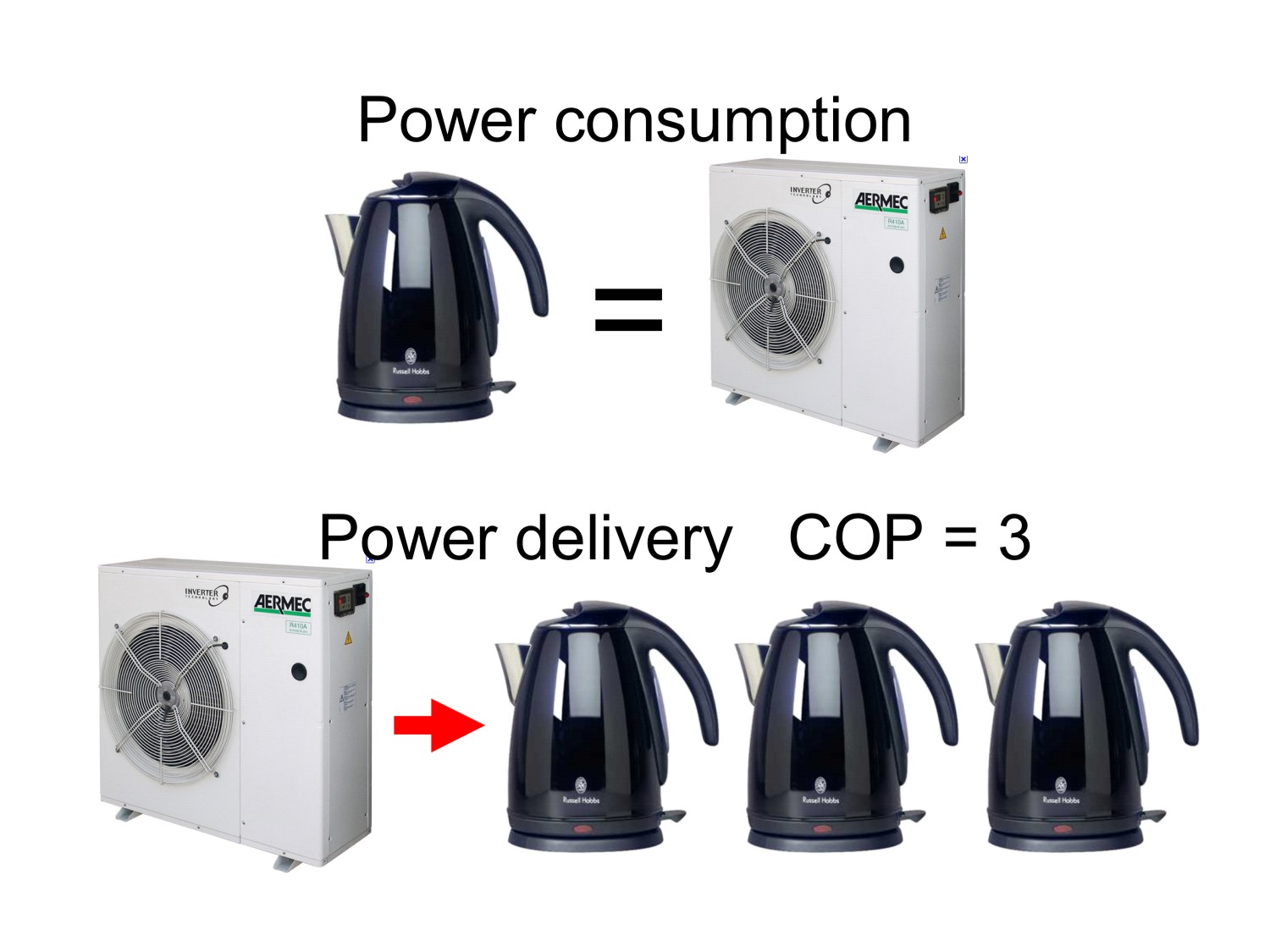
 A heat pump takes electrical power and delivers around 3 times as much more energy in the form of hot water. This engineering miracle might be the core of the system, but …
The power multiplier

The power multiplier

…. the times 3 trick (coefficient of performance or COP) is highly variable, and depending on outside temperatures and delivery temperatures, can vary from 2 to 5. The manufacturer’s quoted COP is for very specific conditions which you might not see very often.  Even the quoted power output of a heat pump will not be reached when it is very cold outside.


Air source heat pumps are a better choice than ground source heat pumps

They cost less and are easier to install. For the full argument see:-

https://originaltwist.com/2015/02/27/air-source-heat-pumps-and-the-renewable-heat-incentive/

https://originaltwist.com/2014/03/19/heat-pumps-in-southern-europe-air-or-ground/

Unfortunately the RHI payments are biased heavily towards ground source which will skew the decision. Even the government is confused about efficiency and we can punish their oversight with the Original Twist Hybrid Heat Pump … four tanks now – how exciting.

PV + heat pump = Free heating

A heat pump on a COP of 3 redresses the shortcomings of the PV panels on that bad day, so a PV and heat pump combination can deliver 300W for each panel and two or three times as much on good days.  This energy, in the form of hot water, can be delivered to underfloor heating which usually uses about 50W per square metre of floor and never more than 100W (which would make your feet hot).  So, for a rule of thumb, 8 PV panels will do 50 square metres of heated floor area. Then add up to another 10 panels to cover background consumption.

Two things to take on board at this point.

1/.If you are going off-grid your energy storage (in batteries and the water tanks) will tide you over for the bad days and the wood burning stove will always cover all the heating and domestic hot water demands.

2/. A popular size (and so a cheaper size) of PV rig is based around 6kW and this implies a matching 18 panels. Have a look at the overclock and tilt theme here to see why you’ll increase that to 24 panels.

Therefore, most self-supporting Eco-houses are likely to have 20 – 24 PV panels on the roof; a lot. The calculation for a Passivhaus is scaled back considerably; there might be no floor heating at all and just fan-coil units , even so there will still be a lot of panels to cope with the bad days.

Air source heat pumps run much more efficiently during the day when the air is warmer.

Not only more efficiently but combined with PV panels much of the daytime energy produced is free.  Obviously big PV and a slightly oversized heat pump can produce excess energy which could keep the heating on after the sun goes down. The surplus energy will need to be stored in tanks of water – big ones.

A house with high thermal mass will also work better in this respect.

Solar thermal panels are much cheaper and much more efficient than PV. and, given some sun, they do produce very hot and free high grade water heating. Cheaper P.V. panels are challenging this space but this system leaves both doors open. Massive solar is hard to manage and here again big tanks are part of the answer.

Solar thermal panels can be made to run more efficiently.

Solar panels can only heat a tank that is cooler than they are. In winter when the tank is usually already hot and solar is weak the panels often stop working altogether.  Given 2 tanks however – one hot and one cool – the panels will run almost daily throughout the year and this dramatically improves effective panel efficiency. The Original Twist solar stripper circuit decides which tank, or both together, can use the available heat more favourably.

A pair of 500 litre tanks are only 2m high and together under 1.5m wide.  Tanks up to 500 litres can be made of light gauge steel so they are relatively cheap and easy to handle. However there is a case for making the cooler tank 1,000 litres – it’s a cheaper energy store than batteries.

Gas boilers – not quite redundant for big houses

On the coldest night the heat pump with reduced power output and the lowest COP might be struggling, especially if it was sized within the limitations of single phase electricity. A gas boiler is a towering powerhouse by comparison, producing instant high grade heat at a low(ish) price. Hot water recovery times are just minutes and a shower could run hot forever if required.  For a larger eco-house, a gas boiler for very occasional use makes sense and ensures that there are no compromises to comfort whatsoever.

Under floor heating is not always best.

Bedrooms need to be heated quickly, usually briefly, and preferably not with a hot floor under the bed.  Floors of upstairs bedrooms are often reasonably warm already because they are above rooms which are heated all day so paying to heat them more makes little sense.  The answer for bedrooms is the fan-coil unit which is essentially a hot water powered fan heater. Not only will they heat the room in minutes, but connected to a suitable heat pump they will cool it as well.  Air quality can be enhanced by UV purification, a boon to asthma and hay fever sufferers.

Towel rails are different.

After your shower the towel rails will need to be on long after you have got up or gone to bed. The timing and heating requirements for towel rails is completely at odds with the rest of the system and they need to be properly integrated with a dedicated pump and timer.

Wood burning stove

Mankind has been sitting round fires for thousands of years; for many people it is unthinkable not to have a real fire in the home.  We are talking eco-heating here so an open fire is out of the question but a good stove is much nicer to live with anyway.  A big stove with a big view of the flames will be too hot for most rooms so it will need to be connected to the water tanks in order to take some heat away. That’s no bad thing as high grade hot water is not so readily produced by the heat pump. A well matched stove can usually cope with all the hot water and heating needs which relegates the heat pump to an auxiliary role and certainly means that smaller heat pumps can be used.

Controls

Although it is not an absolute requirement, the eco-heating system will work much better with a home automation system such as the Z-Wave Vera. The hot water circulation system, for example, can be activated by sensors in the bathrooms when they turn on the lights. Temperature sensors and relays to activate pumps and valves can be found in the Qubino Z-Wave flush relay which has a built in temperature sensor.  The destratification routine (see below) can be triggered by the integrated temperature sensor and the short pump runs monitored by a controller which easily copes with ‘if this then that’ situations.

Efficiency – the humbug

Just a reminder; the sun is free. There is no need to agonise over panel efficiency. Flat plate thermal panels are cheap and reliable so if you need more power just add more. Anyway, during the hotter months they are more efficient than evacuated tube types.

To store daytime heat pump production, the target temperature needs to be raised and that is less efficient than driving the under-floor heating directly. Again the pump is usually running free, courtesy of the sun, so the efficiency doesn’t matter.

Aircon and the renewable heat incentive

The RHI only applies to heating only heat pumps. If you want aircon you should add a separate chiller unit. The diagram above will only be a little different.


The Eco-heating system

Considering all of the above your ultimate Eco-heating system should be like this:-

Much of the suitable roof surfaces will be covered in PV and thermal solar panels.

An air source heat pump

Air conditioning via heat pump

Under floor heating on the ground level

Fan-coils in bedrooms

Fan-coils in some living rooms for air conditioning

A gas boiler (optional)

A twin tank heat store system. 1000 litres + 500 litres.

A wood burning stove connected to the tanks

A system that can optimally integrate all of the above with no compromises at all is a tall order.  Here it is though; the Original Twist Eco-heating System.

Two tanks it is then – one hot one cooler – but with some sound thinking around the connections to the heat sources:-

Domestic hot water delivery.       

Fresh and pressurised water is heated by the hot tank via a plate heat exchanger – standard heat store practice. However, as the hot tank water will be rather modestly heated by the heat pump, the ability of the plate heat exchanger to cope with icy fresh water can be compromised. So to warm the incoming water it first runs through an internal coil in the cooler tank before getting to the external heat exchanger on the hot tank. The pre-warming is not mission critical so there are no controls or pumps to worry about. It’s just a passive coil in the cooler tank.

Back on the hot tank the usual temperature limiting valve – anti scalding – has been dropped in favour of electronic regulation of the heat exchanger flow pump with a Steca  TF A603 MC+ controller. This modulates the pump to give a precise output temperature and so leaves more water at the top of the tank ready for more showers. The flow out of the heat exchanger and to the bottom of the tank is also cooler which aids cooling of the solar coil.

Water circulation around the house is essential to save water wastage and eliminate that annoying wait for hot water.  The same Steca controller also regulates the circulation pump speed.

Preheating the domestic hot water via the cool tank not only makes a heat pump a feasible hot water maker but it also raises the efficiency in a subtle way. The water in the cool tank is heated just enough to supply the floors and fan-coil units and a heat pump does that very efficiently. Blending this cheaper energy into the hot tank system gives an efficiency boost and also allows the hot tank to be maintained a little cooler which gives another efficiency boost.

Other potential heat inputs to the hot tank (wood, solar and gas) are not disruptive to stratification so hot water drawn from the top is always ready for service.

The solar stripper circuit.

Solar thermal panels connected to a hot tank which is already hot – as it would be with a stove or heat pump keeping it ready for hot water delivery – will be effectively switched off in weak sunlight.  But given access to a cool tank they will leap into action at the first glimmer of sunshine, practically every day of the year. Low temperature solar flow addresses the coil in the cool tank first but as soon as it is hot enough it is switched to the hot tank. The flow emerging from the hot tank is usually still very hot so the return flow to the panels goes back via the coil in the cool tank to strip out some more energy.  The panels not only run throughout the year but more efficiently due to a cooler return feed.

The Original Twist Solar Stripper Circuit achieves all this with a special 3 port Coster valve that does not interrupt flow as it changes over. The solar pump is started by the cold tank sensor and everything is managed by the Steca TR 603 solar controller which also modulates the pump speed to keep flow temperatures up.

With two solar coils in use, a bigger solar array can be used without resorting to the absurd remedy of using an external plate heat exchanger and circulation pump. Absurd? Imagine sunrise, the panels and the pump start up, the tank is destratified and your morning shower is there no longer. Dooh!

Heat management

With high grade heat sources connected – wood burning stove and solar – the hot tank can get very hot. High grade heat is valuable so the system hangs on to it as long as possible but excess energy will have to be moved eventually. The system does this in 4 stages, each triggered by a cascade of temperature levels.

Destratification  – First the pump for the hot water plate heat exchanger is activated for short bursts. This moves hot water down the tank and effectively increases its capacity.  The process is limited to the maximum return temperature a wood burning stove can tolerate before the back boiler starts to kettle.

Blending the tanks – If surplus energy is still arriving, a valve connecting the hot and cool tanks opens and the cool tank starts to warm up via a thermosiphon. In this way a wood burning stove would provide for masses of hot water first and then go on to address the central heating. The valve sets to open in a power cut and is controlled by the overheat stat on the hot tank.

Overheat thermostat 2 – In the unlikely event of the cool tank reaching 70 degrees, the overheat thermostat starts the heating pump to dump heat to the heating system or a purpose heat-dump fan-coil.

Power free heat dump – As a last resort, and in the case of a power cut, a power free valve in the hot tank is activated to flow cold mains water through a small coil and send energy down the drain.  It is hard to envisage a system where this would really be required but the option is there.

Heat pump integration

The floors pump and the fan-coils pump first draw water from the tank, the repository for free energy. The heat pump starts when the tank temperature becomes too low and then the flow goes directly to the floors or fan-coils. The latter can only be achieved if the heat pump circulation pump flows slightly more than the demand pumps and there are a couple of ways to ensure that. When the heat pump is running under PV energy during the day it will top up the tanks or supply heating depending on demand. Heat pump set points to suit fan-coils or floors will be triggered by the relevant circulation pumps and by the PV output.

Controls

You might imagine that a sophisticated control system would be needed but that is far from the case as many of the functions are independent of each other with only temperature levels causing any interaction.  For example, the circulation pumps for floors and fan-coils are only activated by programmable thermostats which do not control the heating.  The heat pump is timed and only tops up the tanks if temperatures fall enough to call it, otherwise the wood and solar do the job. Destratification and blending are all independently triggered by temperature levels.

Simplicity is a major benefit. Should any problems arise there is no need to call in a specialist expert.

Who makes it?

In the first instance I will help you to specify and match the various elements of the system so that a bespoke specification is readied for production by the British manufacturer.

The system is based on a standard heat store with a few additions and those additions contain nothing new or untested.

Despite the simplicity this is the absolute cutting edge of Eco-heating systems.

Pre-wired and plumbed this is a quick and cost effective way to solve all your heating issues. The successful integration of wood and solar means a smaller and less expensive heat pump can be used with fewer P.V. panels to drive it. Considering all these savings and minimal running costs the Original Twist Eco-heating System is what every new Eco-house needs.

To see if this, or a single heat store, would be suitable for you just use the contact form and we can discuss your requirements.


The Original Twist Eco-heating system

Features summary

Stainless steel tanks – should last a lifetime

Total of 1,000 – 1,500 litres for energy storage

One cool tank for virtual stratification.

Mains water pressure is maintained but tanks are unpressurised

No hot water is stored – legionnaire’s avoidance

2 stage hot water heating for heat pump compatibility

130Kw heat exchanger for hot water making – more if required

Hot water circulation

Anti scalding

Suitable for solar input of up to 14kW

Solar stripper circuit for dramatically enhanced panel efficiency

Special large ports for wood burning stove gravity connection

Extra sensor pockets for home automation compatibility

DHW prioritised with energy overspill to heating

Condensing gas boiler optimised – controlled return flow temperature

Heat pump optimised and compatible with other heat sources

Heat pump COP raised through extra daytime running

3kW immersion for backup heating

4 stage safety system for energy control

A mix of under-floor heating, towel rails and fan-coils can be used

Fan-coils and a suitable heat pump can give air conditioning
Find more essential reading on my e-book, an easy download on Amazon. Over 100 detailed tips for less than the price of a pint!

‘Dream House – Down To The Details’

…. and check out the LIST OF POSTS for more like this

Go back

Your message has been sent

Warning
Warning
Warning
Warning

Warning.

Modern canal boat

click to enlarge

click to enlarge

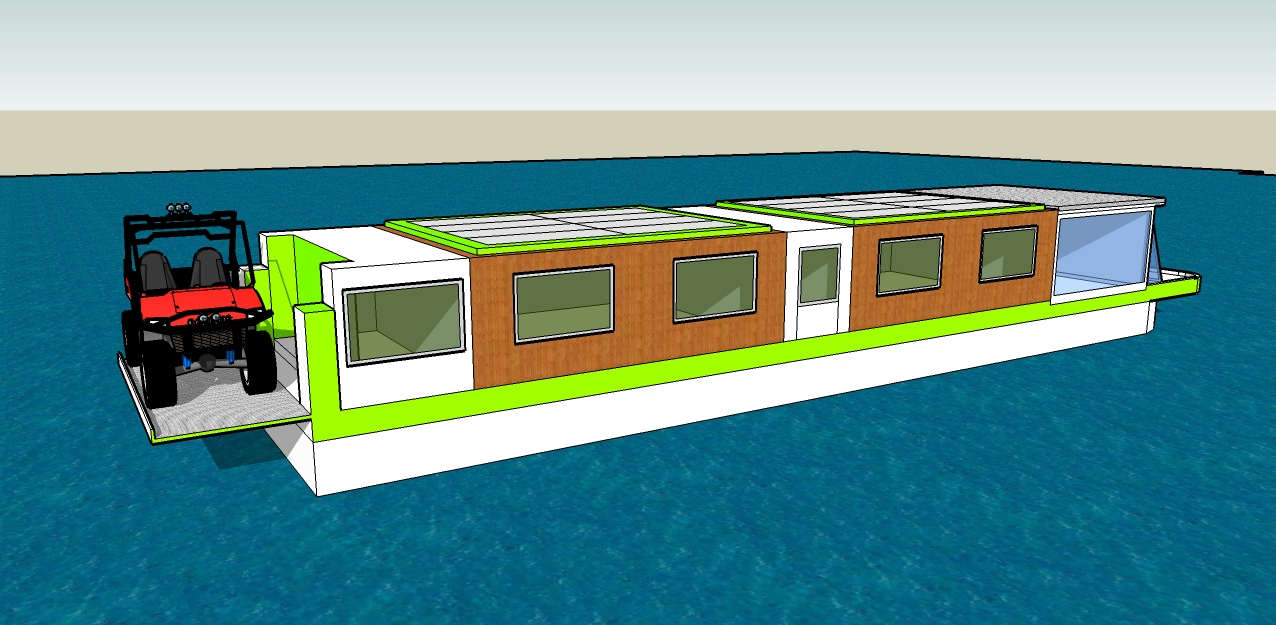
Introducing the Original Twist canal going house boat; in the style of a narrow boat only bigger, better and absolutely modern. As a living unit it presents an economical lifestyle choice. For around £160,000 you get very low cost housing and maybe some change left over for a holiday house, long ski breaks and other good things. A comparable land based house or flat would be twice the price because of the cost of land, a boat on the other hand effectively rents the river via the canal licence and avoids council tax. This one avoids energy bills too which is a good start.

A house boat might be small but as well as reduced outgoings there are some great advantages. You are never stuck anywhere you don’t like; if you need a change you can just cruise to somewhere else, maybe near a cosy riverside pub. River life can be like an aquatic pub crawl but without the driving. You’ll make more friends among the friendly and hospitable canal community too, especially with the most interesting boat on the water.
There is more scope for travel than just the English waters as you can get a tow across the channel to use the huge French network extending all the way down to the South of France where winters are not so harsh. Otherwise the house boat is an attractive proposition for a house swap so the whole world is your lobster.
It’s a tough life being retired!

The Original Twist Eco-house boat is all about, modernity, comfort and enough economy to make a modest pension go far. Many traditional boat ideas have been updated to achieve this.

Construction
Unlike a go-anywhere narrow boat ours is 10 feet wide and 55 feet long – we’ll forgo visits to a few stretches of narrow canal in exchange for a lot more room and the garage – yes that’s right, a garage.
The shell of the boat is normal steel but without the enclosing steel roof parts. The front saloon and the rear transom are full height steel as is the central bulkhead that separates them. The two open parts between the steel constructions are connected at roof level by tubular trellised ladder frames which run the length of the boat interrupted only by the central bulkhead. The open parts of the boat are then covered by 2 insulated wooden rooms made of plywood and foam panels (SIPS).which are factory prefabricated – complete with windows, pipes, wires etc. This makes the boat lighter, cheaper and better insulated.

The two central living spaces house the kitchen a bedroom and shower room, all with heated floors. Each has a large pop-up roof (just like on a camper van) to give a more spacious feel while being flattened whenever a low bridge is encountered. These roofs carry the solar panels and can tilt sideways in either direction to catch the sun – the simple mechanism to switch hinge points is activated by the flick of a switch – an air cylinder shoves a cradle from side to side.
The steel and glass front saloon is very light and airy with a door giving access to the front deck. Standard fan-coil units are turned on end to make a pair of powerful demisters for the huge windscreen and to heat the room too.
A flat sun deck on the roof of the saloon makes a great place to watch the world go by and as we shall see later the boat can be steered from up there too.
The steel rear transom accommodates the propeller shaft, engine mounts, rudder mechanism, a niche for the air source heat pump.  A tail hoist mounted across the back (like on delivery trucks) supports a light vehicle such as a Polaris RAZR side by side.  After adjusting the height the ramps are dropped and locked onto a nearby bank so one can drive off in style and comfort. What is life without wheels?  Because the hoist can be folded up, the length of the whole boat can be shortened to navigate some of the tighter locks. An awning can be extended over the vehicle and there we have it; the first house boat with a garage.

Eco-tech
The real point about eco-technomologicalness is to get along as cheaply as possible without damaging the planet. The 20 solar panels on the top produce a nominal 8kWp; a lot more than most domestic arrays and enough for the small air source heat pump and to charge the batteries for the electric hybrid drive system. The hybrid drive is almost identical to that on the Original Twist hybrid 3-wheeler found on this site; here with a Lynch motor and a Kohler water cooled diesel. The usual benefits of a hybrid drive are there; the batteries give a few hours silent cruising and the diesel can take over indefinitely. The batteries are mostly solar charged or sometimes diesel engine charged with the Lynch motor doubling as a generator. Many moorings supply electricity so the batteries can be charged on cloudy days. With the air source heat pump the heating will run cheaply and conveniently off connected electricity or the batteries.  So there are 3 sources of heating power; the PV panels, outside electricity and engine cooling . Most boat engines are cooled by river water but here a second coil in the heat bank uses the 60% of wasted heat to make hot water. There is no connection to the river or the gunk that blocks up the filters (boat owners nod knowingly here).
Heating is supplied by the little 2kW heat pump which delivers about 6kW. N.B. River water is not used as the heat source. See ‘Air source heat pumps in Southern Europe’ also on this web site. here
Notable omissions are a wood stove and any gas as there is no need for either. Cooking is all electric.

Controls
Control of all the lights, heating, entertainment and even the steering is done by i-pad and Z-Wave meshed radio modules which are cheap, reliable home automation items. Narrow boats are usually driven from the back, a bit like a bus driver standing on the rear bumper. We can sit at the front in the saloon and steer from there or from anywhere else within range of the wi-fi; perhaps the sun deck even from the nearby pub! The Z-Wave controller allows for plenty of home automation tweaks like lighting control, security and leak detection, all from anywhere in the world. Theoretically the boat can be driven from anywhere there is an internet connection.
Actuators to move things like the roof panels and the rudder are operated by compressed air which is cleaner and easier to maintain than hydraulics. An i-pad and Z-Wave relays makes child’s play of these things; even a simple dimmer switch allows proportional control of the rudder.  The motorised satellite dish also needs to fold into a recess in the centre section when a bridge is encountered.

Neat extras
To make the kitchen a great place for eating while admiring the view the picture window on one side tilts up and out and a table is pushed outwards to make use of the outside space. Once parked up an extending awning over a drop down side deck, complete with an extending Barbie unit, makes an outside cooking area.

Central dust extraction – The centre section houses a fixed dust extractor plumbed to outlets around the boat to make cleaning much easier.

With a boat like this life will certainly be rich and varied.

ECO-HIPPY – One who is sufficiently off-grid to live almost cost free.

More on this topic in LIST OF POSTS

Go back

Your message has been sent

Warning
Warning
Warning
Warning

Warning.

Air Source Heat Pumps vs. gas boilers

First the bad news for heat pumps. The Energy Saving Trust heat pump survey in 2009 found that many users were not impressed at all. The follow up in 2013 improved the results but the final average system COPs of 2.45 (air source) and 2.82 (ground source) were still way below the headline figures quoted for these machines a lot of which are claiming over 4 these days. So maybe heat pumps are intrinsically good but tricky to install?


Despite all that, what is really good about heat pumps is that they can deliver more energy than they consume in electricity.

The power multiplier

So a small one would be just like this; working on the power of an electric kettle but delivering the power of 3 to your hot tank – a COP (Coefficient Of Performance) of 3 then. By contrast your immersion heater delivers and also consumes the power of an electric kettle so it has a COP of 1.

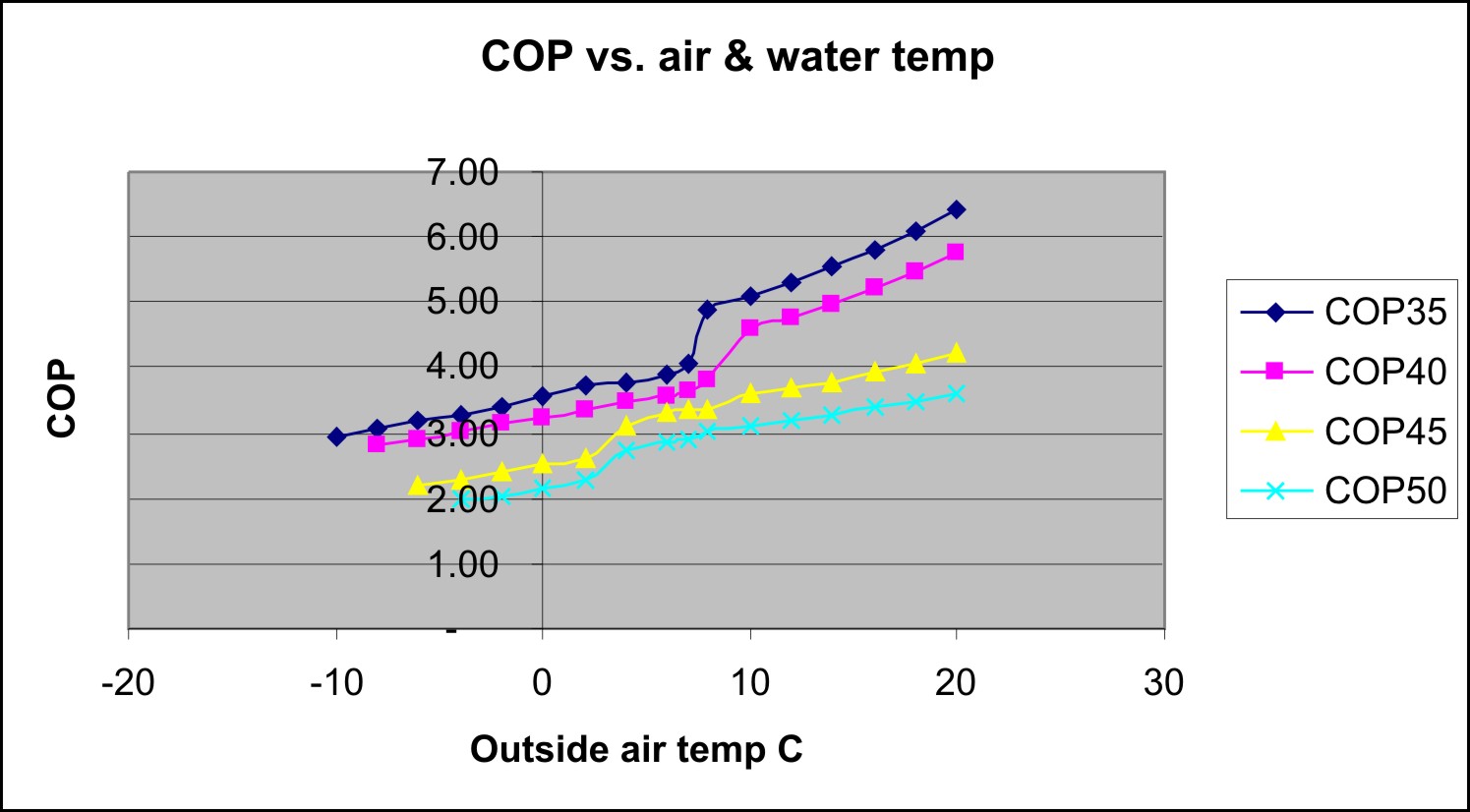
Heat pumps are all sold with an industry standardised COP. This is misleading to say the least and the reason why optimism is defeated by experience. Far from being a fixed figure the COP actually swings widely depending on outside air temperature and temperature delivered in the home. The COP plots here show how a kick is engineered to give a good headline figure; that kink in the graph is exactly at the publication point.

A sneaky kink
A sneaky kink

You might buy a machine with a quoted COP of say 3.75 but while making domestic hot water on a cold night it will be working at less than 2. There are benign swings however and given a sunny winter day with some warm air to chew on an ASHP can see COPs almost up to 5. You can see this on the dark blue line on the graph. Delivering 35c water to the underfloor heating the COP goes over 5 as the outside air goes over 10c. Note that the pale blue line (delivery temperature 50c for radiators) still only goes to around 3 so for most of the time the average COP will only be near 2.5. So, heat pump with radiators – think carefully.

Gas per kW.hr costs about a third of electrical power so after adjusting for efficiency a gas boiler is similar to a heat pump with a COP of 3. Many people in the survey would be comparing their new heat pump to a gas boiler; a formidable opponent when running on cheap gas. A gas boiler is much more powerful than most heat pumps and delivers at usefully high temperatures so a heat pump must have an overall COP of over 3 to justify a hefty purchase price.
Perhaps the performance could be lifted further?

The next bit is a bit dull – you might want to skip on to conclusions below.

To winkle out some ideas we’ll take daily temperature data for January in Guildford (http://www.wunderground.com/) and relate that to a COP matrix made from the published data from a modern ASHP (inverter drive scroll, r410a, delivering to under floor heating at 35 degrees).
We will be looking to lift the COP by running the ASHP at the warmest ambient temperatures possible.
A look at a January temperature trace shows:
There is usually a 5 degree swing between the mean night time temperatures and the daytime mean.
Night time temperatures are flatter and longer than the sharper daytime peak at 1-2pm.
The morning transition from lows to highs is halfway there by 10am.
Temperature rises coincide with sunrise, not surprisingly.

Relating the above to the COP matrix:
Running a 7hr shift from 10am gives an average COP of 3.86 – much better than gas.
The equivalent night time shift only gives a COP of 2.92 – but almost as good as gas.
If the pump has to make hotter water for radiators these day/night figures drop to 2.7 and 2.11 and for 55 degree hot water making 2.3 and 1.85– gas beats this hands down.
Storing daytime running means that delivery temperatures probably need to be around 50 degrees leading to an average COP of under 3 although bigger storage tanks improve this.
ASHPs can be smaller if they run continuously day and night on an average COP of 3.4 – still 13% better than gas.
Direct electrical heating is often used to boost hot water making (COP = 1) and this can lower the average COP. If we can avoid this practice and run predominantly in the daytime it should theoretically be possible to get a COP of 3.35 (7hrs day, 2hrs night, 2hrs hot water).

Transmission: Put 100W/square metre through your floors and your feet will be uncomfortably hot so somewhere near half that will be a good yardstick for calculating the power you need.

Conclusions
A small ASHP can run a bit more efficiently than a gas boiler in a modest well insulated house. Fan-coil units in bedrooms and underfloor heating elsewhere are essential. The heat pump should run in daylight except maybe for a boost before dawn to guarantee morning showers and take the chill off the floors.

Of course, with PV solar panel prices falling relative to electricity prices, the time is coming when your heat pump will run for free while the sun shines. At the moment it looks like we are firmly in no brainer territory and it is certainly worth checking now to see how the sums stack up.

A tip to make your heat pump installation cheaper. Use the PV panels and an energy diverter (e.g. Eddi) to heat your existing immersion heater. then you won’t need the special tank to accompany the heat pump which will just do central heating. Your installation might get a lot nearer to the £5,000 grant.

And while we are at it, don’t forget to consider a mini-split heat pump air conditioner; It’s an air to air unit that makes heat as well as cooling. They are relatively so cheap it’s hard not to go and get one right away. I did, bought and installed for under £1,000.

so, probably nothing conclusive so far. Have a look at ‘off-peak energy storage’ and you’ll instantly become a heat pump convert.

More on this topic in LIST OF POSTS