Featuring the Emrax 348
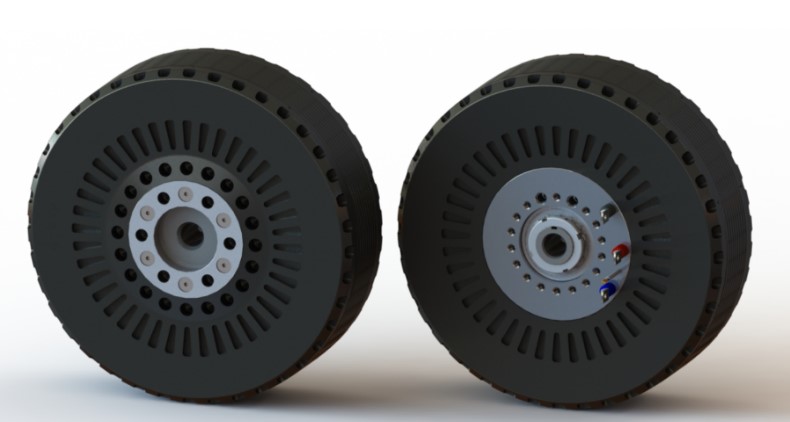
If you’re building an EV or converting an existing car, why settle for ordinary when you can create something extraordinary? Enter the Emrax 348 electric motor—one of the most impressive motors available today. Whether you’re using one, a pair, or going all out with four, the numbers are jaw-dropping:
Emrax 348 Quick Specs:
- Dimensions: 348mm diameter × 110mm depth (about the size of a wheelbarrow wheel).
- Torque: 1,000 Nm—nearly as much as a Bugatti Chiron (1,600 Nm), so a pair of Emrax motors surpass it. Of course, the Chiron has a gearbox, but still.
- Power: 500 hp per motor (1,000 hp for a pair). Although output is halved after 2 minutes, that’s more than enough if you’re hitting 100 mph in under 7 seconds.
- Max Revs: 4,000 RPM—this limits top speed and influences gear ratios, making it a balancing act between acceleration and top speed.
Design Objective:
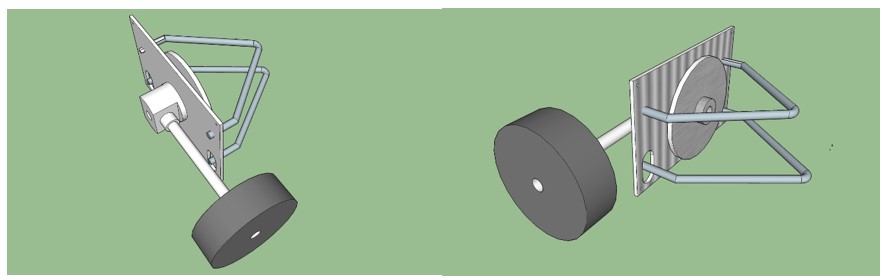
Create a modular unit that combines suspension, steering, braking, and drive—all in one elegant package. The idea is to keep it compact and cost-effective, but versatile enough to be used on any corner of the car.
The core of the module is a CNC-machined aluminium plate (approx. 60×40 cm). Mounted to it are:
- Unequal-length wishbones shorter upper arms – longer bottom arms bolted at the rear through slots.
- A universal hub carrier (e.g. Brypar Motorsport) for flexibility in steering geometry and the strength of Porsche-grade hubs and bearings.
- Brake discs mounted close to the plate with callipers fixed directly to it, minimising unsprung weight.
- Electric motor + bevel gear drive: Instead of mounting the reduction gear and motor inline (which causes width and cooling problems), we use a bevel gear connected to a short, angled prop shaft. The drive motor is then mounted elsewhere, anywhere along an arc—say, on the rear bulkhead behind the back seats —improving cooling, packaging, and polar moment of inertia. The gear ratio can be changed very quickly just by exchanging the whole bevel gear housing.
The suspension uses a pushrod-actuated rocker linked to a spring/damper mounted along the top of the plate—neatly tucked away and easy to tune.

Performance Examples:
Two-Wheel Drive:
Cap your top speed at 150 mph and the gearing and torque gives around 1.4 tons of thrust at the wheels. If your car weighs more than that—and most EVs do—you won’t hit the 1g needed for a 2.5-second 0–60 mph time although circa 3 seconds would be a reasonable expectation. So while a 1,000hp car will be pretty spectacular, to graduate from supercar to hypercar territory, you’ll need four-wheel drive.
Four-Wheel Drive:
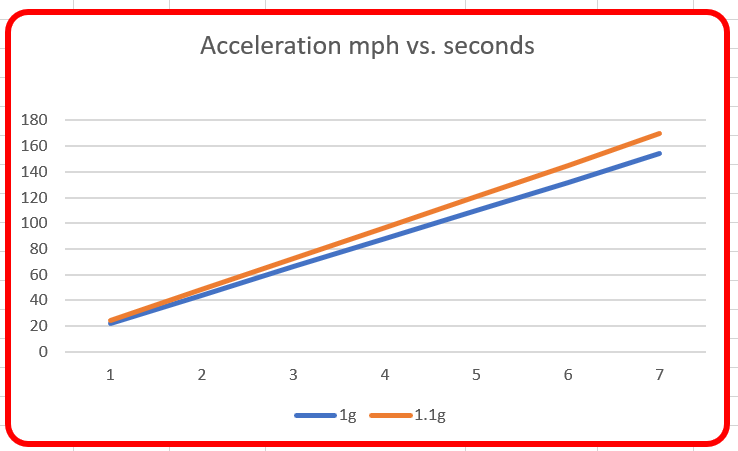
Use all four corners, and with a tyre speed rating limit of 186 mph, you’ll get 2.2 tons of thrust (or 2.67 tons if limiting top speed to 155 mph). With a 2.2 ton car that translates to 0–60 in 2.5 seconds—now we’re talking hypercar credentials. Tyres are usually grippy enough to allow acceleration of at least 1g. The chart below shows how long that takes to reach various speeds. Unfortunately, the faster you go, the more wind resistance bends those lines; even so, 0-100 in 4 seconds looks like a realistic target.
Braking Considerations:
Even with regenerative braking, powerful cars still need strong friction brakes. Freed from the constraints of wheel diameter, the brake disc can be as large as needed—and even have a second calliper. That means you don’t need massive wheels just to fit oversized brakes. Big discs and double calipers make no difference to unsprung weight – perfect.
Final Thoughts:
These integrated modules are perfect for developing a powertrain test mule. Any sturdy hatchback will do. With most of the engineering already solved, you can jump straight into drivetrain testing without reinventing the wheel.
And because they’re stealthy, we’re entering the golden age of Q-cars. That humble Citroën Berlingo sketched above? It could quietly hide 2,000 hp. Why the Berlingo? There’s loads of room in the nose for front motors, even more in the back, and already wide wheels with arches ready to take bigger tyres. Inside, you’ve got ample space for batteries, telemetry, and more. Why sit on the floor of a cramped supercar when a roomy Berlingo is just as quick?
In case you were wondering, the McMurtry Speirling fan car does 0-60 in 1.4 seconds – but you can’t get a sofa in the back.
 Original Twist