Heating makeover – step by step into the heat pump era

There is a hard push under way to make us abandon fossil fuel boilers and adopt heat pumps instead. The trouble is they don’t seem to work for everybody and they are expensive too. So, in many cases that’s a lot of money for something we don’t even want. Don’t despair though, there’s a way through this maze and the outcome could be cheaper heating for less initial outlay. The trick, in a nutshell, is to have more than one heat pump; the one they pay you £7,500 to install and then a smaller one to back it up.

Learn to love heat pumps
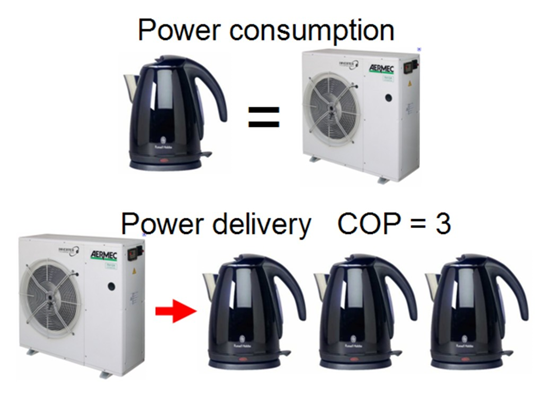
Typically consuming not much more power than an electric kettle the heat pump will deliver about 3 times as much energy to your heating, often more. The power is increasingly produced by renewables so the heat pump is an essential multiplier of green energy. That’s why we love them and that’s why we should have them.

Overcome the issues

Heat pumps work well at lower temperatures but that drastically reduces the effectiveness of your existing pipes and radiators. The pipes – usually 22mm copper – are the first bottleneck and probably only transmit around 12kW. So, without a total pipes overhaul the biggest heat pump you can have is 12kW (4kW drawn power). Half that, 6kW delivered is very common and suits well insulated modern houses and that might be the one for you too but only with extra back-up power.

Down the line the radiators will need an overhaul though; either some unsightly bigger ones or, preferably, fan-coil units with smart radiator valves on them to make heat distribution more selective and locally more effective. I prefer my own design for a DIY fan-coil unit (obvs).

With a smaller heat pump in the mix the chances are you can cover most of the cost with the £7,500 grant. A good start but now we need more power to back up a system living on the edge.

First things last

Before you start the big overhaul it’s best to install the back-up element, a mini-split heat pump – those aircon units often found in a hot foreign holiday rental. You probably only need one and they are so effective it should be a low power unit. The 1.71kW Mitsubishi SRK60ZSX-WF, for example, bangs out a healthy 6kW. Expect to spend under £2,000 for each one fully installed.

With the heat pump makeover done the running costs will still be the same as oil or gas but now the fun begins as we can move to the cost reduction phase.

First off, solar panels. Fitted with Enphase micro inverters you can fit odd numbers in odd places without any problems and they should give 20 years of trouble-free power. String inverters? Cheaper but when it fails in ten years everything fails at once; is the installer still around? Expect a long downtime, lots of grief and final expenditure higher than the Enphase route.

Because your heat pumps are low powered you will often find you can run one for free even when panel output is reduced. Include a solar diverter (like the Eddi) and the panels can send their surplus power to the immersion heater. This fixes the problem of poor hot water delivery associated with low temperature heat pumps and is the reason you might get away with not changing the tank in the first place. Keep your old tank, spend the money on panels. N.B the reason why your installer wants to change the tank is that the new one will have a much bigger coil to reduce recovery times – if you can afford it then go for it. Now the heating and electricity bills are usefully reduced and maybe servicing costs too. Do you service your fridge every year? No; same for heat pumps.

What about batteries? They used to be expensive and they wore out too quickly to justify the cost. But now they are cheaper (check out the Fogstar site) there is a better case for storing cheap off-peak electricity and running your (low powered) heat pump on it later. This can literally halve your energy bills – see graph below.

There’s a useful tactic to be considered when you are finally persuaded into owning an electric car.

Some EVs can offer 240v vehicle to load (V2L) with around 3kW available from a socket behind the back seat. They imagine you might plug in a toaster when you go camping. Never mind the toaster, you could plug in a mini-split and use cheap off-peak electricity to heat the house. If you are looking for a box of tricks to make this work check out the Victron Quattro-II which has an extra 240v input. The idea here is to go for a domestic battery first but be ready for the EV when it comes.

This all gets you connected to super cheap heating and air-conditioning too.

As you can see, cheap off-peak electricity, time shifted then multiplied with a heat pump gives astonishing results. Vehicle to Grid charging is another way although not yet mainstream but V2L gets us there now without installing the expensive V2G charger and you can choose from a bigger range of cars. So not a Nissan Leaf now, more likely a Kia or Hyundai. The result; half price for a lot of your heating if not all of it.

The picture wouldn’t be complete without mentioning off-peak energy storage in water rather than batteries. Check out the idea in Grand Designs Heating System. Water lasts forever, batteries don’t.

Of course, all houses are different but hopefully there are some ideas here to help make a complex topic simpler. Small heat pump + mini-split + solar – the way to go – then batteries or tanks.

Finally, to see every heating tweak wrapped up in one ultimate system see Big house heat pump system
Heat pump conversion – the successful way

How much is a heat pump – £15,000?       Actually, they start at £1.200

so let’s get going.

It’s easy to ruin a perfectly good house by doing a heat pump conversion. Thousands of people have already done so and yet the pressure is on to keep doing it. So, here’s how to do it logically and successfully. The measure of success here being better comfort with lower running costs and the satisfaction of lowering emissions too, but most of all, a system that actually works.

First of all, don’t rush in until you know how much power you have already and whether that is too much or too little. All installers have to err on the side of caution so your boiler will certainly be bigger than it needs to be.

Stage 1/:

Insulate, insulate, insulate, floors, walls, loft windows, all of that. Start here because, compared to your old boiler a heat pump is relatively weedy and anyway very different. It’s a low temperature high flow device and it will need all the help you can give it.

Stage2/:

How much power?

After insulating take a look at how much energy you are currently using and hoping to replace. There are a couple of ways of doing this and it is best to do them both. First check the nominal power of your boiler then see how often it cycles on and off on a cold day. This might involve half an hour standing by the boiler with a stop watch. You might have a 30kW boiler but the chances are it will be short cycling, especially if it runs on oil. When you have the time to running ratio you can see the average power your boiler is delivering and this will give an idea of your peak power requirement.

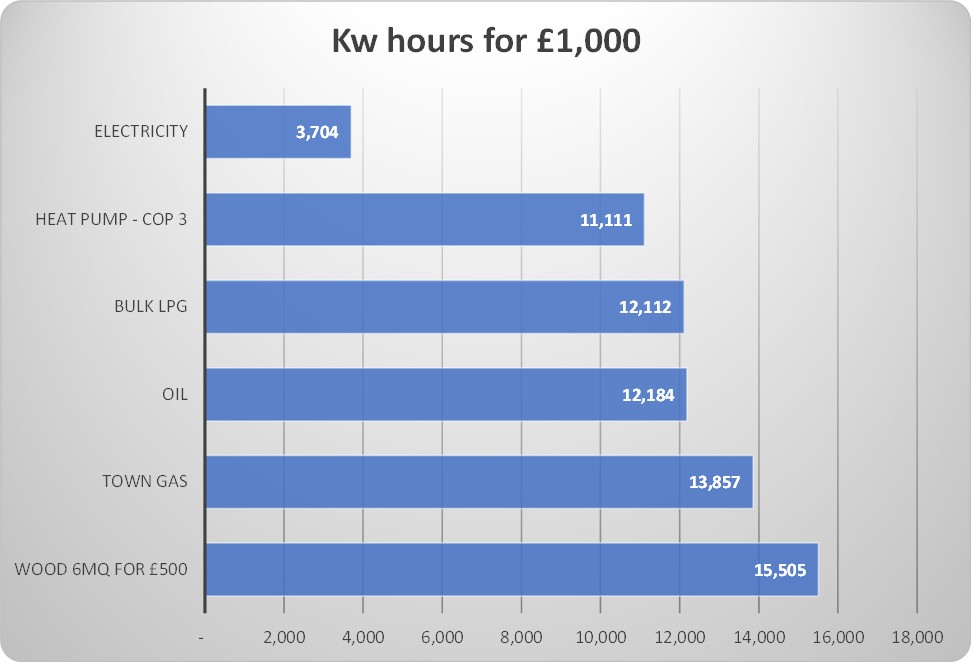
Secondly, check your total oil or gas bill and use this chart to calculate how many kilowatt hours of energy you have been buying. Whatever you replace your boiler with will have to make as many kW.hrs over the season.

There are about 200 days of winter so dividing the energy total by 200 will give you an idea of the average daily power requirement. This is only going to give a rough idea but that may be enough if you add a mini-split to the mix as a substantial top up for those arctic-blast days.

Unfortunately, we are not there yet because there are transmission issues to consider. The pipe that runs from your boiler to the radiators is likely to be 22mm copper which with typical heat pump temperatures will transmit between 10 to 15 kW and more likely towards the lower end of that. On a COP of 3 that means the maximum heat pump power will be around 5kW (delivering 15kW), any more cannot be used. That almost certainly leaves a large hole in the requirement and is the reason why so many installations are a disaster. The solution is pretty obvious though; just add that mini-split air to air heat pump or even two. They will plug the gap and leave your existing pipework untouched. A mini-split has no connection to your existing system and all the pipes and radiators etc. It’s a stand-alone heat pump and that’s why it is so cheap to install.

Stage 3/:

Transmission

It’s not just the limitations of the pipework to consider, now the heat has to come out. Assuming there is no underfloor heating in place that leaves replacing existing radiators with really huge ones (not an inviting prospect) or fan coil units. The latter can be inexpensive and effective – see DIY fan-coil units. Again, the mini-splits make up for transmission shortfalls.

Hot water

Quite often you will be quoted for a new hot water cylinder to go with the heat pump. The reason being that the coil needs to be bigger (3msq is good) to accommodate heat pump low temperatures. If you don’t have room for a new tank consider ignoring that suggestion and spend the money on solar panels and an energy diverter like the Eddi. Cheap night time electricity might be in your mix and that too can drive the immersion heater.

Looking back at that chart it appears that there are no savings to be made by running a heat pump. You can press on happily though because further tweaks will lead to the cheapest heating available. Heat pumps can run on renewable electricity too so they really will help you to save the planet.

If you have solar panels, they can make a free contribution and the low power mini-split(s) will often run for free on the first glimmer of sunlight.

In the long run you might have an electric car that allows the use of its battery to power the house. In one stroke that will easily halve your energy bill as you time-shift cheap night time electricity and amplify it with a heat pump.

For bigger houses with unusually high heating demands the answers are still the same although the transmission limitations can be bypassed with the aid of a heat bank with its multiple pumped outlets. That’s a longer discussion but have a look at The Grand Designs Heating System to see what the cutting edge system might look like. You might be a bit shocked.

So that’s it. Just sidestep the limitations and embrace the advantages. Easy really.

P.S. Some EVs can offer 240v vehicle to load with around 3kW available. They imagine you might plug in a toaster when you go camping. So you could plug in, for example, a Mitsubishi SRK60ZSX-WF Heat Pump System along with a changeover switch to pull in the mains when the car is not connected. This unit consumes 1.71kW (a lot less than a toaster) and delivers 6kW which is pretty punchy when it comes to making up any system shortfalls. Expect to pay £2,000 fully installed. This all gets you connected to super cheap heating without installing the expensive V2H charger and you can choose from a much bigger range of cars.