It’s no good just working out how much per kilowatt hour a heat pump costs to run compared to, say, a gas boiler. What’s more to the point is what is the total hit to your pocket will be after a reasonable length of time. Your system might have to generate around 15,000 kW.hrs or more each year. After about 6 years that will come to a neat 100,000 kW.hrs which is handy for making the maths easier. Say you spend £5,000 on a gas boiler then the capital cost per kW.hr it makes over that time is 5p. Each £1,000 becomes pence per kilowatt hour. Adding to that the actual running cost of the plant in question and we can get a good idea of the total long term cost. Similar maths for the energy component. So12p per kW.hr for gas is £12,000 for the 100,000 kW.hrs.
Putting those together. A £5,000 gas boiler with gas at 12p/kW.hr makes a total of £17,000 for 6 years.
What about in the longer term when the cost of the kit is spread out? Below there’s a graph with the results. Double click on it to get a bigger view.
The blue bars are kit plus energy for 6 years and the grey bars go to 200,000 kW.hrs with the kit cost remaining the same Here the differences become even more marked.
These sums illustrate the danger of adding more kit to your mix. If you were to follow the government lead on hybrid heat pumps that would cost about £10,000 (after the grant) so you’d add about 10p/kW.hr to your existing set up but the 100,000 target doesn’t move. Add £10,000 to the natural gas bar on the chart and the total cost is worse than EVERYTHING on the chart except neat electricity.
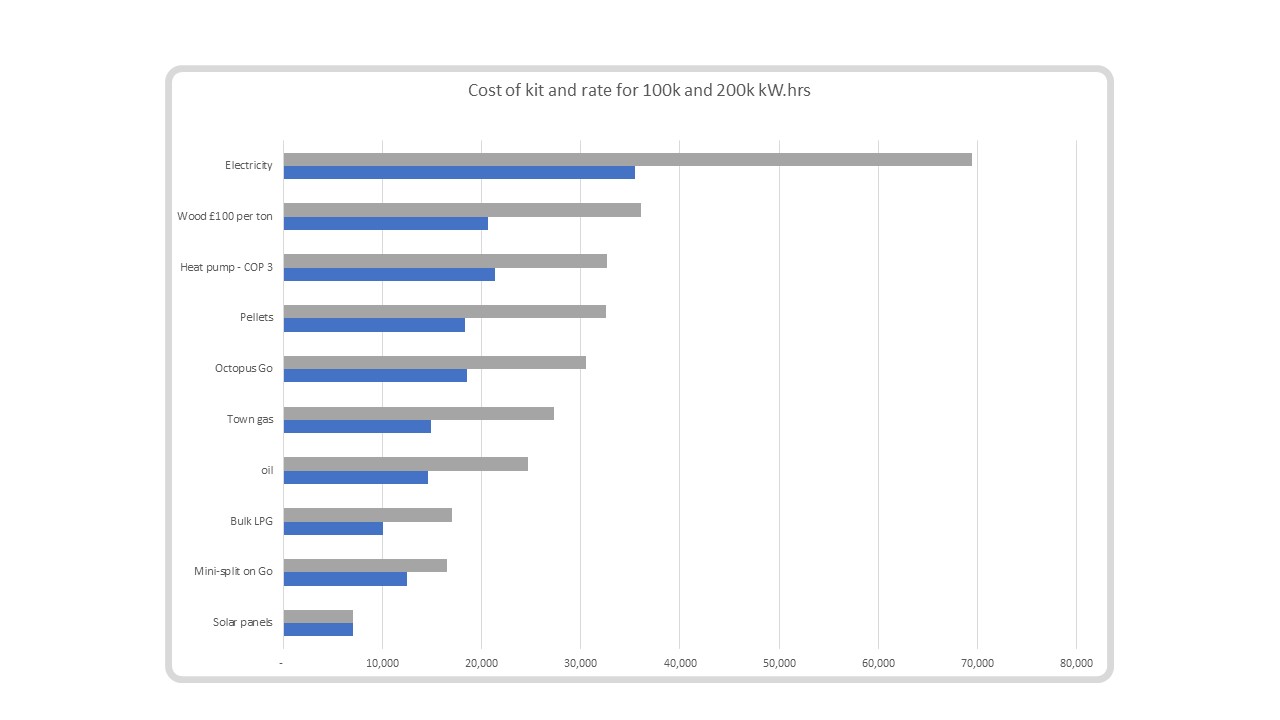
Bearing in mind that the bottom scale shows your future heating bills and those figures are £thousands the differences are significant.
Electricity £1,500 for rads – Electric radiators are cheap enough to tempt one down this route but the sheer weight of expensive electricity has made this the worst choice by a long way. £70,000 for 10 years! Ads for 100% efficient electric radiators should be banned.
Stove and tank £5,200 – A stove connected to a heat bank is expensive but fares well compared to electricity. Even better if you can access cheap wood.
Heat pumps £10,000 – The heavy up front cost and use of the most expensive fuel makes heat pumps, sadly, the third worse choice. However, free power from solar panels makes a big difference. A smaller heat pump plus a separate mini-split is well worth considering.
Battery on Go £6,500 – An expensive battery grabbing cheap night time electricity from Octopus works out well but it’s always a limited supply.
Pellet boiler £4,000 – Who cares?
Gas boiler £2,500 – Getting better and reassuring seeing that this is what most people already have.
Oil boiler and tank £4,500- Expensive to buy and install. Expensive to service. We can do better.
Mini-split and battery £8,500 – Expensive battery meets cheap heat pump and the result is magic. Not the winner here because the battery will wear out eventually. Not shown on the graph but solar + mini-split is the way to go – this was only evident after the graph was there to see.
LPG gas boiler and tank £3,500 – Not too bad up front and cheap’ish to run. The winner by miles and leaves you much better off than with a heat pump.
Solar £7,000 for 20 panels – Not a fair comparison with this list as it would take 10 years to make the 100,000 kW.hrs but there are no running costs at all. Whatever you chose above, the panels will always be sort of better but you’d need them as well. Add a mini-split and that’s proper magic.
Conclusion – LPG gives plenty of power for not too much up front. Add lots of solar panels and a mini-split or two (without the battery) and you’ll be cushtie – relatively. Remember you will have electricity costs as well as all this heating and solar panels reduce this considerably and often run the mini-split free of charge. Free aircon in the summer is a bonus. A mini-split costs about £1,200 and it is a proper heat pump. So add £1,200 to the solar panel bar on the chart and you can see why this should be part of your strategy.
The choice for you? Take your quotes, add on the rate x 100,000 and draw it on the graph.
While I hope my figures are correct please check before making any decisions.
Bend the rules a bit and you can make a heat pump win this race – heres how Absolute ultimate heat pump system
 Original Twist